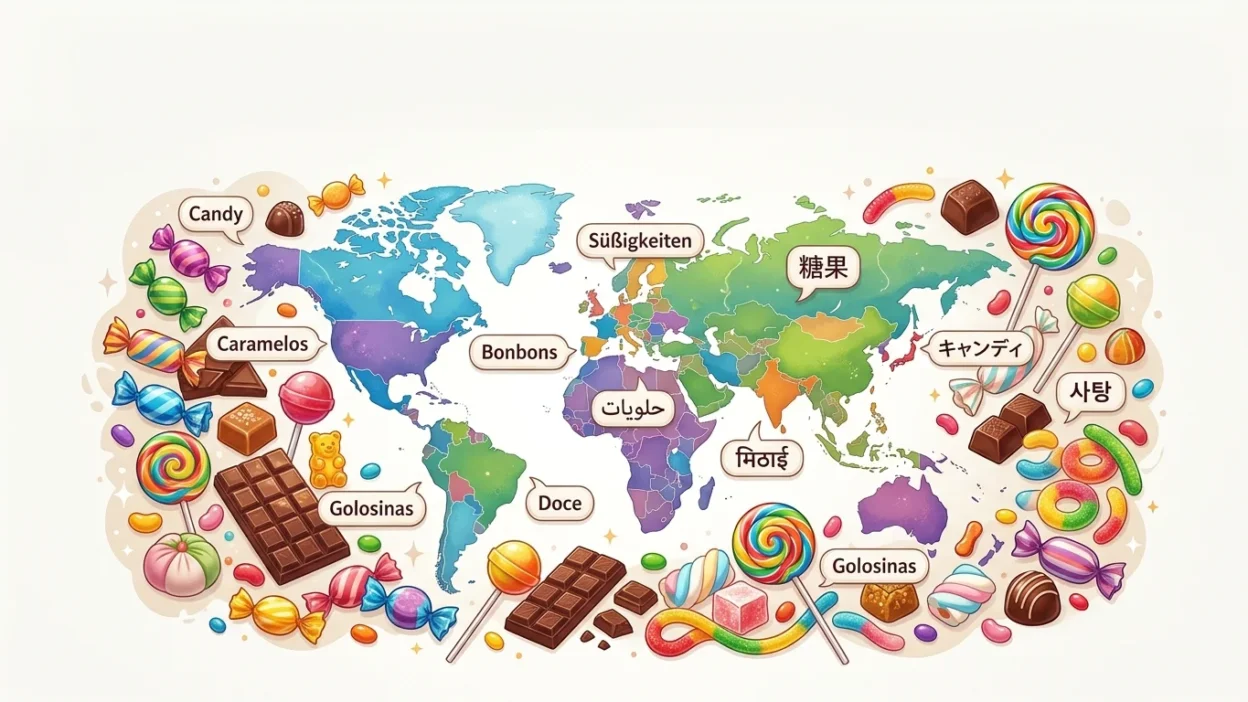
Candy is a small treat with a big vocabulary. Around the world, people use different words for candy, sweets, confectionery, and sugary treats, reflecting their language and culture. Learning candy in different languages is a fun way to expand your vocabulary while discovering how everyday foods are described across countries. Some languages use a word specifically for a sweet, while others have broader terms covering candies and confectionery. Whether you are learning a new language, traveling, writing creatively, or simply curious about international words, candy in different languages offers an easy and enjoyable starting point for exploring global vocabulary and food traditions.
Quick Answer
The word for candy changes across languages. Common examples include caramelo in Spanish, bonbon in French, Süßigkeit in German, caramella in Italian, kẹo in Vietnamese, and キャンディー (kyandī) in Japanese.
Candy in Different Languages Around the World
| Language | Native Word | Pronunciation |
| English | Candy | KAN-dee |
| Spanish | Caramelo | kah-rah-MEH-loh |
| French | Bonbon | bohn-BOHN |
| German | Süßigkeit | ZOOS-igh-kite |
| Italian | Caramella | kah-rah-MEL-lah |
| Portuguese | Doce | DOH-see |
| Dutch | Snoep | snoop |
| Swedish | Godis | GOO-dis |
| Norwegian | Godteri | GOO-deh-ree |
| Danish | Slik | sleek |
| Finnish | Karkki | KAR-kkee |
| Icelandic | Nammi | NAM-mee |
| Irish | Milseán | MIL-shawn |
| Welsh | Candy | KAN-dee |
| Polish | Cukierek | tsoo-KYEH-rek |
| Czech | Bonbón | bon-BOHN |
| Slovak | Cukrík | TSOO-kreek |
| Hungarian | Cukorka | tsoo-KOR-kah |
| Romanian | Bomboană | bom-BOAH-nuh |
| Bulgarian | Бонбон | bon-BON |
| Serbian | Бомбона | bom-BOH-nah |
| Croatian | Bombon | BOM-bon |
| Slovenian | Bonbon | BON-bon |
| Macedonian | Бонбона | bom-BOH-nah |
| Russian | Конфета | kon-FYEH-tah |
| Ukrainian | Цукерка | tsoo-KER-kah |
| Belarusian | Цукерка | tsoo-KYER-kah |
| Lithuanian | Saldainis | sal-DIE-nis |
| Latvian | Konfekte | kon-FEK-teh |
| Estonian | Komm | komm |
| Greek | Καραμέλα | kah-rah-MEH-lah |
| Turkish | Şeker | sheh-KEHR |
| Arabic | حلوى | HAL-wah |
| Hebrew | ממתק | mam-TAK |
| Persian | آبنبات | aab-na-BAAT |
| Urdu | ٹافی | TAA-fee |
| Hindi | टॉफ़ी | TAW-fee |
| Bengali | মিষ্টি | MISH-tee |
| Punjabi | ਟੌਫ਼ੀ | TAW-fee |
| Gujarati | ટૉફી | TAW-fee |
| Marathi | गोळी | GOH-lee |
| Tamil | மிட்டாய் | MIT-taai |
| Telugu | మిఠాయి | mi-THAA-yee |
| Kannada | ಮಿಠಾಯಿ | mi-THAA-yee |
| Malayalam | മിഠായി | mi-THAA-yee |
| Sinhala | ටොෆී | TOH-fee |
| Nepali | मिठाई | mi-THAA-ee |
| Chinese | 糖果 | tángguǒ |
| Japanese | キャンディー | KYAN-dee |
| Korean | 사탕 | sah-TANG |
| Vietnamese | Kẹo | keh-OH |
| Thai | ลูกอม | look-OM |
Why Learn Candy in Different Languages?
Learning the word for candy in another language is simple, practical, and memorable. Food vocabulary often sticks because it connects language with familiar experiences, making it useful for beginners and casual learners alike.
The phrase candy in different languages can also introduce learners to related vocabulary such as chocolate, sweets, sugar, dessert, and confectionery. These words can help build a broader food-related vocabulary.
For travelers, knowing a basic sweet-related word can make shopping and conversations easier. Even if you only remember one word, it can be a friendly way to connect with speakers of another language.
How Different Languages Describe Sweet Treats
Not every language uses a word that matches the English meaning of “candy” perfectly. In some languages, the common term refers specifically to a hard sweet or sugar-based confection. In others, it can describe sweets more broadly.
For example, French bonbon is a familiar term for candy, while German Süßigkeit has a broader meaning connected with sweet things. In South Asian languages, words such as mithai can refer to traditional sweets that include many varieties beyond Western-style candy.
This distinction matters when translating food vocabulary because cultural categories do not always match exactly.
Pronunciation Tips for Candy Vocabulary
Pronunciation becomes easier when you break unfamiliar words into smaller sounds. Start slowly, listen to native speakers, and repeat each word several times rather than trying to sound perfect immediately.
Words such as French bonbon and Dutch snoep may feel unfamiliar to English speakers because their vowel sounds differ from English. Japanese キャンディー is comparatively approachable because it adapts the English word into Japanese pronunciation.
For accurate communication, remember that English-style pronunciation guides are only approximations. Native pronunciation can vary by region, accent, and speaking speed.
Candy Vocabulary and Cultural Traditions
Candy is closely connected with celebrations, holidays, festivals, childhood memories, and hospitality in many cultures. However, the types of sweets people enjoy can differ dramatically from one country to another.
Some cultures emphasize chocolate and boiled sweets, while others have rich traditions involving sugar syrup, nuts, fruit, milk, spices, or flour. South Asian mithai, for example, represents a broad family of traditional sweets rather than one specific candy.
Understanding these differences makes food vocabulary more meaningful. Instead of treating translation as a simple word-for-word exercise, learners can explore the cultural ideas surrounding each term.
Related Words You Can Learn With Candy
Once you know the word for candy, learning related vocabulary is a natural next step. Useful words include sweet, sugar, chocolate, dessert, lollipop, gummy, caramel, and confectionery.
These terms can help you create simple sentences and understand conversations about food. For example, you might learn how to say “I like candy,” “This candy is sweet,” or “Do you want some candy?”
Building vocabulary in groups is often more effective than memorizing isolated words. A single familiar word can become the starting point for an entire collection of useful expressions.
Common Translation Mistakes to Avoid
One common mistake is assuming that every translation of “candy” has exactly the same meaning. A dictionary may provide a word that is technically related to candy but is not the most natural everyday expression in a particular region.
Another mistake is ignoring differences between candy, sweets, desserts, and traditional confections. Context matters, especially when discussing food.
Pronunciation is another potential challenge. A word may look familiar because it uses a Latin alphabet, yet its sounds can be completely different from English. Checking native pronunciation and examples helps avoid misunderstandings.
When Should You Use These Candy Words?
You can use candy vocabulary in everyday conversations about food, shopping, celebrations, gifts, childhood, and personal preferences. It is especially useful when visiting markets, candy shops, supermarkets, or festivals where sweets are commonly sold.
Language learners can also practice these words through simple sentences. Try combining the word for candy with expressions such as “I like,” “I want,” “This is delicious,” or “How much does it cost?”
Because candy is familiar and easy to visualize, it makes an excellent vocabulary topic for beginners. Teachers can also use candy-related words in classroom activities and pronunciation exercises.
Benefits of Learning Food Words in Different Languages
Food vocabulary offers an approachable way to develop practical language skills. Words for familiar items are often easier to remember because learners can immediately connect them with real objects and experiences.
Studying candy in different languages also encourages curiosity about pronunciation, grammar, regional vocabulary, and cultural traditions. Comparing words can reveal similarities between related languages while highlighting major differences between language families.
Most importantly, food vocabulary can make language learning enjoyable. Small groups of familiar words can gradually expand into conversations about meals, preferences, shopping, celebrations, and travel, giving beginners useful opportunities to practice naturally.
Key Takeaways
- “Candy” has different names across languages and regions.
- Some translations mean candy specifically, while others refer to sweets more broadly.
- Pronunciation can vary considerably between languages.
- Cultural traditions influence the types of sweets people enjoy.
- Learning food vocabulary is a practical way to expand language skills.
Conclusion
Learning candy in different languages is a simple and enjoyable way to discover international vocabulary. From Spanish caramelo and French bonbon to Japanese キャンディー and Vietnamese kẹo, each language offers its own expression for sweet treats. These words can help travelers, students, teachers, and language enthusiasts build practical vocabulary while exploring cultural differences. Remember that translations do not always match perfectly, so context and regional usage matter. By learning candy alongside related food words, you can turn one familiar treat into a useful starting point for broader language and cultural exploration.
Frequently Asked Questions
1. What is candy called in different languages?
Candy has many names around the world. Spanish uses caramelo, French uses bonbon, Italian uses caramella, German commonly uses Süßigkeit, Japanese uses キャンディー, and Vietnamese uses kẹo. The exact meaning can vary because some languages use broader words for sweets or confectionery.
2. What is the French word for candy?
The French word commonly used for candy is bonbon. It is pronounced approximately “bohn-BOHN.” The word can refer to individual candies and sweet treats. French food vocabulary also contains more specific terms for particular types of confectionery, depending on the ingredient and preparation.
3. What is candy called in Spanish?
Candy is commonly called caramelo in Spanish. It can refer to a caramel or candy depending on context. Spanish-speaking regions may also use other words for specific sweets. Because vocabulary varies between countries, regional usage should be considered when choosing the most natural expression.
4. What is candy called in Japanese?
A common Japanese word for candy is キャンディー (kyandī), which is a loanword derived from English “candy.” Japanese also has other words for particular types of sweets and confectionery. The exact term depends on the type of treat, its ingredients, and how it is commonly described.
5. Why are candy translations different across languages?
Candy translations differ because languages divide food categories in different ways. One language may have a specific word for candy, while another may use a broader term meaning sweets or confectionery. Cultural traditions also influence vocabulary, particularly in regions with distinctive traditional desserts and sugar-based treats.

Brooklyn Walker is a contemporary writer known for engaging storytelling, memorable characters, and emotionally rich narratives. Their work inspires readers through creativity, imagination, meaningful themes, and compelling literary style.