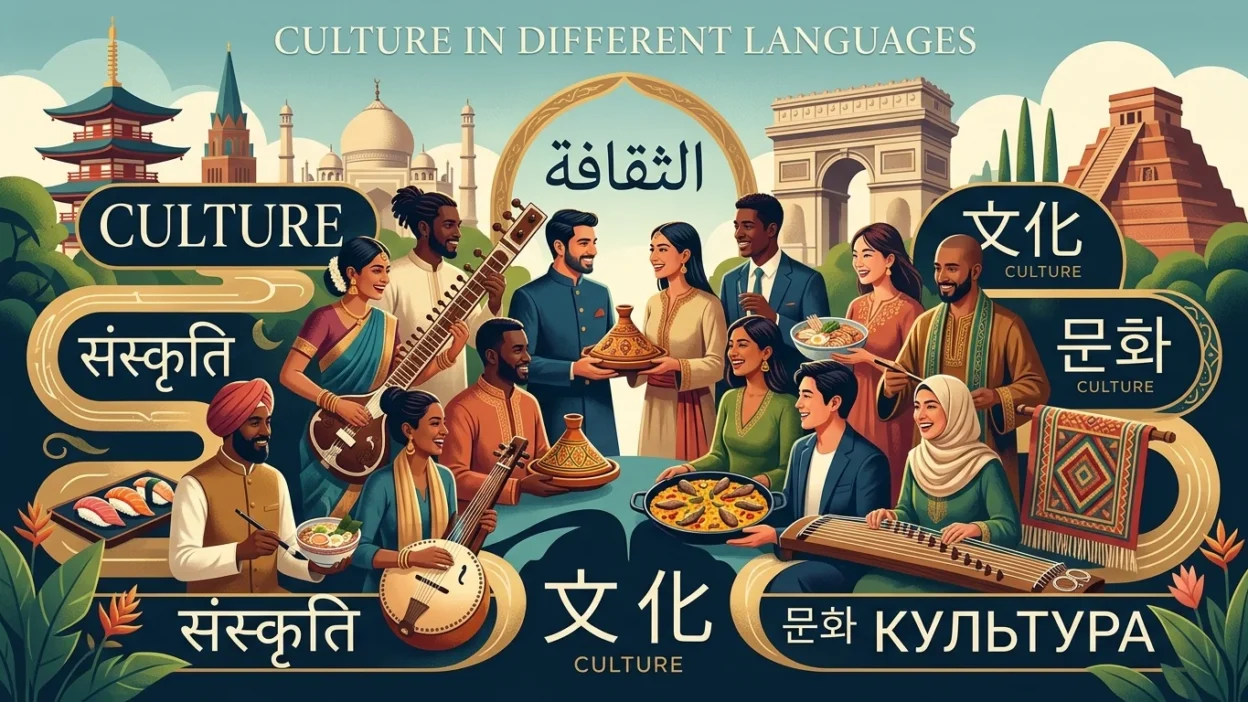
Culture shapes how people communicate, celebrate traditions, understand family, and connect with their communities. Learning the word for culture in different languages offers more than a vocabulary lesson. It provides a simple way to explore how societies describe their shared customs, values, beliefs, arts, and ways of life.
The phrase culture in different languages can also reveal fascinating differences in pronunciation and linguistic history. Whether you are learning a language, traveling, studying anthropology, or simply curious about global traditions, knowing this essential word can deepen your understanding of people around the world. Exploring culture in different languages makes language learning more meaningful and culturally enriching.
Quick Answer
The word “culture” has distinct forms across languages, often referring to traditions, customs, arts, values, and shared ways of life. Learning these translations helps language learners communicate respectfully across cultures.
Culture in Different Languages Around the World
| Language | Native Word | Pronunciation |
| English | Culture | KUL-chur |
| Spanish | Cultura | kool-TOO-rah |
| French | Culture | kool-TEWR |
| German | Kultur | kool-TOOR |
| Italian | Cultura | kool-TOO-rah |
| Portuguese | Cultura | kool-TOO-rah |
| Dutch | Cultuur | kool-TEWR |
| Swedish | Kultur | kool-TOOR |
| Norwegian | Kultur | kool-TOOR |
| Danish | Kultur | kool-TOOR |
| Finnish | Kulttuuri | kool-TOO-ree |
| Icelandic | Menning | MEN-ning |
| Irish | Cultúr | KUL-toor |
| Welsh | Diwylliant | dee-WILL-yant |
| Scottish Gaelic | Cultar | KUL-tar |
| Polish | Kultura | kool-TOO-rah |
| Czech | Kultura | KOOL-too-rah |
| Slovak | Kultúra | kool-TOO-rah |
| Slovenian | Kultura | kool-TOO-rah |
| Croatian | Kultura | kool-TOO-rah |
| Serbian | Култура | kool-TOO-rah |
| Bulgarian | Култура | kool-TOO-rah |
| Macedonian | Култура | kool-TOO-rah |
| Russian | Культура | kool-TOO-rah |
| Ukrainian | Культура | kool-TOO-rah |
| Belarusian | Культура | kool-TOO-rah |
| Lithuanian | Kultūra | kool-TOO-rah |
| Latvian | Kultūra | kool-TOO-rah |
| Estonian | Kultuur | kool-TOOR |
| Romanian | Cultură | kool-TOO-rah |
| Hungarian | Kultúra | kool-TOO-rah |
| Greek | Πολιτισμός | po-lee-tee-zMOS |
| Albanian | Kulturë | kool-TOOR-uh |
| Turkish | Kültür | kool-TOOR |
| Azerbaijani | Mədəniyyət | ma-deh-nee-YET |
| Georgian | კულტურა | kool-TOO-rah |
| Armenian | Մշակույթ | muh-sha-KOYT |
| Arabic | ثقافة | tha-QAA-fah |
| Hebrew | תרבות | tar-BOOT |
| Persian | فرهنگ | far-HANG |
| Urdu | ثقافت | saqaafat |
| Hindi | संस्कृति | sun-SKRI-tee |
| Bengali | সংস্কৃতি | shong-SKRI-tee |
| Punjabi | ਸੱਭਿਆਚਾਰ | sab-BHYA-achaar |
| Gujarati | સંસ્કૃતિ | sun-SKRI-tee |
| Marathi | संस्कृती | sun-SKRU-tee |
| Tamil | கலாசாரம் | ka-laa-SAA-ram |
| Telugu | సంస్కృతి | sun-SKRU-tee |
| Kannada | ಸಂಸ್ಕೃತಿ | sun-SKRU-tee |
| Malayalam | സംസ്കാരം | sams-KAA-ram |
| Chinese | 文化 | WEN-hwah |
| Japanese | 文化 | bun-KAH |
| Korean | 문화 | moon-hwah |
Why Learn the Word Culture in Different Languages?
Learning “culture” in another language gives you vocabulary for conversations about traditions, identity, history, art, and society. It is especially useful when discussing travel experiences, local customs, festivals, food, literature, or social practices.
The word also appears frequently in educational and professional settings. Students may encounter it in history, sociology, anthropology, and language courses, while travelers can use it when asking about local traditions.
More importantly, learning culturally meaningful vocabulary encourages curiosity. Instead of viewing language as a collection of isolated words, you begin to understand how communities describe their own experiences and values.
How Culture Shapes Language and Identity
Language and culture are closely connected because people use words to describe experiences that matter within their communities. Some cultural concepts have several expressions or meanings depending on context, while others may be difficult to translate perfectly.
The word for culture itself often connects with ideas such as heritage, tradition, society, customs, and identity. When you learn these related terms together, you gain a broader vocabulary for discussing communities and their histories.
Understanding this relationship can also improve communication. A language learner who understands cultural context is more likely to recognize why certain expressions, greetings, gestures, and forms of politeness are appropriate in particular situations.
Pronunciation Tips for Saying “Culture” Correctly
Pronouncing “culture” correctly depends on the language because spelling patterns and sounds vary considerably. In many European languages, forms such as cultura and kultura have a pronunciation that differs from English.
Start by listening carefully to native speakers and breaking unfamiliar words into manageable syllables. Avoid relying entirely on English pronunciation rules because the same letters can represent different sounds in another language.
For languages using different writing systems, such as Arabic, Hindi, Chinese, Japanese, and Korean, learning the native spelling alongside pronunciation can make memorization easier. Repeating the word aloud several times also helps develop natural pronunciation and confidence.
Culture, Tradition, Heritage, and Society: What Is the Difference?
Although culture, tradition, heritage, and society are related, they do not mean exactly the same thing. Culture broadly describes shared ways of life, including beliefs, values, language, arts, customs, and social practices.
Tradition usually refers to practices, ideas, or customs passed from one generation to another. Heritage focuses on what communities inherit from their past, including cultural, historical, and artistic elements.
Society describes a community or population whose members interact within shared social structures. Understanding these distinctions helps language learners choose vocabulary more accurately and communicate ideas about people and communities with greater precision.
Practical Ways to Use the Word Culture
The word “culture” is useful in everyday conversations, academic writing, travel discussions, and workplace communication. You might use it when describing a country’s traditions, asking about local customs, or discussing cultural differences.
For example, a traveler could ask about the culture of a destination before visiting. A student might write about how music reflects culture, while a language learner could discuss cultural similarities between two countries.
Learning a few related words can make these conversations more natural. Terms such as tradition, heritage, customs, values, history, community, language, and identity provide useful context and help you express more detailed ideas.
Common Mistakes When Talking About Culture
One common mistake is treating culture as something that applies identically to every individual in a country. Cultures are diverse, and people can have different experiences, beliefs, lifestyles, and personal identities.
Another mistake is assuming that one tradition represents an entire population. Regional, generational, religious, linguistic, and historical differences can create substantial variation within the same country.
Language learners should also avoid translating expressions word-for-word without considering context. A culturally appropriate phrase may not have a perfect literal equivalent. Paying attention to how native speakers use vocabulary is therefore just as important as memorizing dictionary definitions.
Easy Ways to Learn Cultural Vocabulary
A practical way to learn vocabulary about culture is to connect each word with a real-world example. Instead of memorizing “culture” alone, associate it with traditions, festivals, food, music, clothing, family customs, and art.
You can create flashcards containing the native word, pronunciation, meaning, and a short example sentence. Watching films, listening to podcasts, reading articles, and speaking with native speakers can reinforce the vocabulary naturally.
It also helps to compare related words across languages. Notice which languages have similar forms and which use completely different words. These comparisons make vocabulary more memorable while introducing you to the history and diversity of human language.
Fascinating Facts About the Word “Culture”
The English word “culture” ultimately traces back to Latin cultura, associated with cultivation and care. Over time, the meaning expanded from cultivating land to cultivating the mind and describing the shared practices of human communities.
Many European languages contain forms that resemble cultura or kultura, reflecting historical linguistic connections. Other languages use words with very different structures and histories.
Another interesting point is that “culture” can describe both broad and specific ideas. It may refer to humanity’s cultural diversity as a whole, a country’s cultural traditions, an organization’s workplace culture, or the practices of a particular community.
Benefits of Learning Different Languages and Cultures
Learning different languages can improve communication while giving you new perspectives on history, traditions, and everyday life. Even learning a few important words can make interactions more respectful and meaningful.
Cultural vocabulary is particularly valuable because it encourages learners to look beyond literal translations. You begin to notice how people describe family, hospitality, celebrations, food, art, and social relationships.
Language learning can also strengthen curiosity and cross-cultural awareness. Rather than assuming that one way of communicating is universal, you become more comfortable recognizing differences. This mindset can be useful when traveling, studying, working internationally, or communicating with people from diverse backgrounds.
Key Takeaways
- “Culture” describes shared values, traditions, customs, arts, beliefs, and ways of life.
- The word has related forms across many European languages.
- Other languages use completely different words and writing systems for the concept.
- Learning cultural vocabulary can improve communication and cross-cultural understanding.
- Knowing a word’s cultural context is often as important as knowing its translation.
Conclusion
Learning culture in different languages is a simple way to connect vocabulary with the wider world. The translations reveal linguistic similarities, differences in pronunciation, and the many ways people describe shared traditions and values. Understanding the meaning of culture also encourages respectful communication and deeper curiosity about communities. Whether you are studying a new language, preparing for travel, or exploring global traditions, learning this word provides useful vocabulary and valuable cultural context. By combining language practice with cultural awareness, you can make your learning experience more meaningful, practical, and memorable.
Frequently Asked Questions
What is the word for culture in different languages?
The word for culture varies by language. For example, Spanish uses cultura, French uses culture, German uses Kultur, Arabic uses ثقافة, Hindi uses संस्कृति, Chinese uses 文化, and Japanese uses 文化. Each term refers broadly to shared traditions, values, customs, arts, or ways of life.
How do you say culture in Spanish?
In Spanish, culture is cultura, pronounced approximately “kool-TOO-rah.” It can describe the traditions, customs, arts, beliefs, and shared practices of a community. The word is commonly used when discussing cultural heritage, national traditions, literature, music, food, and social customs.
Why is learning culture-related vocabulary important?
Culture-related vocabulary helps language learners discuss traditions, customs, identity, history, arts, and social practices more naturally. It also provides cultural context that can prevent misunderstandings. Learning these words encourages curiosity about how communities communicate and helps learners develop stronger cross-cultural awareness.
Is the word “culture” similar across many languages?
Yes. Several European languages have words resembling culture, cultura, or kultura. These similarities are partly connected to shared linguistic history and borrowing. However, many languages use completely different words, particularly outside the European language family, showing the diversity of vocabulary worldwide.
What is the difference between culture and tradition?
Culture is a broad concept covering shared values, beliefs, language, customs, arts, behaviors, and ways of life. Tradition is narrower and usually refers to practices or ideas passed between generations. A tradition can therefore be part of a community’s broader culture, but culture includes much more than tradition alone.

Emery Foster writes captivating stories that blend emotion, adventure, and thoughtful themes. Their creative voice, relatable characters, and engaging plots have attracted readers from diverse backgrounds worldwide.