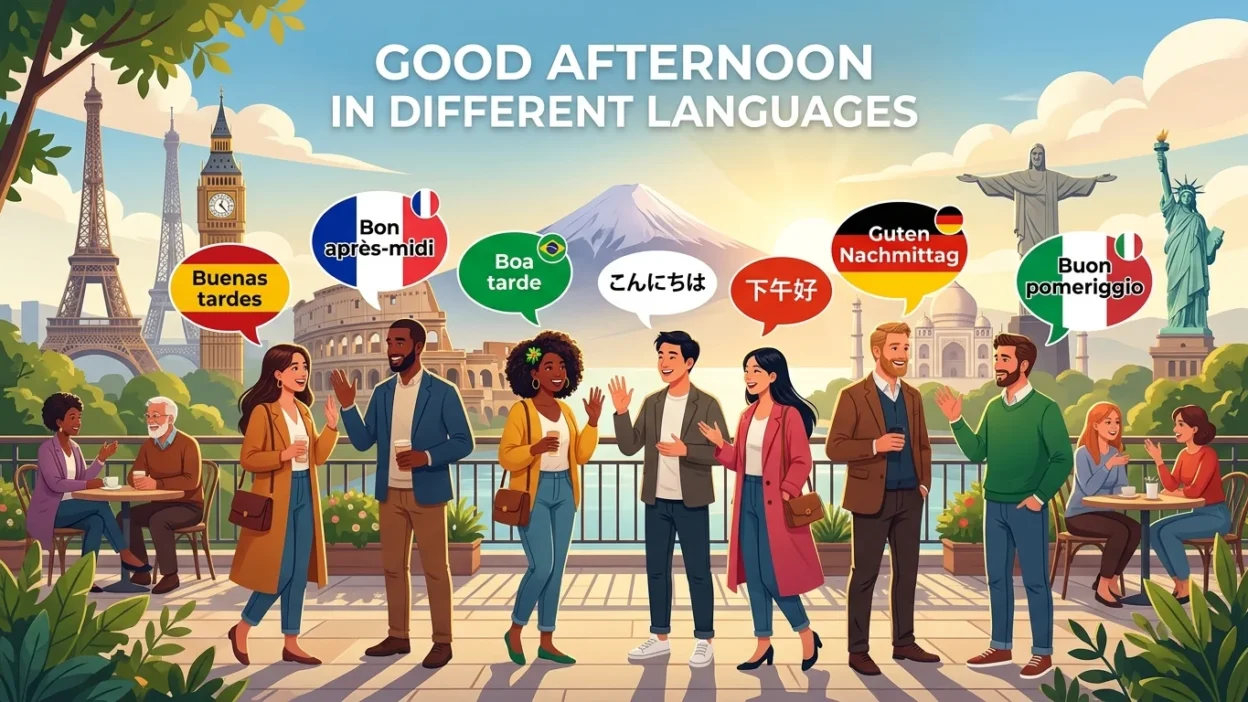
Learning good afternoon in different languages is a simple way to connect across cultures and make your communication feel warmer. Whether you are traveling, working with international clients, or just curious about languages, knowing how to say good afternoon in different languages helps you sound more respectful and approachable.
This phrase also gives you a practical entry point into pronunciation, etiquette, and cultural awareness. In everyday conversations, good afternoon in different languages can open doors, start friendly interactions, and make a lasting impression in both personal and professional settings.
Quick Answer
“Good afternoon” is a polite daytime greeting used after noon and before evening. Around the world, it changes by language, but the meaning stays the same: a respectful way to say hello during the afternoon.
Good Afternoon in Different Languages Around the World
| Language | Native Word | Pronunciation |
| Spanish | Buenas tardes | bweh-nas TAR-des |
| French | Bon après-midi | bohn ah-pray-mee-DEE |
| German | Guten Nachmittag | GOO-ten NAHKH-mih-tahk |
| Italian | Buon pomeriggio | bwon poh-meh-REE-joh |
| Portuguese | Boa tarde | BOH-ah TAR-deh |
| Dutch | Goedemiddag | KHOO-duh-mih-dakh |
| Russian | Добрый день | DOH-briy dyen’ |
| Ukrainian | Добрий день | DOH-bryi den’ |
| Polish | Dzień dobry | JEEN doh-bri |
| Czech | Dobrý den | DOH-bree den |
| Slovak | Dobrý deň | DOH-bree dyen’ |
| Hungarian | Jó napot | YOH nah-pot |
| Romanian | Bună ziua | BOO-nuh ZEE-wah |
| Greek | Καλό απόγευμα | kah-LOH ah-POH-yev-mah |
| Turkish | İyi günler | EE-yee GOON-ler |
| Arabic | مساء الخير | ma-saa’ al-khayr |
| Hebrew | אחר הצהריים טובים | ah-KHAR ha-tsa-hoh-RAH-yim toh-VEEM |
| Persian | عصر بخیر | asr beh-KHEIR |
| Hindi | शुभ दोपहर | shubh doh-pu-HER |
| Urdu | دوپہر بخیر | doh-PEHR beh-KHEIR |
| Bengali | শুভ অপরাহ্ণ | shubho oh-poh-RAH-nho |
| Tamil | மதிய வணக்கம் | mah-diya vah-NAK-kam |
| Telugu | శుభ మద్యాహ్నం | shubha madh-YAAH-nam |
| Marathi | शुभ दुपार | shubh doo-PAAR |
| Gujarati | શુભ બપોર | shubh ba-POHR |
| Punjabi | ਸ਼ੁਭ ਦੁਪਹਿਰ | shubh doo-pe-HER |
| Malayalam | ശുഭ മധ്യാഹ്നം | shubha madh-YAAH-nam |
| Sinhala | සුභ දහවල | soo-bha dah-ha-wa-la |
| Japanese | こんにちは | kon-nee-chi-wah |
| Korean | 안녕하세요 | an-nyeong-ha-se-yo |
| Mandarin Chinese | 下午好 | shia-ow haow |
| Cantonese Chinese | 午安 | ng5 on1 |
| Thai | สวัสดีตอนบ่าย | sa-wat-DEE ton baai |
| Vietnamese | Chào buổi chiều | chow bwoi chyoo-eh |
| Indonesian | Selamat siang | suh-lah-mat see-ahng |
| Malay | Selamat petang | suh-lah-mat puh-tahng |
| Filipino/Tagalog | Magandang hapon | mah-gahn-dahng HAH-pon |
| Swahili | Habari za mchana | ha-BAH-ree zah m-CHAH-nah |
| Zulu | Sawubona ntambama | sah-woo-BOH-nah n-tam-BAH-mah |
| Afrikaans | Goeie middag | KHOO-ee mih-dakh |
| Icelandic | Góðan dag | GOH-than dahg |
| Norwegian | God ettermiddag | goo et-ter-MID-dahg |
| Swedish | God eftermiddag | good EF-ter-mid-dahg |
| Danish | God eftermiddag | goo ETH-ter-MYTH-ah |
| Finnish | Hyvää iltapäivää | HY-vah IHL-tah-PIE-vah |
| Estonian | Tere päevast | TEH-reh PYEH-vast |
| Latvian | Labdien | lahb-DYEHN |
| Lithuanian | Laba diena | LAH-bah DYEH-nah |
| Slovenian | Dober dan | DOH-ber dahn |
| Croatian | Dobar dan | DOH-bar dahn |
| Serbian | Добар дан | DOH-bar dahn |
| Albanian | Mirëdita | meer-DEE-tah |
Why Learning Afternoon Greetings Matters
A simple greeting can change the tone of an entire conversation. When you know how to say good afternoon in another language, you show curiosity, respect, and cultural awareness. That matters in travel, business, hospitality, education, and online communities.
These phrases are also low-risk, high-value vocabulary. They are easy to learn, easy to use, and often remembered by the person hearing them. Even if your accent is not perfect, the effort itself builds trust and makes interactions feel more human.
Cultural Significance of Afternoon Greetings
Afternoon greetings are more than translations. In many cultures, they reflect manners, social hierarchy, and local customs. Some languages use a distinct afternoon phrase, while others rely on a general daytime greeting that works across noon and early evening.
Understanding the cultural context helps you avoid sounding unnatural. In some places, the greeting is formal and respectful. In others, people prefer a relaxed, friendly expression. Learning the phrase alongside the social meaning makes your language use feel more authentic and appropriate.
How to Pronounce Them Clearly
Pronunciation matters because the same greeting can sound very different across languages. The best strategy is to break the phrase into small parts, then repeat it slowly before increasing speed. Focus on stress, vowel length, and unfamiliar sounds.
For example, Spanish and Italian tend to flow smoothly, while languages like German, Polish, or Arabic may need more attention to consonants. Listening first, then speaking, is the fastest way to improve. Even a clean, simple attempt is usually better than rushing through the phrase.
When to Use Good Afternoon Politely
Use afternoon greetings after lunch and before evening, especially when meeting someone for the first time. They work well in emails, calls, hotel check-ins, meetings, classrooms, and casual introductions. A polite greeting creates a positive first impression.
In many settings, the phrase is better than jumping straight into a question or request. It softens the conversation and shows consideration. If you are unsure whether to use a formal or casual version, choose the more respectful one. It is almost always the safer option.
Practical Uses for Travel, Work, and Social Media
These greetings are useful in more places than people expect. Travelers can use them with hotel staff, taxi drivers, shop owners, and local residents. Professionals can use them in international meetings, client messages, and networking conversations.
On social media, multilingual greetings can make captions, comments, and community posts feel more welcoming. They are also helpful for teachers, content creators, and language learners who want to engage a global audience. A small phrase often creates a surprisingly strong connection.
Easy Ways to Remember Afternoon Phrases
The easiest way to remember greetings is to group them by language family or by sound pattern. For example, Romance languages often sound similar, while many Slavic greetings share recognizable structures. Pattern recognition reduces memorization pressure.
Another useful method is repetition with context. Say the phrase out loud when you see a clock in the afternoon, or pair it with a location, person, or routine. Flashcards, voice notes, and short daily practice sessions also help the words stick naturally.
Common Mistakes to Avoid
One common mistake is using a greeting at the wrong time of day. Some languages are flexible, but others are tied closely to cultural timing. Another mistake is pronouncing every word as if it were English, which can change the sound completely.
It is also easy to overdo the effort. A polite greeting is enough; you do not need to force a perfect accent or long sentence. Keep it simple, respectful, and natural. People usually appreciate the intention more than flawless delivery.
Benefits of Learning Different Language Greetings
Learning greetings builds confidence fast because they are short, useful, and easy to apply in real life. You get an immediate win, and that success often motivates you to learn more vocabulary later.
These phrases also improve memory, listening, and pronunciation skills. Just a few greetings can help you understand the rhythm of a language and make your communication feel warmer. Over time, small phrases like these support bigger language goals and stronger cross-cultural connections.
Key Takeaways
- Afternoon greetings are a practical and polite way to start conversations.
- Learning them helps with travel, work, and everyday communication.
- Pronunciation improves when you practice slowly and repeat often.
- Cultural context matters as much as the translation itself.
- Small greetings can create a strong first impression.
Conclusion
Knowing good afternoon in different languages is a simple skill with a big impact. It helps you greet people respectfully, communicate across cultures, and feel more confident in real-world situations. From travel to business to casual conversation, these phrases make interactions smoother and warmer. The more you practice good afternoon in different languages, the more natural it becomes to connect with people around the world.
Frequently Asked Questions
1. What is the best way to say good afternoon in different languages?
The best way is to learn the native phrase, the approximate pronunciation, and the cultural setting. That combination helps you sound polite and natural. Start with the languages you use most, then build your list gradually with short daily practice.
2. Is “good afternoon” used in every language?
Not always. Some languages have a direct afternoon greeting, while others use a general daytime greeting that works in many situations. In those cases, the phrase may not translate word-for-word, but the social meaning stays similar and still serves as a polite hello.
3. When should I use a good afternoon greeting?
Use it after noon and before evening, especially in formal or respectful situations. It works well in meetings, emails, stores, hotels, and introductions. If you are unsure about timing, a daytime greeting is usually safer than a casual phrase that may feel too relaxed.
4. Why should I learn afternoon greetings in other languages?
Learning these greetings helps you connect with people more easily and shows cultural awareness. It is one of the fastest ways to make a conversation feel warmer. It also supports travel, business communication, and language learning by giving you practical vocabulary you can use right away.
5. Are pronunciation guides important for language greetings?
Yes, pronunciation guides help you speak clearly and avoid misunderstandings. Even a rough guide can make a big difference when learning unfamiliar sounds. By practicing the syllables slowly, you improve confidence and make your greeting easier for native speakers to recognize.

Paisley Cooper is celebrated for expressive writing and imaginative narratives. Their stories emphasize courage, friendship, and personal growth, creating meaningful connections with readers through engaging and inspiring literature.