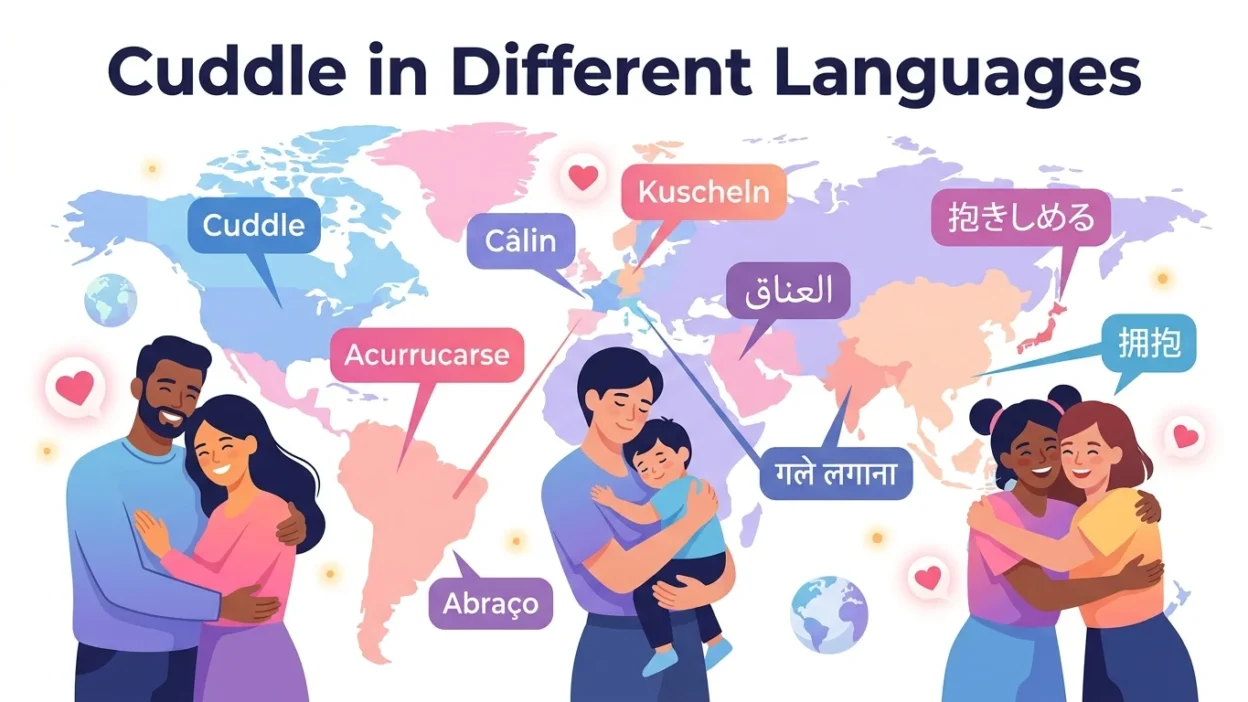
If you want to learn cuddle in different languages, you are in the right place. The phrase may sound simple, but it reveals how people express comfort, affection, and closeness across cultures. Many readers search for cuddle in different languages when writing romantic notes, learning a new tongue, or exploring family-friendly words.
This guide makes cuddle in different languages easy to understand with translations, pronunciations, and practical examples. Since many languages use the closest word for hug, snuggle, or embrace, you will see how affection changes from one culture to another. That makes the topic useful, warm, and surprisingly memorable.
Quick Answer
Cuddle in different languages is usually expressed with the closest word for hug, snuggle, or embrace. This guide shares 50 translations, simple pronunciations, and real-life tips for using affectionate words naturally across cultures.
Cuddle in Different Languages Around the World
| Language | Native Word | Pronunciation |
| English | cuddle | KUH-dul |
| Spanish | acurrucarse | ah-koo-roo-KAR-seh |
| French | câliner | kah-lee-NAY |
| German | kuscheln | KOO-shəln |
| Italian | coccolare | koh-koh-LAH-reh |
| Portuguese | aconchegar | ah-kohn-sheh-GAR |
| Dutch | knuffelen | KNUF-feh-luhn |
| Russian | прижаться | pree-ZHAT-sya |
| Mandarin Chinese | 拥抱 | yong-BOW |
| Japanese | 抱きしめる | dah-kee-shee-MEH-roo |
| Korean | 껴안다 | kkyuh-AN-da |
| Arabic | يعانق | yoo-AA-nik |
| Hindi | गले लगाना | guh-LEH lah-GAA-nah |
| Bengali | জড়িয়ে ধরা | joh-REE-yeh DHOH-rah |
| Urdu | گلے لگانا | guh-LEH lah-GAA-nah |
| Turkish | sarılmak | sah-ril-MAK |
| Greek | αγκαλιάζω | ahn-gah-LYAH-zoh |
| Swedish | mysa | MEE-sah |
| Norwegian | kose | KOO-seh |
| Danish | kramme | KRAH-meh |
| Finnish | halailla | hah-LAH-il-lah |
| Polish | przytulać się | pshih-TOO-lach shyeh |
| Czech | mazlit se | MAHZ-lit seh |
| Slovak | pritúliť sa | pree-TOO-lyit sah |
| Hungarian | ölelni | UH-lel-nee |
| Romanian | a îmbrățișa | ah eem-bră-tee-SHAH |
| Ukrainian | обіймати | oh-bee-YMA-ty |
| Hebrew | לחבק | leh-hah-BEK |
| Thai | กอด | gaawt |
| Vietnamese | ôm ấp | ohm up |
| Indonesian | memeluk | meh-meh-LOOK |
| Malay | memeluk | meh-meh-LOOK |
| Filipino/Tagalog | yakapin | ya-KAH-pin |
| Swahili | kukumbatia | koo-koom-bah-TYAH |
| Zulu | ukugona | oo-koo-GOH-nah |
| Afrikaans | koes | koos |
| Persian | بغل کردن | bah-GHAL kar-DAN |
| Tamil | அணைத்துக்கொள் | ah-nayth-THOOK-kol |
| Telugu | హత్తుకోవడం | hut-too-ko-VAH-dum |
| Marathi | मिठी मारणे | mee-THEE MAR-nay |
| Gujarati | ગળે લગાવવું | guh-LEH lah-GAA-vvoo |
| Punjabi | ਗਲੇ ਲਗਾਉਣਾ | guh-LEH la-GAH-oo-nah |
| Khmer | អោប | aob |
| Lao | ກອດ | goht |
| Mongolian | тэврэх | TEV-rekh |
| Nepali | अँगालो हाल्नु | an-GAA-lo HAA-lnu |
| Sinhala | බදා ගන්න | bah-DAH gan-nah |
| Amharic | ማቀፍ | mah-KEF |
| Icelandic | knúsa | KNOO-sah |
| Serbian | грлити се | GREE-lee-tee seh |
Why People Search for Cuddle in Different Languages
Learning cuddle in different languages is useful because it gives you a softer, more personal way to connect with people. A single affectionate word can make a message feel warmer than a direct translation. It also helps when you are studying greetings, romantic phrases, or family-friendly vocabulary. Many languages do not use one perfect match for cuddle, so learners discover related verbs such as hug, snuggle, embrace, or hold close. That small difference teaches a bigger lesson: language is shaped by culture, comfort, and everyday emotion.
Cultural Meaning Behind Cuddling Words
The cultural meaning of cuddle in different languages is not identical everywhere. In some places, affection is shown openly with warm words and close physical gestures. In others, people prefer gentler or more reserved expressions. That is why the local word may lean more toward hug, hold, or nestle instead of a direct cuddle equivalent. Understanding this helps you avoid awkward phrasing and use language with more respect. It also shows how people in every culture value comfort, care, and emotional closeness, even if they express it differently.
How to Pronounce These Words Clearly
Pronunciation matters when you say cuddle in different languages, especially if you want your words to sound natural. Start by listening to the rhythm of each language instead of focusing only on individual letters. Some words are soft and flowing, while others use stronger consonants or shorter syllables. Say each translation slowly, then repeat it in a normal speaking pace. If a word has unfamiliar sounds, break it into chunks and practice one part at a time. Clear pronunciation builds confidence and makes affectionate phrases easier to remember.
When to Use Cuddle Phrases in Real Life
Knowing when to use cuddle in different languages can save you from sounding too casual or too intimate. These words fit best in friendly, romantic, or family settings where warmth is welcome. They work well in text messages, greeting cards, and language-learning practice. In more formal situations, a direct cuddle word may feel too personal, so a simple hug or comfort phrase can be better. Always think about the relationship, tone, and setting before using affectionate vocabulary. Good timing makes your message feel natural and thoughtful.
Related Words for Hug, Snuggle, and Affection
Related words often appear when people search for cuddle in different languages, because many languages prefer a nearby meaning instead of a perfect match. Words like hug, embrace, snuggle, nestle, or hold close can all carry a similar feeling. These variations are helpful when you want to describe affection in a more precise way. For example, a romantic phrase may sound better with embrace, while a family message may sound better with hug or cuddle. Learning the range of meanings gives you more flexibility and better cultural awareness.
Easy Ways to Remember the Translations
The easiest way to remember cuddle in different languages is to group the words by sound, region, or meaning. For example, some translations feel soft and cozy, while others are short and strong. You can also connect each word to a real person, place, or memory, which makes recall faster. Flashcards, repetition, and speaking aloud all help. Try using one new word in a sentence every day. When vocabulary is attached to emotion, it tends to stay in your memory longer and feel more useful in real conversations.
Common Mistakes Learners Make
A common mistake with cuddle in different languages is assuming every word means exactly the same thing. In reality, some translations mean hug, while others mean cuddle, embrace, or hold tightly. Another mistake is ignoring context and using an affectionate word in a situation that feels too personal. Learners also sometimes mispronounce soft consonants or stress the wrong syllable. The best fix is to check the meaning, hear the pronunciation, and practice in a complete sentence. That approach keeps your language warm, accurate, and natural.
Benefits of Learning Affectionate Words Across Languages
Learning affectionate vocabulary like cuddle in different languages gives you more than just a new word list. It improves listening skills, strengthens memory, and deepens your understanding of how emotions are expressed across cultures. It also makes travel, language exchange, and international friendships feel more personal. Even one warm phrase can help you sound kinder and more approachable. Over time, these small words build cultural confidence. They remind you that language is not only about facts and grammar, but also about human connection and care.
Key Takeaways
- Cuddle often translates to a nearby idea like hug, snuggle, or embrace.
- Many languages use different words depending on tone, culture, and context.
- Pronunciation becomes easier when you practice words slowly and in chunks.
- Affectionate vocabulary works best in warm, personal, or friendly settings.
- Learning these words helps you sound more natural and culturally aware.
Conclusion
Learning cuddle in different languages is a small but meaningful way to understand affection across cultures. It gives you vocabulary for warm conversations, romantic messages, and family moments, while also improving pronunciation and memory. Because many languages use hug, embrace, or snuggle as the closest match, you learn both the word and the culture behind it. Whether you are studying for travel, curiosity, or connection, these translations make language feel more human, personal, and memorable in everyday life and conversation.
Frequently Asked Questions
1. What does cuddle in different languages usually mean?
It usually means the nearest affectionate word in each language, such as hug, snuggle, embrace, or hold close. Many languages do not have one exact equivalent for “cuddle,” so the closest natural expression is often the best choice for everyday use.
2. Is there one exact translation for cuddle in every language?
Yes, but the meaning may shift slightly from language to language. In some places it sounds romantic, while in others it feels family-friendly or comforting. Checking the context helps you choose the right word and avoid sounding too intimate or too formal.
3. What is the best way to memorize these translations?
The best method is to group translations by sound, region, or meaning. Say the word slowly, then use it in a sentence. Repeating the phrase aloud, using flashcards, and connecting it to a real memory will help you remember it faster.
4. Why do some translations mean hug instead of cuddle?
Most languages use a closest-match word rather than a perfect one-word translation. That is why you may see options like hug, embrace, or snuggle. This is normal and actually gives you a better understanding of how affection is expressed worldwide.
5. When should I use affectionate words like these?
Use it in friendly messages, language study, romantic notes, or family conversations where warmth is welcome. In formal situations, a simpler comfort word may be better. The key is to match the tone of the relationship and the setting naturally.

Brooklyn Walker is a contemporary writer known for engaging storytelling, memorable characters, and emotionally rich narratives. Their work inspires readers through creativity, imagination, meaningful themes, and compelling literary style.