Cell phone in different languages is a useful topic for travelers, language learners, students, and anyone communicating across cultures. Knowing how to say cell phone in different languages helps you ask for assistance, shop for devices, or simply expand your vocabulary while exploring new places.
Whether you call it a mobile phone, cellphone, or smartphone, the term varies across countries and languages. This guide explains cell phone in different languages, provides translations in 50 languages, and shares practical tips to help you use the words confidently in everyday conversations.
Quick Answer
The phrase cell phone in different languages refers to how people say “cell phone” or “mobile phone” across the world. Learning these translations improves communication while traveling, studying languages, or interacting with people from different cultural backgrounds.
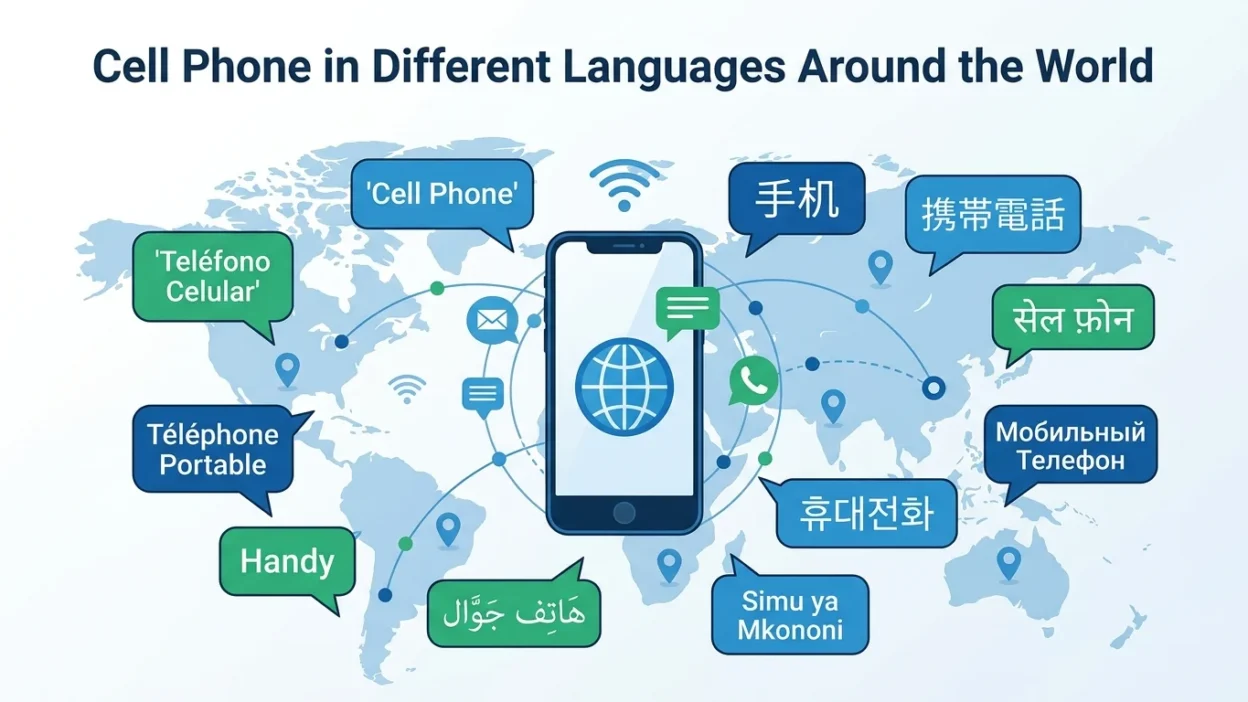
Cell Phone in Different Languages Around the World
| Language | Native Word | Pronunciation |
| English | Cell phone | Sel Fohn |
| Spanish | Teléfono móvil | Teh-LEH-fo-no MO-veel |
| French | Téléphone portable | Tay-lay-FON por-TA-bluh |
| German | Handy | HAN-dee |
| Italian | Cellulare | Chel-loo-LAH-reh |
| Portuguese | Celular | Seh-loo-LAR |
| Dutch | Mobiele telefoon | Mo-BEE-luh TEH-luh-foon |
| Russian | Мобильный телефон | Mo-BEEL-nee te-le-FON |
| Ukrainian | Мобільний телефон | Mo-BEEL-nee te-le-FON |
| Polish | Telefon komórkowy | TEH-le-fon ko-moor-KO-vee |
| Czech | Mobilní telefon | MO-bil-nee TE-le-fon |
| Slovak | Mobilný telefón | MO-bil-nee TE-le-fon |
| Hungarian | Mobiltelefon | MO-bil-te-le-fon |
| Romanian | Telefon mobil | TE-le-fon MO-beel |
| Greek | Κινητό τηλέφωνο | Kee-nee-TO tee-LE-fo-no |
| Turkish | Cep telefonu | Jep te-le-FOH-noo |
| Arabic | هاتف محمول | HA-tef mahm-OOL |
| Hebrew | טלפון נייד | Te-le-FON na-YED |
| Persian | تلفن همراه | Te-le-FON ham-RAH |
| Hindi | मोबाइल फ़ोन | MO-bile phone |
| Urdu | موبائل فون | MO-bile phone |
| Punjabi | ਮੋਬਾਈਲ ਫੋਨ | MO-bile phone |
| Bengali | মোবাইল ফোন | MO-bile phone |
| Gujarati | મોબાઇલ ફોન | MO-bile phone |
| Marathi | मोबाईल फोन | MO-bile phone |
| Tamil | கைபேசி | Kai-PAY-see |
| Telugu | మొబైల్ ఫోన్ | MO-bile phone |
| Kannada | ಮೊಬೈಲ್ ಫೋನ್ | MO-bile phone |
| Malayalam | മൊബൈൽ ഫോൺ | MO-bile phone |
| Sinhala | ජංගම දුරකථනය | JAN-ga-ma du-ra-ka-tha-na-ya |
| Nepali | मोबाइल फोन | MO-bile phone |
| Chinese (Simplified) | 手机 | Show-JEE |
| Chinese (Traditional) | 手機 | Show-JEE |
| Japanese | 携帯電話 | Keh-tie den-WAH |
| Korean | 휴대전화 | Hyoo-day-JON-hwa |
| Vietnamese | Điện thoại di động | Dee-en THO-eye zee ZONG |
| Thai | โทรศัพท์มือถือ | To-ra-sap MUE-thue |
| Indonesian | Ponsel | PON-sel |
| Malay | Telefon bimbit | TE-le-fon BIM-bit |
| Filipino | Cellphone | SEL-fon |
| Swahili | Simu ya mkononi | SEE-moo ya mko-NO-nee |
| Afrikaans | Selfoon | SEL-foon |
| Yoruba | Fóònù alágbèéká | FOH-nu a-la-gbay-KA |
| Igbo | Ekwentị mkpanaaka | Eh-KWEN-tee mpa-na-A-ka |
| Zulu | Umakhalekhukhwini | Oo-ma-ka-le-khoo-KWIN-ee |
| Finnish | Matkapuhelin | MAT-ka-poo-he-lin |
| Swedish | Mobiltelefon | Mo-BEEL-te-le-fon |
| Norwegian | Mobiltelefon | Mo-BEEL-te-le-fon |
| Danish | Mobiltelefon | Mo-BEEL-te-le-fon |
| Icelandic | Farsími | FAR-see-mi |
Why Learn Cell Phone in Different Languages?
Learning the translation of “cell phone” in multiple languages makes international communication much easier. It is one of the most practical words you can know because mobile phones play a central role in modern life.
Whether you are asking to borrow a phone, purchasing a SIM card, or requesting technical support, using the local word creates smoother conversations. It also shows respect for local culture and helps language learners build useful everyday vocabulary.
Cultural Importance of Mobile Phone Vocabulary
Although smartphones are nearly universal, the words used for them often reflect local language traditions. Some languages describe the device as a “mobile phone,” while others focus on portability or wireless communication.
Understanding these differences gives learners a deeper appreciation of linguistic diversity. It also demonstrates how languages adapt to technological changes while preserving their own grammatical and cultural identities.
Pronunciation Tips for Better Communication
Correct pronunciation matters just as much as learning the written translation. Listening carefully to native speakers and repeating the word aloud improves both confidence and accuracy.
Focus on natural rhythm instead of trying to imitate every sound perfectly. Recording yourself, practicing slowly, and using the word in simple sentences will help you remember it more effectively over time.
Related Technology Words to Learn
After learning how to say “cell phone,” expand your vocabulary with other useful technology terms. Words like smartphone, charger, battery, screen, headphones, internet, Wi-Fi, and message frequently appear in everyday conversations.
Learning related vocabulary helps you communicate in real situations, whether you are shopping for electronics, asking for technical help, or using public transportation during international travel.
Practical Situations Where These Words Help
Knowing how to say “cell phone” becomes valuable in airports, hotels, shopping centers, repair shops, and tourist attractions. It also helps when asking for charging stations or purchasing accessories.
Students studying abroad and business travelers benefit from learning common technology vocabulary because it makes daily interactions more comfortable and reduces misunderstandings in unfamiliar environments.
Easy Ways to Remember Cell Phone in Different Languages
Group similar languages together because many share related vocabulary. For example, several European languages use words similar to “mobile” or “telephone,” making them easier to memorize.
Flashcards, language-learning apps, and regular review sessions strengthen memory. Using new words during conversations, even briefly, reinforces learning and improves long-term retention.
Common Mistakes to Avoid
A frequent mistake is assuming every country uses the same word for “cell phone.” English alone includes variations such as cellphone, mobile phone, and smartphone depending on the region.
Another common error is focusing only on spelling while ignoring pronunciation. Learning both forms helps avoid confusion and makes communication more natural with native speakers.
Benefits of Learning Different Languages
Learning everyday words across languages develops stronger communication skills and increases cultural awareness. Even a single practical word can help start conversations and build positive relationships.
Language learning also improves memory, problem-solving, and confidence. Understanding common vocabulary like “cell phone” encourages curiosity about other languages and motivates learners to continue expanding their knowledge.
Interesting Facts About Cell Phone Names Worldwide
Many languages borrowed their word for “cell phone” from English, while others created unique native expressions. German famously uses “Handy,” whereas Chinese simply uses the word meaning “hand machine.”
These differences show how languages evolve alongside technology. Studying these variations makes vocabulary learning more enjoyable while offering fascinating insights into global communication and cultural development.
Key Takeaways
- Learning cell phone translations improves everyday communication.
- Different languages use unique words for the same device.
- Pronunciation is as important as correct spelling.
- Technology vocabulary is useful for travel and education.
- Regular practice helps you remember new words more effectively.
Conclusion
Learning cell phone in different languages is a practical way to improve communication wherever you travel or study. These translations help you navigate everyday situations, understand different cultures, and build useful vocabulary that you can apply immediately. By practicing pronunciation, learning related technology terms, and reviewing the translations regularly, you will gain confidence using this essential expression in conversations around the world. Even one familiar word can make international interactions easier and more meaningful.
Frequently Asked Questions
1. Why should I learn cell phone in different languages?
Learning this common phrase makes travel, language study, and international communication much easier. It helps you ask questions, purchase mobile services, request assistance, and connect more naturally with native speakers in many different countries.
2. Is “cell phone” the same as “mobile phone”?
Yes. Both terms describe the same device, but usage depends on the country. North American English commonly uses “cell phone,” while many other English-speaking regions prefer “mobile phone” or simply “mobile.”
3. Which languages use words similar to English?
Many languages borrow similar words, including Spanish, Portuguese, Italian, Romanian, and several South Asian languages. However, pronunciation and spelling often differ according to each language’s writing system and pronunciation rules.
4. How can I remember these translations easily?
Practice a few languages at a time, create flashcards, repeat the words aloud, and use them in simple sentences. Reviewing vocabulary regularly and connecting similar words across related languages makes memorization much easier.
5. Are these translations useful for travelers?
Yes. Knowing how to say “cell phone” helps when buying SIM cards, asking for charging points, finding repair services, or requesting directions to electronics stores. It also improves confidence during conversations in unfamiliar countries.

Everly Bennett is recognized for imaginative storytelling and heartfelt writing. Their books explore relationships, resilience, and hope, delivering memorable reading experiences that resonate with audiences across generations.