Change in different languages is a useful phrase for travelers, students, language enthusiasts, and professionals communicating across cultures. Learning how to say change in different languages helps you understand everyday conversations while expanding your global vocabulary in a practical way.
Whether you mean personal transformation, switching something, or exchanging money, the word can have different meanings depending on the language and context. This guide explores change in different languages, pronunciation, cultural importance, and practical usage worldwide.
Quick Answer
The word change in different languages varies by country and culture. While each language has its own native term and pronunciation, understanding these translations improves communication, language learning, travel experiences, and cultural awareness across the world.
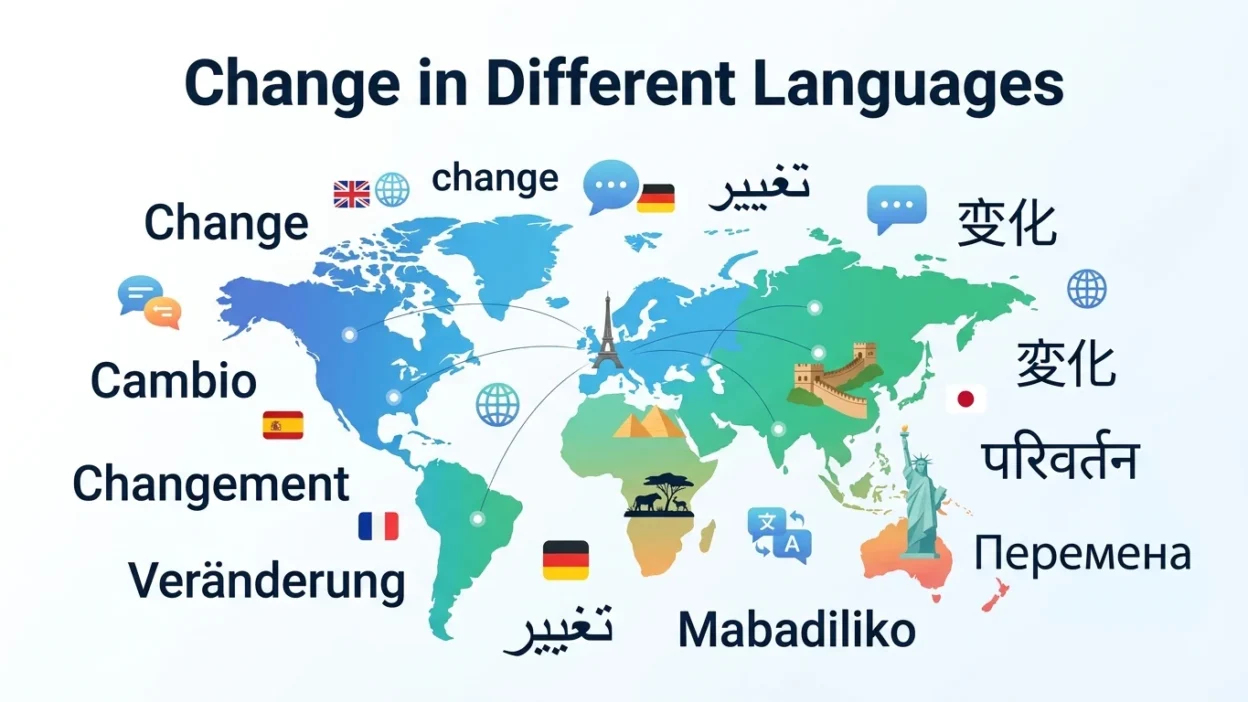
Change in Different Languages Around the World
| Language | Native Word | Pronunciation |
| English | Change | Chaynj |
| Spanish | Cambio | KAHM-bee-oh |
| French | Changement | Shahnzh-mahn |
| German | Veränderung | Fer-EN-deh-roong |
| Italian | Cambiamento | Kahm-bee-ah-MEN-toh |
| Portuguese | Mudança | Moo-DAN-sah |
| Dutch | Verandering | Ver-AN-de-ring |
| Swedish | Förändring | Fur-END-ring |
| Norwegian | Endring | END-ring |
| Danish | Forandring | Fo-RAN-dring |
| Finnish | Muutos | MOO-tohs |
| Icelandic | Breyting | BRAY-ting |
| Russian | Изменение | Iz-me-NYE-ni-ye |
| Ukrainian | Зміна | ZMEE-na |
| Polish | Zmiana | ZMYA-na |
| Czech | Změna | ZMYEH-na |
| Slovak | Zmena | ZMEH-na |
| Hungarian | Változás | VAAL-to-zhash |
| Romanian | Schimbare | Skeem-BAH-re |
| Bulgarian | Промяна | Pro-MYA-na |
| Greek | Αλλαγή | Ah-lah-GHEE |
| Turkish | Değişim | Deh-ee-SHEEM |
| Arabic | تغيير | Tagh-YEER |
| Hebrew | שינוי | Shi-NOO-ee |
| Persian | تغییر | Tagh-YEER |
| Hindi | परिवर्तन | Pari-var-TAN |
| Urdu | تبدیلی | Tab-DEE-lee |
| Bengali | পরিবর্তন | Pori-bor-TON |
| Punjabi | ਤਬਦੀਲੀ | Tab-DEE-lee |
| Gujarati | ફેરફાર | Fair-FAR |
| Marathi | बदल | Buh-DUL |
| Tamil | மாற்றம் | MAA-tram |
| Telugu | మార్పు | MAAR-poo |
| Kannada | ಬದಲಾವಣೆ | Buh-duh-LAA-va-nay |
| Malayalam | മാറ്റം | MAA-tam |
| Sinhala | වෙනස | Veh-NA-sa |
| Chinese (Simplified) | 改变 | Gai-byen |
| Japanese | 変化 | Hen-ka |
| Korean | 변화 | Byun-hwa |
| Vietnamese | Thay đổi | Thai Doy |
| Thai | การเปลี่ยนแปลง | Gaan Plian Plaeng |
| Indonesian | Perubahan | Peh-roo-BAH-han |
| Malay | Perubahan | Peh-roo-BAH-han |
| Filipino | Pagbabago | Pag-ba-BA-go |
| Swahili | Mabadiliko | Ma-ba-dee-LEE-ko |
| Zulu | Ushintsho | Oo-SHIN-tsho |
| Afrikaans | Verandering | Ver-AN-de-ring |
| Irish | Athrú | Ah-HROO |
| Welsh | Newid | NEH-wid |
| Maori | Huringa | Hoo-REE-nga |
What Does “Change” Mean?
The word “change” has several meanings depending on the situation. It may describe personal growth, a modification, replacing one thing with another, or adapting to new circumstances. It can also refer to exchanging money or switching plans.
Because of these different meanings, many languages use separate words for specific situations. Understanding the context ensures you choose the most accurate translation while communicating naturally with native speakers.
Why Learn Change in Different Languages?
Knowing how to say “change” in multiple languages is useful in travel, education, international business, and everyday conversations. It helps you understand signs, discussions, and cultural expressions related to progress, improvement, and adaptation.
Learning vocabulary with practical value also improves memory. Since change is a common concept in daily life, remembering its translation becomes easier and strengthens your overall language-learning skills.
Cultural Significance of Change
Every culture views change differently. Some societies celebrate change as growth and innovation, while others value stability and gradual transformation. Language reflects these beliefs through idioms, sayings, and traditional expressions.
Understanding cultural perspectives allows learners to appreciate more than vocabulary alone. It helps build meaningful communication and avoids misunderstandings when discussing personal development, social changes, or important life events.
Pronunciation Tips for Different Languages
Pronunciation becomes easier when you break words into smaller syllables and repeat them slowly. Listening carefully to native speakers also improves accuracy and confidence over time.
Focus on difficult sounds that may not exist in your own language. Practising regularly, speaking aloud, and comparing your pronunciation with native examples will help you master the word naturally in different languages.
Related Words and Expressions
The concept of change is often connected with words such as improvement, growth, transformation, progress, adaptation, transition, and development. Learning these related terms expands your vocabulary significantly.
Many languages also have unique phrases describing positive or negative change. Understanding these expressions helps you communicate more naturally and better understand books, films, news articles, and everyday conversations.
Practical Uses of the Word Change
The word appears frequently in schools, workplaces, travel situations, and daily conversations. People use it when discussing schedule changes, career changes, lifestyle improvements, technology updates, or environmental changes.
Travellers may also hear the word when exchanging currency or receiving small coins after shopping. Recognising the correct meaning depends entirely on the surrounding conversation and context.
Common Mistakes When Using Change
A common mistake is assuming one translation works in every situation. Many languages distinguish between changing an object, changing yourself, changing plans, or exchanging money.
Another frequent error is incorrect pronunciation. Speaking too quickly or stressing the wrong syllable may confuse listeners. Taking time to practise pronunciation greatly improves communication and confidence.
Benefits of Learning Words in Different Languages
Learning words across many languages improves memory, strengthens communication skills, and increases cultural awareness. It also makes travelling more enjoyable because you recognise familiar vocabulary in everyday situations.
Studying multilingual vocabulary encourages curiosity about different cultures and language families. Over time, learners develop stronger listening skills, improved pronunciation, and greater confidence when communicating internationally.
Interesting Facts About the Word Change
The idea of change exists in every known language because transformation is part of everyday life. Despite different spellings and pronunciations, many translations share similar meanings related to movement, improvement, or adaptation.
Languages continue evolving themselves, meaning the words people use today may gradually change over generations. This makes language learning both fascinating and continuously rewarding.
Key Takeaways
- Change has multiple meanings depending on context and language.
- Learning change in different languages improves communication skills.
- Pronunciation practice helps build confidence and accuracy.
- Cultural understanding adds deeper meaning to vocabulary learning.
- Regular exposure makes multilingual vocabulary easier to remember.
Conclusion
Learning change in different languages is an excellent way to improve your vocabulary while understanding how cultures express transformation, progress, and adaptation. Whether you are travelling, studying, or communicating internationally, knowing these translations helps build stronger connections with people around the world. Practising pronunciation, recognising different contexts, and exploring cultural meanings will make your language-learning journey more enjoyable and effective. Every new word you learn brings you one step closer to becoming a more confident global communicator.
Frequently Asked Questions
1. Why should I learn change in different languages?
Learning this word helps you communicate in everyday situations, understand cultural perspectives, and improve your multilingual vocabulary. Since change is a common concept, knowing its translation makes conversations easier during travel, education, and international communication while strengthening your overall language skills.
2. Does every language use the same word for every type of change?
No. Many languages have separate words depending on whether you mean personal change, changing an object, exchanging money, or making adjustments. Understanding the situation helps you choose the correct translation and communicate more naturally with native speakers.
3. What is the best way to remember these translations?
Practice regularly by grouping languages into families, repeating pronunciations aloud, and using flashcards. Reading simple sentences and speaking the words in context also improves long-term memory and helps you recognise them during real conversations.
4. Is pronunciation important when learning foreign vocabulary?
Yes. Correct pronunciation helps listeners understand your meaning and builds confidence. Breaking words into syllables, listening to native speakers, and practising consistently are effective ways to improve your speaking accuracy over time.
5. Can learning common words improve language skills faster?
Absolutely. Frequently used words like “change” appear in daily conversations, books, news, and media. Mastering common vocabulary first creates a strong language foundation, making it easier to understand more advanced grammar and expressions later.

Paisley Cooper is celebrated for expressive writing and imaginative narratives. Their stories emphasize courage, friendship, and personal growth, creating meaningful connections with readers through engaging and inspiring literature.