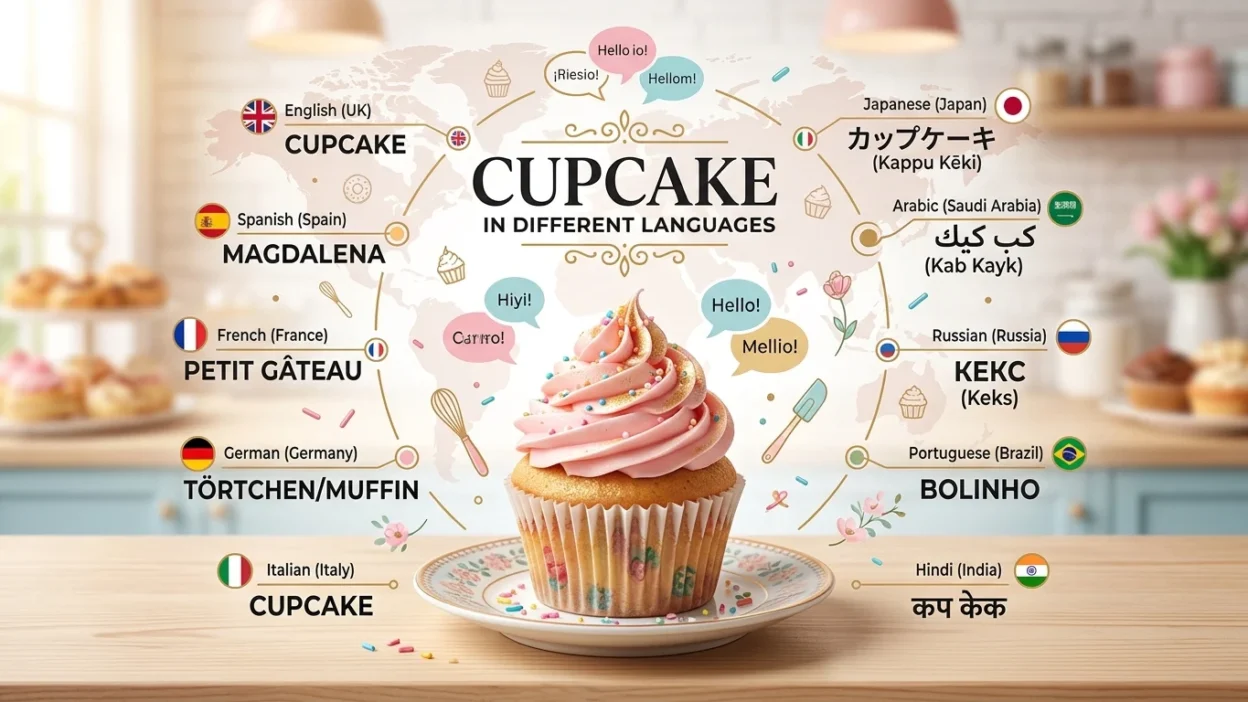
Cupcakes are small, colorful cakes enjoyed at birthdays, celebrations, cafés, and everyday treats. Learning how to say cupcake in different languages is a fun way to discover how cultures describe familiar foods. Some languages use a direct translation, while others commonly borrow the English word.
Whether you are learning vocabulary, traveling, creating multilingual content, or simply curious about international food words, knowing cupcake in different languages can make conversations more interesting. This guide explores the word across 50 languages, including native spellings and simple pronunciations. You will also learn useful cultural, pronunciation, and vocabulary tips related to cupcakes.
Quick Answer
The word for cupcake in different languages varies widely. Many languages use an adapted form of the English “cupcake,” while others describe it as a small cake, muffin, or individual baked cake.
Cupcake in Different Languages Around the World
| Language | Native Word | Pronunciation |
| English | Cupcake | CUP-cake |
| Spanish | Cupcake | KOOP-kayk |
| French | Cupcake | KUP-kayk |
| German | Cupcake | KUP-kayk |
| Italian | Cupcake | KUP-kayk |
| Portuguese | Cupcake | KUP-kayk |
| Dutch | Cupcake | KUP-kayk |
| Swedish | Cupcake | KUP-kayk |
| Norwegian | Cupcake | KUP-kayk |
| Danish | Cupcake | KUP-kayk |
| Finnish | Kuorrutettu kuppikakku | KWOHR-roo-tet-too KOOP-pee-kak-koo |
| Icelandic | Bollakaka | BOL-la-ka-ka |
| Estonian | Tassikook | TAS-see-kook |
| Latvian | Kēksiņš | KAYK-sinsh |
| Lithuanian | Keksiukas | KEK-see-oo-kas |
| Polish | Babeczka | ba-BETCH-ka |
| Czech | Košíček | KOH-shee-chek |
| Slovak | Košíček | KOH-shee-chek |
| Slovenian | Kolaček | koh-LAH-chek |
| Croatian | Kolačić | koh-LAH-chich |
| Serbian | Кексић | KEK-sich |
| Bulgarian | Кексче | KEKS-cheh |
| Russian | Капкейк | kap-KAYK |
| Ukrainian | Капкейк | kap-KAYK |
| Greek | Κάπκεϊκ | KAP-kayk |
| Romanian | Brioșă | bree-OH-shuh |
| Hungarian | Cupcake | KUP-kayk |
| Turkish | Cupcake | KUP-kayk |
| Arabic | كَب كيك | kab KEEK |
| Hebrew | קאפקייק | KAP-kayk |
| Persian | کاپکیک | KAP-keek |
| Urdu | کپ کیک | KUP-kayk |
| Hindi | कपकेक | KUP-kayk |
| Bengali | কাপকেক | KUP-kayk |
| Punjabi | ਕੱਪਕੇਕ | KUP-kayk |
| Gujarati | કપકેક | KUP-kayk |
| Marathi | कपकेक | KUP-kayk |
| Tamil | கப்கேக் | KUP-kayk |
| Telugu | కప్కేక్ | KUP-kayk |
| Kannada | ಕಪ್ಕೇಕ್ | KUP-kayk |
| Malayalam | കപ്പ്കേക്ക് | KUP-kayk |
| Chinese | 纸杯蛋糕 | JHUR BAY DAN-gaow |
| Japanese | カップケーキ | KAP-poo KAY-kee |
| Korean | 컵케이크 | KUP-kay-ee-keu |
| Vietnamese | Bánh cupcake | BAN KOOP-kayk |
| Thai | คัพเค้ก | KAP-kayk |
| Indonesian | Cupcake | KUP-kayk |
| Malay | Kek cawan | KEK CHA-wan |
| Filipino | Cupcake | KUP-kayk |
| Swahili | Keki ndogo | KEH-kee NDOH-goh |
| Afrikaans | Kolwyntjie | kol-VAYN-kee |
Why Learn Cupcake in Different Languages?
Learning food vocabulary is one of the easiest ways to expand practical language skills. The word “cupcake” is especially useful because these small cakes appear in bakeries, cafés, restaurants, parties, and social gatherings around the world.
Studying cupcake in different languages also reveals how languages handle borrowed words. Some simply adopt “cupcake,” while others create a descriptive expression based on ideas such as cups, small cakes, or individual portions.
For travelers and language learners, food words provide memorable vocabulary because they connect language with real experiences. Even learning a single dessert word can make ordering food or discussing favorite treats more enjoyable.
How Different Cultures Describe Cupcakes
Cupcakes are closely associated with modern baking culture, but similar individual-sized cakes exist in many culinary traditions. The terminology therefore does not always match the English word exactly.
In some languages, the common term is a direct borrowing of “cupcake.” Other languages use words meaning “small cake,” “little cake,” “cup cake,” or “muffin-like cake.” These differences show how vocabulary develops naturally within each culture.
The distinction can also depend on the country. A word that commonly means cupcake in one region may refer to a different small baked item elsewhere. Context is important when translating food vocabulary.
Pronunciation Tips for Saying Cupcake Correctly
The English pronunciation of “cupcake” is straightforward: CUP-cake. The first part sounds like “cup,” while the second sounds like “cake.” However, speakers of other languages may pronounce the borrowed word according to their own sound systems.
For example, Japanese and Korean adapt the sounds into their respective writing systems, producing forms that closely resemble the English pronunciation but follow local pronunciation rules.
When practicing cupcake in different languages, focus first on the rhythm and major sounds rather than trying to imitate a native accent perfectly. Listening to native speakers and repeating short phrases can gradually improve accuracy.
Cupcake, Muffin, and Small Cake: What Is the Difference?
Cupcakes, muffins, and other individual cakes can look similar, but they are not always interchangeable. A cupcake is generally a small cake designed as an individual serving and often decorated with frosting, icing, sprinkles, or other toppings.
Muffins are typically less sweet and may contain fruit, nuts, grains, or savory ingredients. Their texture and preparation can also differ from traditional cake.
These distinctions matter when translating food terms. A dictionary may provide a word for a small cake or muffin, but that does not always communicate the exact meaning of the English “cupcake.” Local culinary usage is often the best guide.
How to Use the Word Cupcake in Everyday Conversation
The word cupcake is easy to use in simple sentences about food, celebrations, shopping, and preferences. For example, you might say, “I bought a chocolate cupcake,” “She decorated the cupcakes,” or “Which cupcake would you like?”
When learning cupcake in different languages, practice the word with related vocabulary such as chocolate, vanilla, frosting, bakery, birthday, sweet, cake, and dessert. This creates useful word associations.
Language learners can also practice short questions such as “Do you like cupcakes?” or “How much is this cupcake?” Building complete phrases helps you remember vocabulary more effectively than memorizing isolated words.
Interesting Facts About Cupcake Vocabulary
One interesting feature of cupcake vocabulary is the widespread use of the English loanword. Modern food trends, international bakeries, social media, and global pop culture have helped “cupcake” travel across linguistic boundaries.
However, not every language relies on the English form. Some have established native expressions that describe the dessert more literally. Chinese, for example, uses 纸杯蛋糕, which can be understood as “paper-cup cake.”
This variation makes food vocabulary particularly interesting for language learners. A familiar dessert can reveal how different languages borrow, translate, shorten, or creatively adapt words to fit local pronunciation and grammar.
Common Mistakes When Translating Cupcake
A common mistake is assuming that every language has one exact equivalent of the English word “cupcake.” In reality, culinary vocabulary can vary by country, region, context, and local food traditions.
Another mistake is confusing cupcakes with muffins, small pastries, or other individually portioned cakes. A translation may be technically understandable but still sound unnatural to native speakers.
Pronunciation can also cause confusion when English loanwords are adapted into another writing system. Rather than translating word-for-word, learners should consider how native speakers actually use the term. When possible, learning the word alongside a simple example sentence makes its meaning much clearer.
Benefits of Learning Food Words in Different Languages
Food vocabulary is practical, memorable, and culturally meaningful. Learning words such as cupcake, bread, coffee, fruit, and dessert can help beginners communicate in restaurants, bakeries, markets, and social situations.
Studying cupcake in different languages also provides a simple introduction to translation. You can compare how languages borrow English words, form compounds, or use descriptive phrases.
Food words are especially easy to remember because they connect language with taste, smell, experiences, and visual images. For students, travelers, multilingual families, and language enthusiasts, learning a small set of food-related terms can build confidence while introducing interesting cultural differences.
Key Takeaways
- “Cupcake” is borrowed directly into many languages.
- Some languages use native terms meaning small cake or cup cake.
- Pronunciation changes according to each language’s sound system.
- Cupcakes should not always be confused with muffins or pastries.
- Learning food vocabulary can make language study practical and memorable.
Conclusion
Learning cupcake in different languages is a simple and enjoyable way to explore international vocabulary. While many languages use an adapted version of the English word, others have their own expressions based on local language and culinary traditions. Comparing these terms can improve vocabulary, pronunciation, and cultural awareness at the same time. Whether you are studying languages, preparing for travel, or simply curious about how people around the world describe favorite desserts, the word “cupcake” offers a delicious starting point for discovering linguistic diversity.
Frequently Asked Questions
What is cupcake in different languages?
“Cupcake” is expressed in several ways depending on the language. Many languages, including Spanish, French, German, Italian, Japanese, and Korean, use adapted forms of the English word. Others use descriptive terms that refer to a small cake or individually served baked cake.
What is cupcake called in Spanish?
In Spanish, cupcake is commonly used, particularly in modern bakeries and food-related contexts. Some speakers may also describe it as a small cake using more traditional Spanish wording. Usage can vary depending on the country, region, and type of bakery or dessert being discussed.
What is cupcake called in Chinese?
In Chinese, cupcake can be written as 纸杯蛋糕, pronounced approximately “zhǐ bēi dàngāo.” The expression literally describes a cake associated with a paper cup. The term clearly communicates the individual-sized cake commonly recognized as a cupcake.
Is cupcake the same word in every language?
No. Many languages borrow and adapt the English word “cupcake,” but others use native expressions. Differences can reflect pronunciation systems, local culinary traditions, and established vocabulary. Some translations emphasize the cake itself, its small size, or the cup-shaped baking method.
Why is cupcake a useful word to learn in another language?
Cupcake is useful because it belongs to everyday food vocabulary and appears in bakeries, cafés, celebrations, and casual conversations. Learning it alongside words for cake, frosting, chocolate, vanilla, and dessert helps language learners build practical vocabulary around a familiar and memorable topic.

Michael Wyatt creates compelling fiction featuring dynamic characters, emotional depth, and engaging plots. His storytelling combines creativity with relatable experiences, leaving readers entertained, inspired, and eager for more.