Learning how to say clean in different languages is useful for travelers, students, writers, and anyone building vocabulary across cultures. The word can describe something neat, fresh, or free from dirt, but it can also appear in phrases about style, health, and daily routines. Knowing clean in different languages helps you recognize those meanings quickly.
This guide gives you accurate translations, simple pronunciations, and practical context so you can use clean in different languages with confidence. You will also see how the word changes in everyday speech and why some languages prefer an adjective while others use a verb. It is a small word with big value.
Quick Answer
Clean in different languages refers to translated forms of a word that can mean neat, pure, or free from dirt. The exact translation changes by context, grammar, and whether the language uses an adjective or a verb.
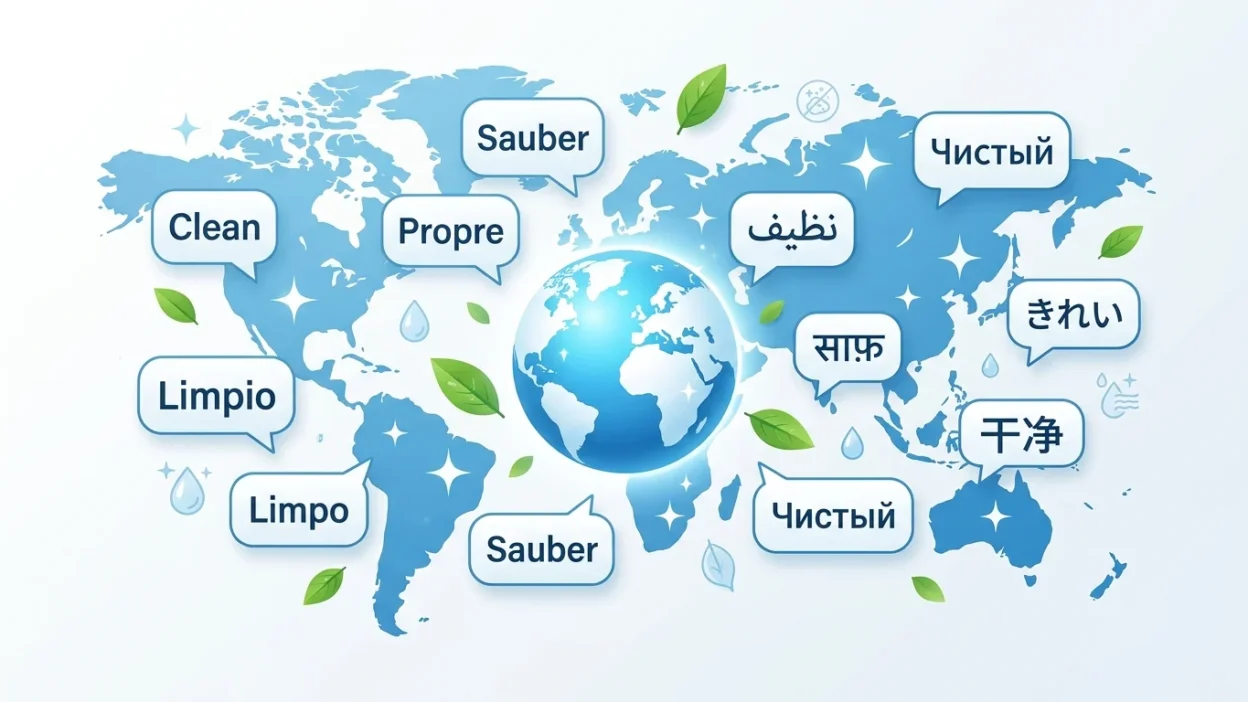
Clean in Different Languages Around the World
| Language | Native Word | Pronunciation |
| English | clean | kleen |
| Spanish | limpio | LEEM-pee-oh |
| French | propre | prop |
| German | sauber | ZOW-ber |
| Italian | pulito | poo-LEE-toh |
| Portuguese | limpo | LEEM-poo |
| Dutch | schoon | skhoon |
| Russian | чистый | CHEE-sty |
| Arabic | نظيف | na-ZEEF |
| Hindi | साफ़ | saaf |
| Bengali | পরিষ্কার | po-rish-KAAR |
| Urdu | صاف | saaf |
| Chinese (Mandarin) | 干净 | gan-jing |
| Japanese | きれい | kee-reh-ee |
| Korean | 깨끗한 | kkae-keut-han |
| Turkish | temiz | teh-MEEZ |
| Persian | تمیز | tah-MEEZ |
| Greek | καθαρός | ka-tha-ROS |
| Polish | czysty | CHIS-tee |
| Czech | čistý | CHEES-tee |
| Slovak | čistý | CHEES-tee |
| Hungarian | tiszta | TIS-tah |
| Romanian | curat | koo-RAT |
| Swedish | ren | rehn |
| Norwegian | ren | rehn |
| Danish | ren | rehn |
| Finnish | puhdas | POO-hdas |
| Ukrainian | чистий | CHYS-tyi |
| Thai | สะอาด | sa-aat |
| Vietnamese | sạch | sahk |
| Indonesian | bersih | ber-SEEH |
| Malay | bersih | BER-sih |
| Filipino | malinis | mah-LEE-nis |
| Swahili | safi | SAH-fee |
| Hebrew | נקי | nah-KEE |
| Latin | mundus | MOON-doos |
| Tamil | சுத்தம் | SUT-tham |
| Sanskrit | शुद्ध | SHUD-dha |
| Marathi | स्वच्छ | SWUH-chha |
| Gujarati | સ્વચ્છ | SWUH-chha |
| Nepali | सफा | sa-FA |
| Khmer | ស្អាត | sa-aat |
| Lao | ສະອາດ | sa-aat |
| Sinhala | පිරිසිදු | pi-ri-si-doo |
| Serbian | чист | CHEEST |
| Croatian | čist | CHEEST |
| Bulgarian | чист | CHEEST |
| Lithuanian | švarus | SHVAH-roos |
| Estonian | puhas | POO-has |
| Irish | glan | glan |
| Welsh | glân | GLAAN |
Why Clean Vocabulary Matters
Learning clean in different languages is helpful because the word appears in daily life far more often than many learners expect. You may see it on cleaning products, in hotel instructions, in health and safety notices, or in descriptions of food and spaces. Once you know the term, you can scan signs and conversations faster.
It also supports smarter vocabulary learning. Clean often connects to related words like hygiene, purity, tidy, wash, and fresh. When you study one useful word across many languages, you build a stronger mental network. That makes it easier to remember new phrases and understand how meaning shifts from one culture to another.
Clean as an Adjective and a Verb
One reason clean in different languages can feel tricky is that the English word works in more than one way. It can describe something already neat, such as a clean room, or an action, such as to clean the table. Many languages separate those ideas with different words or grammatical forms.
For that reason, translations are not always one-to-one. Spanish often uses limpio for the adjective and limpiar for the verb. Other languages may use one root with different endings, while some rely on context. Paying attention to the sentence around the word helps you choose the right form and avoid awkward phrasing.
Pronunciation Tips for Learners
Pronunciation matters when you study clean in different languages because the word often changes sound patterns that are new to English speakers. Some languages use crisp consonants, while others stretch the vowel or soften the ending. Breaking the word into syllables can make it easier to remember.
Say the translation slowly first, then speed up after you feel comfortable. For example, German sauber sounds like “ZOW-ber,” and French propre is short and clipped. If a word includes unfamiliar letters or accents, listen for stress. The stressed syllable is usually the one that sounds strongest and most natural.
How Context Changes the Meaning
Clean in different languages does not always mean the same thing in every situation. In some cases, it means physically free from dirt. In others, it can mean pure, respectful, polished, safe, or even morally upright. That is why context matters so much.
A clean street, clean water, and a clean design each call for slightly different vocabulary in some languages. For learners, the safest method is to check example sentences. Once you see the word in context, the translation becomes easier to use correctly. Context turns memorization into real understanding.
Clean in Everyday Phrases
Clean in different languages becomes more useful when you see it inside everyday phrases. Travelers may hear instructions like “keep this area clean,” “wash and clean your hands,” or “the room is clean.” In restaurants, schools, hospitals, and homes, the word appears constantly.
You will also notice related expressions such as “clean water,” “clean clothes,” “clean up,” and “clean and tidy.” These phrases help you recognize whether the language uses a noun, adjective, or verb. Learning the word alone is a good start, but learning it in common phrases makes your vocabulary far more practical.
Common Mistakes to Avoid
A common mistake when studying clean in different languages is assuming every translation matches English exactly. Some learners pick the adjective when the sentence needs a verb, or they choose the verb when the language prefers a descriptive form. That can make a sentence sound unnatural.
Another mistake is ignoring gender, number, or formality rules. In many languages, the word may change depending on the noun it describes or the social setting. To avoid confusion, learn a short example sentence with each translation. That approach is more reliable than memorizing a single isolated word.
Easy Ways to Remember the Translations
The best way to remember clean in different languages is to connect the word with a visual image. Picture a shiny table, a fresh shirt, or a sparkling room, then repeat the translation aloud. Associating meaning with an image helps the word stick faster.
You can also group translations by sound or language family. For example, several Slavic languages use a similar root, and several Scandinavian languages share the word ren. Flashcards, voice notes, and short daily reviews work well too. Repetition in small amounts is usually more effective than long study sessions.
Practical Uses for Travel, Study, and Content
Knowing clean in different languages is practical for travel, school, translation, and content creation. Travelers may need to ask for a clean room, understand a cleanliness notice, or read labels on products. Students may encounter the word in language classes, reading passages, or conversation practice.
Writers and creators also benefit from this vocabulary because it helps them localize content more naturally. A simple word like clean can shape product descriptions, hygiene guides, and travel articles. When you understand its forms, you can write with more accuracy and sound more fluent in multilingual settings.
Key Takeaways
- Clean in different languages can mean neat, pure, or free from dirt.
- Many languages use different forms for the adjective and the verb.
- Context is essential for choosing the right translation.
- Pronunciation varies widely, so syllable practice helps.
- Learning the word in phrases makes it easier to remember and use.
Conclusion
Learning clean in different languages is a simple way to build stronger vocabulary and better cultural awareness. The word may look small, but it appears in travel, health, home, and everyday communication more often than people expect.
Once you recognize the translations, pronunciation patterns, and sentence context, clean in different languages becomes easier to understand and use naturally. That extra confidence can make reading, speaking, and translation feel much smoother across many languages.
Frequently Asked Questions
1. What does clean mean in different languages?
Clean in different languages usually refers to a word meaning neat, free from dirt, or pure. The exact translation changes by grammar and context, so some languages use separate forms for the adjective and the verb.
2. Is there one universal translation for clean?
No, there is no single universal translation. Many languages use different words depending on whether you mean “clean” as an adjective, “to clean” as a verb, or “clean” in a figurative sense such as pure or safe.
3. Why do some translations look very different?
Some translations look different because languages organize meaning in different ways. A word may change by gender, tense, or sentence structure, and some languages prefer short descriptive words while others use forms built from verb roots.
4. How can I remember clean in different languages faster?
The fastest way is to learn the word in a short phrase and repeat it with an image in mind. Flashcards, audio practice, and daily review also help. Grouping similar-sounding languages can make memorization easier.
5. Where is this word most useful in real life?
This word is especially useful in travel, school, hospitality, health, and product labeling. You may see it in hotel rooms, cleaning instructions, food packaging, safety signs, and daily conversation about tidiness or hygiene.

Michael Wyatt creates compelling fiction featuring dynamic characters, emotional depth, and engaging plots. His storytelling combines creativity with relatable experiences, leaving readers entertained, inspired, and eager for more.