
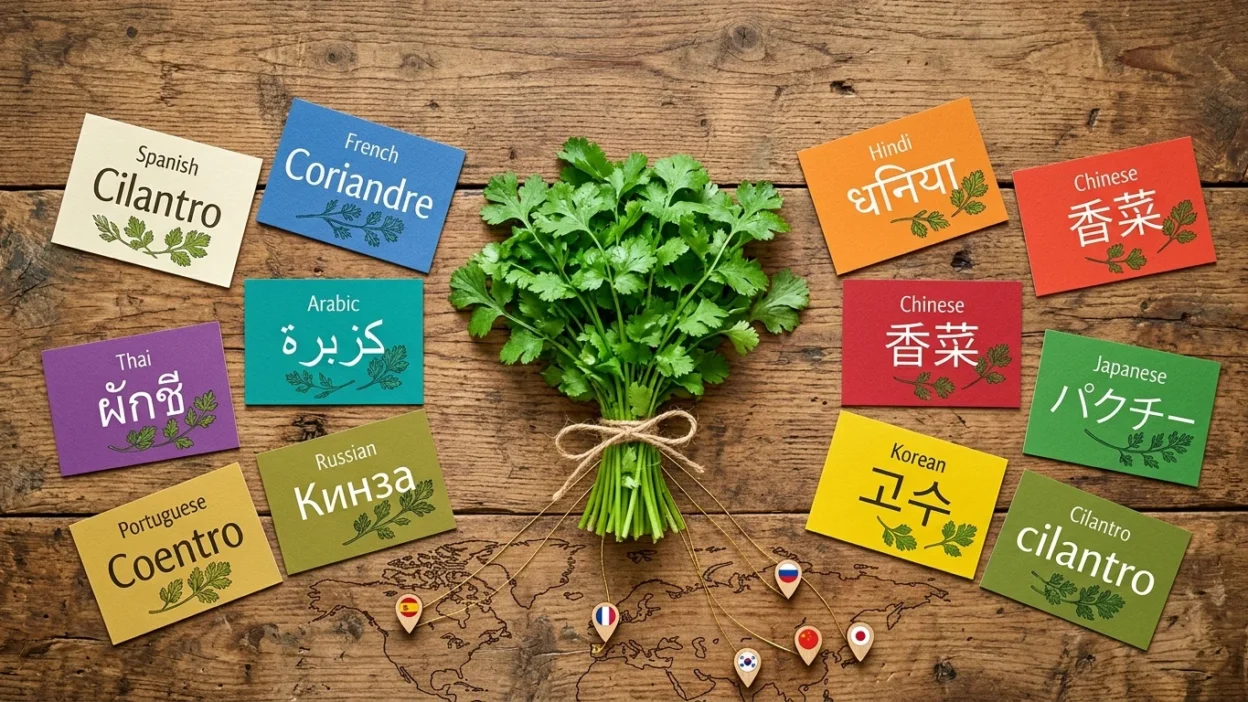
Cilantro in different languages is a fascinating topic for language learners, travelers, home cooks, and food enthusiasts. Whether you’re reading international recipes, shopping in foreign markets, or exploring new cultures, knowing cilantro in different languages helps you communicate more confidently and understand local cuisines.
Across the world, cilantro is known by many names, although the herb remains a favourite ingredient in countless traditional dishes. This guide explores cilantro in different languages, pronunciation tips, cultural significance, and practical ways to remember the word in 50 different languages.
Quick Answer
Cilantro in different languages varies widely because each culture has its own name for the herb. Learning these translations helps with international cooking, travel, language learning, and understanding recipes from around the world.
Cilantro in Different Languages Around the World
| Language | Native Word | Pronunciation |
| English | Cilantro | sih-LAN-troh |
| Spanish | Cilantro | see-LAHN-troh |
| French | Coriandre | koh-ree-AHN-druh |
| German | Koriander | koh-ree-AN-der |
| Italian | Coriandolo | koh-ree-AN-doh-loh |
| Portuguese | Coentro | koo-EN-troo |
| Dutch | Koriander | koh-ree-AN-der |
| Swedish | Koriander | koh-ree-AN-der |
| Norwegian | Koriander | koh-ree-AN-der |
| Danish | Koriander | koh-ree-AN-der |
| Finnish | Korianteri | koh-ree-AHN-teh-ree |
| Polish | Kolendra | koh-LEN-drah |
| Czech | Koriandr | koh-ree-AHN-dr |
| Slovak | Koriander | koh-ree-AN-der |
| Hungarian | Koriander | koh-ree-AHN-der |
| Romanian | Coriandru | koh-ree-AHN-droo |
| Bulgarian | Кориандър | koh-ree-AN-dur |
| Serbian | Коријандар | koh-ree-YAN-dar |
| Croatian | Korijander | koh-ree-YAN-der |
| Slovenian | Koriander | koh-ree-AN-der |
| Russian | Кинза | KEEN-zah |
| Ukrainian | Кінза | KEEN-zah |
| Belarusian | Кінза | KEEN-zah |
| Greek | Κόλιανδρος | KOH-lee-an-dros |
| Turkish | Kişniş | kish-NEESH |
| Arabic | كزبرة | kuz-BAR-ah |
| Hebrew | כוסברה | koos-BEH-rah |
| Persian | گشنیز | gosh-NEEZ |
| Hindi | धनिया | DHA-nee-ya |
| Urdu | دھنیا | DHA-nee-ya |
| Punjabi | ਧਨੀਆ | dha-NEE-aa |
| Bengali | ধনে পাতা | DHO-nay PA-ta |
| Gujarati | ધાણા | DHA-na |
| Marathi | कोथिंबीर | koh-thim-BEER |
| Tamil | கொத்தமல்லி | koth-tha-MAL-lee |
| Telugu | కొత్తిమీర | koth-thee-MEE-rah |
| Kannada | ಕೊತ್ತಂಬರಿ | koth-tham-ba-ree |
| Malayalam | മല്ലിയില | mal-lee-YEE-la |
| Sinhala | කොත්තමල්ලි | koth-tha-MAL-lee |
| Thai | ผักชี | pak-CHEE |
| Vietnamese | Rau mùi | row MOO-ee |
| Indonesian | Ketumbar | keh-TOOM-bar |
| Malay | Daun ketumbar | DA-un keh-TOOM-bar |
| Filipino | Kulantro | koo-LAN-troh |
| Chinese (Simplified) | 香菜 | SHYANG-tsai |
| Japanese | パクチー | pah-koo-CHEE |
| Korean | 고수 | GO-soo |
| Swahili | Giligilani | gee-lee-gee-LAH-nee |
| Afrikaans | Koljander | kol-YAN-der |
| Icelandic | Kóríander | KOH-ree-an-der |
Why Learn Cilantro in Different Languages?
Knowing the word for cilantro in different languages makes international communication easier. If you enjoy travelling, ordering food abroad becomes much simpler when you recognise the local name of common herbs. This skill also helps when reading multilingual recipes or visiting local grocery stores.
Language learners benefit because food vocabulary appears frequently in everyday conversations. Learning practical words like cilantro builds confidence and expands vocabulary naturally while connecting language with real-life experiences.
Cultural Significance of Cilantro Worldwide
Cilantro has been used in cooking for thousands of years. It plays an important role in Mexican, Indian, Thai, Middle Eastern, Vietnamese, and Latin American cuisines. Although its name changes from one country to another, its fresh flavour remains highly valued.
Many cultures also associate cilantro with traditional remedies and family recipes passed down through generations. Understanding its local name helps people appreciate the cultural traditions behind regional dishes and culinary heritage.
How to Pronounce Cilantro in Different Languages
Pronunciation varies depending on each language’s sounds and writing system. Some names resemble “coriander,” while others sound completely different, such as the Russian “Kinza” or the Japanese “Pakuchi.”
Listening to native speakers and repeating the words aloud improves pronunciation quickly. Breaking each word into smaller syllables also makes unfamiliar names easier to remember and pronounce correctly.
Common Uses of Cilantro Around the World
Cilantro appears in countless recipes including soups, curries, tacos, salads, salsas, noodle dishes, and rice meals. Fresh leaves are often added just before serving to preserve their bright flavour and aroma.
Some countries mainly use the leaves, while others also cook with coriander seeds, which have a completely different taste. Learning both terms helps avoid confusion when following international recipes.
Easy Tips to Remember Cilantro in Different Languages
Grouping similar languages together makes memorisation much easier. For example, many European languages use words closely related to “coriander,” while several South Asian languages share similar versions of “Dhaniya.”
Creating flashcards, labelling herbs in your kitchen, or practising vocabulary during cooking sessions can reinforce your memory. Regular repetition helps these words become part of your everyday vocabulary.
Common Mistakes When Using Cilantro Names
One common mistake is confusing cilantro with coriander. In American English, cilantro usually refers to the fresh leaves, while coriander often refers to the seeds. In many other English-speaking countries, coriander describes both.
Another mistake is assuming every country uses the same translation. Local dialects and regional vocabulary sometimes produce different names for the same herb, making context important during conversations.
When Should You Use These Translations?
These translations are useful when travelling, shopping at international markets, reading foreign cookbooks, or speaking with native speakers. They also help students studying languages through practical everyday vocabulary.
Professional chefs, food bloggers, translators, and cultural researchers often use multilingual food terms to improve communication and create accurate content for global audiences.
Benefits of Learning Food Vocabulary in Different Languages
Food vocabulary is among the most practical language skills anyone can learn. Since everyone eats, these words appear regularly in conversations, menus, recipes, and shopping lists.
Learning words like cilantro expands your vocabulary while introducing cultural traditions from around the world. It also improves reading comprehension and helps you engage more confidently with people from different backgrounds.
Interesting Facts About Cilantro
Cilantro is one of the oldest cultivated herbs in history and has been used for over 3,000 years. Ancient civilisations valued it for both cooking and traditional herbal practices.
Interestingly, people’s opinions about cilantro vary greatly. Some love its fresh citrus-like flavour, while others perceive it differently due to inherited genetic traits affecting taste perception.
Key Takeaways
- Cilantro has unique names across more than 50 languages.
- Learning food vocabulary improves travel and communication.
- Many cultures use cilantro in traditional recipes.
- Pronunciation practice helps build language confidence.
- Understanding local herb names makes international cooking easier.
Conclusion
Learning cilantro in different languages is a practical way to expand your vocabulary while discovering cultures through food. Whether you enjoy travelling, cooking international dishes, or studying new languages, knowing these translations helps you communicate more naturally. Since cilantro appears in cuisines across the globe, recognising its local names makes shopping, reading recipes, and speaking with native speakers much easier. Keep practising these words, and you’ll build useful language skills that serve you in everyday situations around the world.
Frequently Asked Questions
1. Is cilantro the same as coriander?
Yes. Cilantro and coriander come from the same plant. In American English, cilantro usually refers to the fresh leaves, while coriander refers to the dried seeds. In many other countries, coriander is the general name for both parts of the plant.
2. Why does cilantro have different names in different languages?
Every language develops its own vocabulary based on history, culture, and regional influences. As cilantro spread across continents through trade and agriculture, local communities created their own names, many of which are still used today.
3. Which languages use words similar to coriander?
Many European languages use closely related words derived from the same historical origin. French, German, Italian, Dutch, Swedish, Danish, Norwegian, Romanian, and several others have names that closely resemble “coriander.”
4. Can learning herb names improve language skills?
Yes. Food vocabulary is practical because it appears in daily conversations, restaurant menus, shopping lists, and recipes. Learning common herbs like cilantro builds useful vocabulary that you can apply immediately in real-life situations.
5. Why is cilantro important in international cooking?
Cilantro adds fresh flavour and aroma to many traditional dishes worldwide. It is widely used in Mexican, Indian, Thai, Middle Eastern, Vietnamese, and Latin American cuisines, making it one of the most recognised herbs across different cultures.

Brooklyn Walker is a contemporary writer known for engaging storytelling, memorable characters, and emotionally rich narratives. Their work inspires readers through creativity, imagination, meaningful themes, and compelling literary style.