
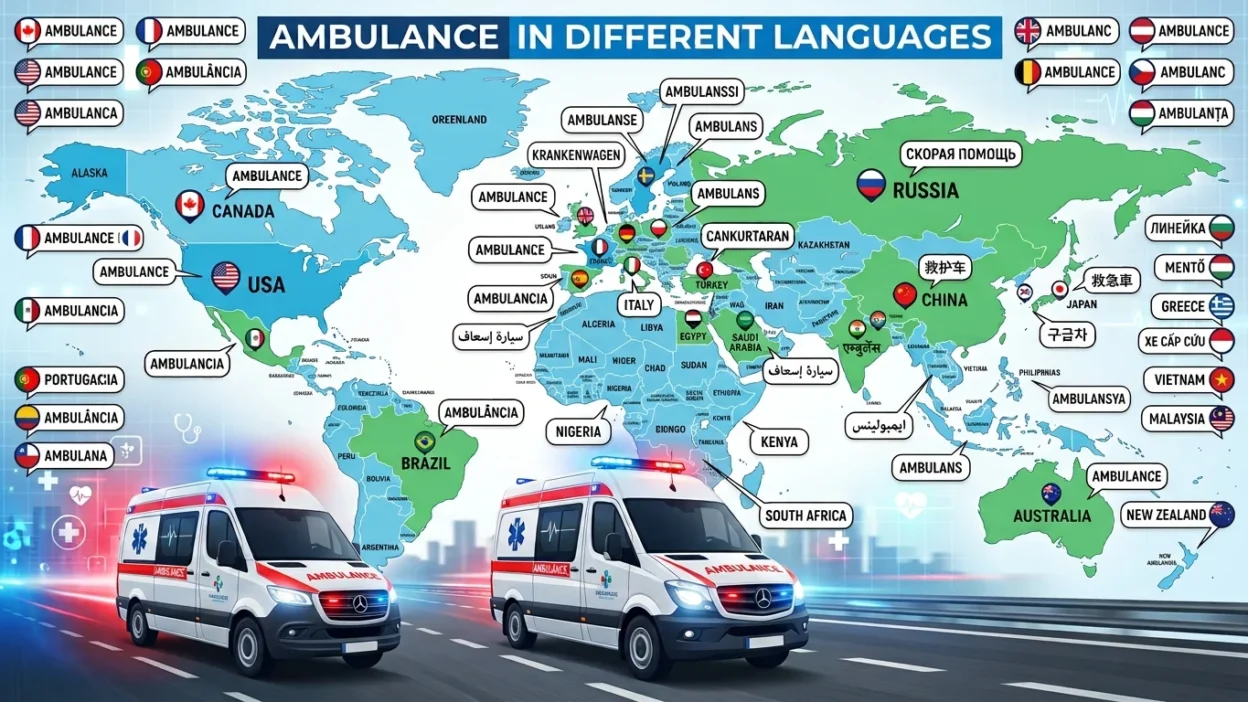
An ambulance in different languages is one of the most useful words to learn when travelling, studying, or communicating across cultures. Knowing how to say ambulance in different languages can help you respond quickly during emergencies and improve your understanding of international healthcare vocabulary.
Whether you are learning a new language, preparing for international travel, or simply expanding your vocabulary, understanding ambulance in different languages provides practical value. This guide covers translations, pronunciations, cultural insights, and useful learning tips to help you remember this important word.
Quick Answer
The word ambulance in different languages refers to emergency medical transport vehicles across the world. While pronunciation and spelling differ by language, many languages use similar terms derived from Latin or French, making them easier to recognise internationally.
Ambulance in Different Languages Around the World
| Language | Native Word | Pronunciation |
| English | Ambulance | AM-byuh-luhns |
| Spanish | Ambulancia | ahm-boo-LAHN-see-ah |
| French | Ambulance | ahm-boo-LAHNS |
| German | Krankenwagen | KRAHN-ken-vah-gen |
| Italian | Ambulanza | ahm-boo-LAHN-tsah |
| Portuguese | Ambulância | ahm-boo-LAHN-see-ah |
| Dutch | Ambulance | AM-bu-lahn-se |
| Swedish | Ambulans | AM-boo-lans |
| Norwegian | Ambulanse | AM-boo-lahn-seh |
| Danish | Ambulance | AM-boo-lahn-se |
| Finnish | Ambulanssi | AM-boo-LAHN-see |
| Icelandic | Sjúkrabíll | SHOO-kra-beetl |
| Polish | Ambulans | am-BOO-lans |
| Czech | Sanitka | sa-NEET-ka |
| Slovak | Sanitka | sa-NEET-ka |
| Hungarian | Mentőautó | MEN-tuh-ow-too |
| Romanian | Ambulanță | ahm-boo-LAHN-tsuh |
| Bulgarian | Линейка | lee-NAY-ka |
| Serbian | Хитна помоћ | HEET-na PO-moach |
| Croatian | Hitna pomoć | HEET-na PO-moach |
| Slovenian | Reševalno vozilo | re-SHEH-val-no vo-ZEE-lo |
| Russian | Скорая помощь | SKO-ra-ya PO-mo-shch |
| Ukrainian | Швидка допомога | SHVYD-ka do-po-MO-ha |
| Belarusian | Хуткая дапамога | HOOT-ka-ya da-pa-MO-ha |
| Greek | Ασθενοφόρο | as-the-no-FO-ro |
| Turkish | Ambulans | am-boo-LANS |
| Arabic | سيارة إسعاف | sa-ya-ra is-AAF |
| Hebrew | אמבולנס | am-boo-LANS |
| Persian | آمبولانس | am-boo-LAANS |
| Urdu | ایمبولینس | em-boo-LENS |
| Hindi | एम्बुलेंस | em-boo-LENS |
| Bengali | অ্যাম্বুলেন্স | am-boo-LENS |
| Punjabi | ਐਂਬੂਲੈਂਸ | em-boo-LENS |
| Gujarati | એમ્બ્યુલન્સ | em-byoo-LENS |
| Marathi | ॲम्ब्युलन्स | am-byoo-LENS |
| Tamil | ஆம்புலன்ஸ் | AAM-boo-lans |
| Telugu | అంబులెన్స్ | am-boo-lens |
| Kannada | ಆಂಬುಲೆನ್ಸ್ | AAM-boo-lens |
| Malayalam | ആംബുലൻസ് | AAM-boo-lans |
| Sinhala | ගිලන් රථය | gi-LAN ra-tha-ya |
| Nepali | एम्बुलेन्स | em-boo-LENS |
| Chinese (Simplified) | 救护车 | JYOH-hoo-chuh |
| Japanese | 救急車 | KYOO-kyoo-sha |
| Korean | 구급차 | goo-geup-cha |
| Vietnamese | Xe cứu thương | seh KOO thoo-ong |
| Thai | รถพยาบาล | rot pha-yaa-baan |
| Indonesian | Ambulans | am-boo-LANS |
| Malay | Ambulans | am-boo-LANS |
| Swahili | Ambulensi | am-boo-LEN-see |
| Afrikaans | Ambulans | am-boo-LANS |
Why Learn the Word “Ambulance” in Different Languages?
Learning this essential emergency word can make a real difference while travelling or communicating abroad. In stressful situations, knowing the local word for ambulance helps you explain emergencies more quickly and understand conversations with local residents or emergency responders.
It also improves language confidence and expands your practical vocabulary. Unlike many words used only in everyday conversation, this term has genuine value because it relates to health, safety, and emergency services that everyone may need at some point.
Cultural Importance of Emergency Medical Services
Although healthcare systems differ worldwide, ambulances represent rapid medical assistance in nearly every country. Many societies view ambulance services as a symbol of public safety and emergency care, making the word universally recognised.
Different countries may operate ambulances through hospitals, fire departments, government agencies, or private organisations. Learning local emergency vocabulary shows respect for another culture while helping you navigate unfamiliar situations with greater confidence.
How to Pronounce Ambulance in Different Languages
Correct pronunciation improves communication, especially during emergencies. Start by listening carefully to native speakers and practise repeating each word slowly before increasing your speed.
Many European languages use words similar to “ambulance,” making pronunciation relatively straightforward. Other languages have completely different words, so focusing on syllables instead of individual letters makes learning much easier and more accurate.
Common Situations Where You May Need This Word
Travellers often need emergency vocabulary while visiting unfamiliar places. Knowing the local word for ambulance helps when asking for assistance, speaking with hotel staff, contacting local authorities, or helping someone who becomes ill.
Students, healthcare professionals, interpreters, and language learners also benefit from understanding this important term. It is one of the first emergency-related words recommended in many travel phrasebooks because of its practical importance.
Related Emergency Words to Learn
Alongside ambulance, learning a few additional emergency terms builds a stronger survival vocabulary. Useful words include hospital, doctor, nurse, emergency, police, fire department, medicine, patient, injury, and help.
These words frequently appear together in healthcare conversations. Understanding them allows you to communicate more clearly and respond effectively if medical assistance is required while travelling or interacting with international visitors.
Easy Tips to Remember Ambulance in Different Languages
Group similar languages together when studying vocabulary. For example, many Romance languages use words closely related to “ambulance,” making them easier to memorise as a family rather than individually.
Create flashcards, practise daily, and repeat the words aloud. Associating each translation with its country’s flag or a memorable image also strengthens long-term memory and improves pronunciation over time.
Interesting Facts About the Word “Ambulance”
The modern word “ambulance” originated from Latin roots associated with movement and later became linked with mobile medical services. Over time, many languages adopted similar spellings while adapting pronunciation to local speech patterns.
Today, despite differences in language, the purpose remains identical across cultures: providing rapid transportation and emergency medical care. This shared meaning makes ambulance one of the world’s most universally understood healthcare terms.
Benefits of Learning Different Languages Through Everyday Vocabulary
Learning practical words like ambulance makes language study more meaningful than memorising random vocabulary. Everyday terms are easier to remember because learners can immediately imagine real-life situations where they might use them.
Practical vocabulary also improves confidence when travelling, meeting international friends, or working in multicultural environments. Building knowledge through useful words creates a strong foundation for expanding communication skills across multiple languages.
Key Takeaways
- Learning ambulance in different languages improves emergency communication.
- Many languages use similar words with different pronunciations.
- Practical vocabulary supports safer international travel.
- Pronunciation practice increases speaking confidence.
- Emergency words are valuable for every language learner.
Conclusion
Learning ambulance in different languages is both practical and educational. It helps travellers, students, professionals, and language enthusiasts communicate more effectively during important situations. Because emergency vocabulary is universally useful, mastering these translations offers real-world benefits beyond ordinary language learning. By practising pronunciation, understanding cultural differences, and remembering related healthcare terms, you can expand your multilingual vocabulary while becoming better prepared for international travel and everyday communication across cultures.
Frequently Asked Questions
1. Why should I learn ambulance in different languages?
Learning ambulance in different languages helps you communicate during emergencies while travelling or living abroad. It also improves practical vocabulary, increases confidence when speaking with native speakers, and prepares you for situations where quick communication can make a meaningful difference.
2. Are the words for ambulance similar in every language?
No. Many European languages use words closely related to “ambulance,” while others use completely different native terms. Although spelling and pronunciation vary, every language has a recognised word that refers to emergency medical transportation.
3. What is the easiest way to remember ambulance in multiple languages?
Study similar languages together, practise pronunciation daily, use flashcards, and connect each translation with a country or visual image. Repeating the words regularly helps transfer them from short-term memory into long-term vocabulary.
4. Is ambulance an important travel word?
Yes. Ambulance is one of the most important emergency words for international travellers. Knowing how to recognise and say it can help you seek medical assistance quickly and communicate more effectively with local people during urgent situations.
5. Can learning emergency vocabulary improve language skills?
Absolutely. Emergency vocabulary introduces practical, frequently recognised words that strengthen communication abilities. These useful terms build confidence, improve listening comprehension, and provide a solid foundation for expanding vocabulary in many different languages.

Paisley Cooper is celebrated for expressive writing and imaginative narratives. Their stories emphasize courage, friendship, and personal growth, creating meaningful connections with readers through engaging and inspiring literature.