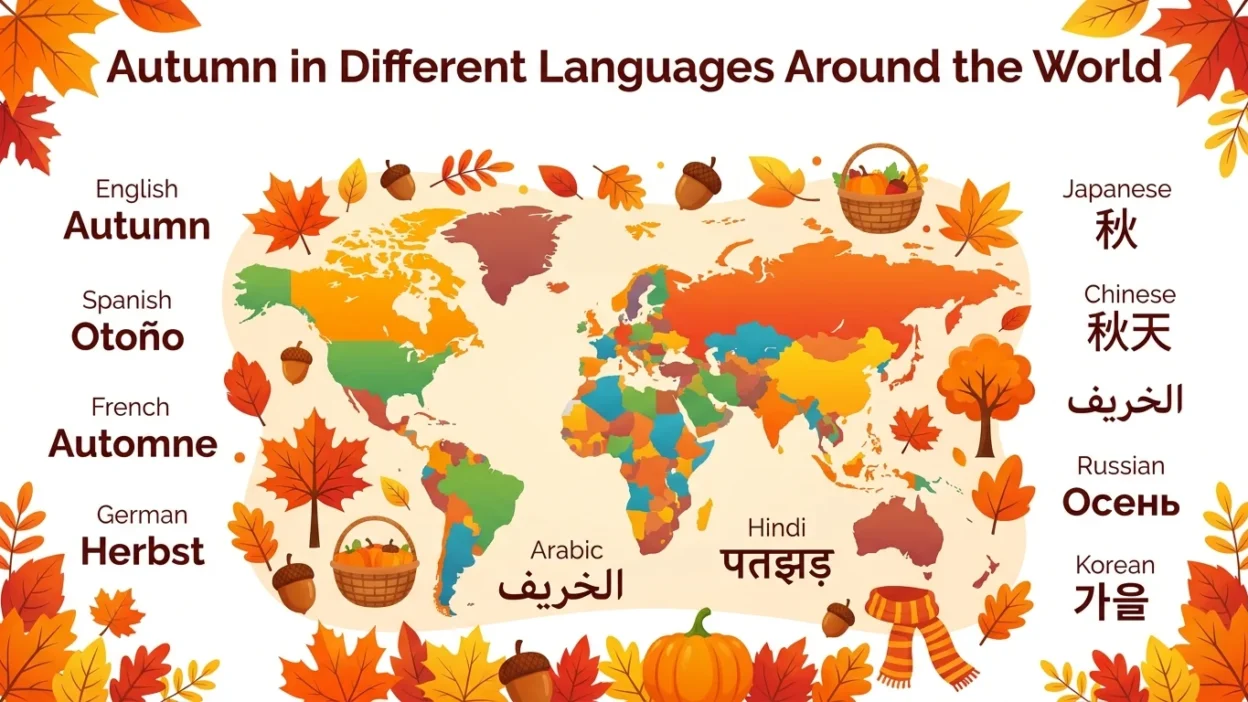
Autumn in different languages is a simple phrase, but it opens a wide window into how people describe the same season in unique ways. From the crisp air of Europe to the harvest traditions of Asia, the words for autumn reveal history, culture, and sound patterns.
Learning autumn in different languages also helps with travel, language study, and seasonal conversations. When you know how people say autumn in different regions, you can spot connections between related languages, pronounce new words more confidently, and remember vocabulary faster.
Quick Answer
Autumn in different languages refers to the seasonal word used for fall across cultures. Translators, travelers, and language learners use these terms to build vocabulary, improve pronunciation, and understand seasonal traditions.
Autumn in Different Languages Around the World
| Language | Native Word | Pronunciation |
| English | autumn | aw-tum |
| Spanish | otoño | oh-TOH-nyoh |
| French | automne | oh-TOM |
| German | Herbst | hehrpst |
| Italian | autunno | ow-TOON-no |
| Portuguese | outono | oh-TOH-noo |
| Dutch | herfst | hehrfst |
| Swedish | höst | huhst |
| Norwegian | høst | huhst |
| Danish | efterår | EF-ter-ore |
| Finnish | syksy | SUEK-sue |
| Polish | jesień | YEH-shyen |
| Czech | podzim | POD-zim |
| Slovak | jeseň | YEH-sen |
| Hungarian | ősz | uhss |
| Romanian | toamnă | toh-AHM-nuh |
| Greek | φθινόπωρο | fthi-NO-poh-ro |
| Turkish | sonbahar | sohn-bah-HAHR |
| Russian | осень | OH-sen |
| Ukrainian | осінь | OH-seen |
| Bulgarian | есен | YEH-sen |
| Serbian | јесен | YEH-sen |
| Croatian | jesen | YEH-sen |
| Slovenian | jesen | YEH-sen |
| Albanian | vjeshtë | VYESH-tuh |
| Arabic | الخريف | al-kha-REEF |
| Hebrew | סתיו | stiv |
| Persian | پاییز | pah-yeez |
| Hindi | पतझड़ | pat-ZHAD |
| Bengali | শরৎ | shoh-ROT |
| Urdu | خزاں | kha-ZAAN |
| Punjabi | ਪਤਝੜ | pat-ZHAR |
| Tamil | இலையுதிர் காலம் | ilai-yoo-THEER kaa-lam |
| Telugu | శరదృతువు | sha-ra-DROO-tu-vu |
| Kannada | ಶರತ್ಕಾಲ | sha-rat-KAA-la |
| Malayalam | ശരത്കാലം | sha-ra-tha-KAA-lam |
| Marathi | शरद ऋतू | sha-rad ri-TOO |
| Gujarati | પાનખર | paa-na-khar |
| Assamese | শৰৎ | sho-rot |
| Thai | ฤดูใบไม้ร่วง | reu-doo bai-mai roong |
| Vietnamese | mùa thu | moo-ah thoo |
| Indonesian | musim gugur | moo-sim goo-goor |
| Malay | musim luruh | moo-seem loo-rooh |
| Filipino | taglagas | tag-lah-gas |
| Japanese | 秋 | a-ki |
| Korean | 가을 | ga-eul |
| Chinese | 秋天 | chyoo-tyen |
| Icelandic | haust | howst |
| Irish | fómhar | FOH-war |
| Welsh | hydref | HUD-rev |
Why Autumn Vocabulary Matters
Knowing autumn vocabulary helps you recognize patterns in language families and makes seasonal communication easier. In many languages, the word for autumn connects to harvest, falling leaves, or the change in weather. That connection gives learners a memorable clue about meaning.
This is useful for students, travelers, and anyone who enjoys language learning. If you hear a word that sounds like “harvest” or “fall,” you can often guess the season even before checking a dictionary. That kind of pattern recognition makes vocabulary stick faster and feels more natural in real conversations.
Cultural Significance of Autumn Words
Autumn is more than a season; it often reflects a culture’s relationship with farming, weather, and celebration. In some regions, the word for autumn links closely to harvest time. In others, it points to falling leaves or the cool shift after summer.
That cultural layer matters because language is never only about translation. When you learn how a community names autumn, you also learn what it values. A word can point to food, festivals, school calendars, or weather patterns, giving you a clearer picture of how people live throughout the year.
Pronunciation Tips for Common Autumn Words
Pronouncing autumn words correctly becomes easier when you break them into small sound units. Start by listening for the stressed syllable. For example, Spanish otoño places stress in the middle, while French automne is short and smooth.
Try reading the word slowly, then speed up once the sound feels comfortable. Pay attention to letters that may not sound the way they look, especially in French, German, and Slavic languages. Repeating the word out loud five or six times helps your mouth remember the rhythm. Short practice sessions work better than one long session.
Seasonal Words and Phrases That Go With Autumn
Autumn vocabulary becomes more useful when you learn the words around it. Common companions include leaves, harvest, weather, cool breeze, pumpkin, and school term. These phrases help you build real sentences instead of memorizing a single term.
For example, you might say “autumn leaves,” “autumn festival,” or “the autumn season.” In many languages, seasonal words also appear in greetings, poems, and holiday expressions. Learning them together gives you a stronger memory chain. One word leads to another, and soon you can speak about the season in a fuller, more natural way.
How Travelers Use Autumn Vocabulary
Travelers often use seasonal vocabulary to understand weather reports, local events, and festival schedules. If you are visiting a country in September or October, knowing the word for autumn can help you follow menus, signs, brochures, and guided tours.
It also helps when locals talk about seasonal clothing, harvest food, or holiday plans. Even a single word can make a conversation warmer and easier. When you know the season in the local language, you show respect and curiosity. That small effort often leads to better interactions and more memorable travel experiences.
Easy Ways to Memorize Translations
The easiest way to memorize autumn translations is to group similar sounds together. Words like jesen, jeseň, and jesień are easy to remember because they look and sound related. Other words, such as autumnus or automne, connect through older language roots.
You can also use flashcards, color coding, or seasonal images. Pair each word with a picture of leaves, rain, or harvest fields. Saying the word while looking at the image creates a stronger memory link. A few minutes a day is enough to build lasting recall, especially if you review the same words regularly.
Common Mistakes to Avoid
A common mistake is assuming every language uses one perfect equivalent for “autumn.” Some languages prefer a word closer to “fall,” while others use a term related to harvest or the cool season. Using the wrong regional form can sound awkward in context.
Another mistake is focusing only on spelling. Pronunciation matters just as much because many autumn words contain sounds that do not exist in English. Learn the native rhythm, not just the letters. It also helps to check whether a language uses a formal term, a spoken term, or both, since everyday usage can vary.
Interesting Facts About Autumn Terms
Autumn words often show how languages developed around nature and farming. In several European languages, the word is close to the idea of harvest or the changing season. In East Asian languages, the term may be tied to the visual beauty of the season or the climate shift.
Another interesting detail is that some languages have both “autumn” and “fall” ideas, even if only one is commonly used. That variety makes seasonal vocabulary a fascinating window into culture. A simple word can preserve old customs, older word roots, and the way people have described nature for centuries.
Benefits of Learning Seasonal Vocabulary
Learning seasonal vocabulary strengthens your overall language skills because it touches daily life, culture, and conversation. Words like autumn are useful in travel, school, reading, and small talk. They also give you confidence when speaking about weather, holidays, and nature.
Seasonal words are often easy to remember because they connect to real experiences. You can see the leaves, feel the temperature change, and notice the weather shift. That makes the vocabulary practical and visual. Once you learn a few seasonal terms, other related words become easier to pick up too, which speeds up progress in any language.
Key Takeaways
- Autumn is a useful seasonal word to learn in many languages.
- Native terms often reflect harvest, weather, or falling leaves.
- Pronunciation becomes easier when you study stress and rhythm.
- Seasonal vocabulary helps with travel, reading, and daily conversation.
- Learning related words makes it easier to remember translations.
Conclusion
Autumn in different languages is more than a translation exercise. It shows how cultures describe the same season through harvest, weather, beauty, and tradition. By learning these words, you improve pronunciation, strengthen memory, and understand language patterns more clearly. Whether you are a traveler, student, or language lover, seasonal vocabulary gives you practical words you can use right away. The more autumn in different languages you learn, the more natural it becomes to connect language with the world around you.
Frequently Asked Questions
What does autumn mean in different languages?
Autumn means the season between summer and winter, but different languages describe it in different ways. Some use words related to harvest, while others focus on falling leaves or cooler weather. Learning these forms helps you understand both vocabulary and culture.
Is autumn the same as fall in every language?
Not exactly. In English, autumn and fall mean the same season, but other languages may use only one common term. Some languages also have regional preferences or poetic alternatives. Knowing the local word helps you sound more natural in conversation.
Why are some autumn words similar across languages?
Many autumn words are similar because languages borrow from shared roots or neighboring cultures. European languages, especially, often have related forms that developed from older language families. These patterns make it easier to recognize and remember translations.
How can I remember autumn in different languages faster?
Use visual memory, repetition, and grouped study. Pair each word with a picture of leaves, rain, or harvest scenes. Review a few words daily and say them aloud. Similar-sounding words are easier to remember when you study them together.
Where can I use autumn vocabulary in real life?
You can use autumn vocabulary in travel, seasonal greetings, classroom work, cultural reading, and everyday conversation. It is especially helpful when discussing weather, festivals, clothing, or nature. Even one seasonal word can make your speech feel more natural.

Michael Wyatt creates compelling fiction featuring dynamic characters, emotional depth, and engaging plots. His storytelling combines creativity with relatable experiences, leaving readers entertained, inspired, and eager for more.