Stories, movies, books, and presentations often finish with a simple phrase that signals completion. The end in different languages is an interesting topic because every language has its own way of expressing the conclusion of a story or event. Learning the end in different languages helps you appreciate global cultures while expanding your vocabulary. Whether you’re a traveler, language learner, writer, or translator, knowing the end in different languages adds both practical value and cultural awareness.
From classic novels to modern films, the phrase has been used for centuries to mark the closing of a narrative. Exploring the end in different languages also offers insight into pronunciation, writing systems, and cultural traditions that make every language unique.
Quick Answer
“The end” is a phrase used to indicate the conclusion of a story, movie, speech, or event. Different languages express this idea with unique words and pronunciations, reflecting their writing systems, grammar, and cultural traditions.
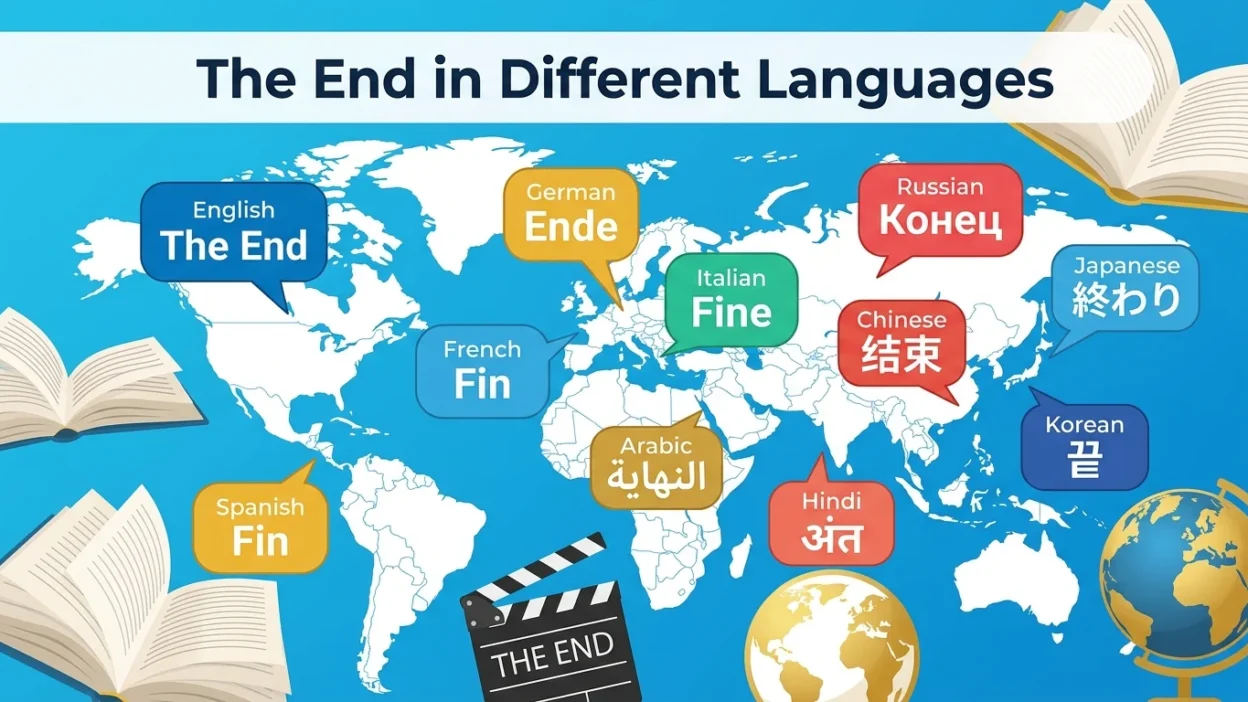
The End in Different Languages Around the World
| Language | Native Word | Pronunciation |
| English | The End | thee end |
| Spanish | Fin | feen |
| French | Fin | fan |
| German | Ende | EN-duh |
| Italian | Fine | FEE-nay |
| Portuguese | Fim | feeng |
| Dutch | Einde | EYEN-duh |
| Swedish | Slut | sloot |
| Norwegian | Slutt | sloot |
| Danish | Slut | sloot |
| Finnish | Loppu | LOP-poo |
| Icelandic | Endir | EN-dir |
| Irish | Deireadh | JER-ah |
| Welsh | Diwedd | DEE-weth |
| Polish | Koniec | KOH-niets |
| Czech | Konec | KOH-nets |
| Slovak | Koniec | KOH-niets |
| Hungarian | Vége | VAY-gheh |
| Romanian | Sfârșit | sfur-SHEET |
| Bulgarian | Край | kray |
| Russian | Конец | ka-NYETS |
| Ukrainian | Кінець | kee-NETS |
| Belarusian | Канец | ka-NYETS |
| Serbian | Крај | krai |
| Croatian | Kraj | krai |
| Slovenian | Konec | KOH-nets |
| Greek | Τέλος | TEH-los |
| Turkish | Son | sohn |
| Arabic | النهاية | an-ni-HA-ya |
| Hebrew | הסוף | ha-SOF |
| Persian | پایان | pa-YAN |
| Hindi | अंत | ant |
| Urdu | اختتام | ikh-ti-TAM |
| Bengali | শেষ | shesh |
| Punjabi | ਅੰਤ | ant |
| Gujarati | અંત | ant |
| Marathi | शेवट | SHE-vut |
| Tamil | முடிவு | mu-DEE-vu |
| Telugu | ముగింపు | mu-GIM-poo |
| Kannada | ಅಂತ್ಯ | an-TYA |
| Malayalam | അവസാനം | ava-SA-nam |
| Chinese (Simplified) | 结束 | jie-shoo |
| Japanese | 終わり | o-wa-ri |
| Korean | 끝 | kkeut |
| Thai | จบ | jop |
| Vietnamese | Kết thúc | ket took |
| Indonesian | Akhir | a-KHEER |
| Malay | Akhir | a-KHEER |
| Swahili | Mwisho | mwee-SHO |
| Esperanto | Fino | FEE-no |
Why Learn The End in Different Languages?
Learning how to say “the end” in multiple languages is useful for language enthusiasts, students, and travelers. It helps you recognize the conclusion of books, films, subtitles, and presentations in different countries.
Understanding simple closing words also builds confidence when learning a new language. Since common expressions are often remembered easily, they become stepping stones toward mastering more advanced vocabulary and improving overall communication skills.
Cultural Significance of Ending Expressions
Although many languages translate directly as “the end,” some cultures prefer expressions that imply completion, farewell, or fulfillment. Literature, cinema, and theater often reflect these traditions through their closing phrases.
Learning these differences deepens your appreciation for storytelling traditions around the world. It also shows how languages express finality while preserving unique cultural identities and historical influences.
Pronunciation Tips for Beginners
Correct pronunciation makes vocabulary more memorable. Start by listening to native speakers whenever possible and repeat the words slowly before increasing your speed.
Focus on difficult sounds that may not exist in your native language. Breaking longer words into smaller syllables helps improve pronunciation accuracy and boosts speaking confidence over time.
When to Use “The End”
The phrase commonly appears at the conclusion of books, films, fairy tales, speeches, and presentations. It clearly tells readers or audiences that the content has finished.
In everyday conversation, people usually use alternative expressions like “that’s all,” “finished,” or “it’s over.” Knowing the appropriate context helps you use each expression naturally.
Related Words You Should Learn
Besides learning “the end,” consider studying related words such as beginning, middle, finish, complete, conclusion, goodbye, farewell, and final chapter.
These connected terms improve your vocabulary while helping you understand books, conversations, and educational materials more effectively. Learning words in groups also makes them easier to remember.
Practical Uses for Travelers and Students
Travelers often encounter local books, museum exhibits, films, and cultural performances where ending phrases appear. Recognizing them improves comprehension without requiring advanced language skills.
Students studying foreign languages also benefit by expanding their vocabulary through common expressions. Small phrases like these create a strong foundation for reading and listening practice.
Easy Tips to Remember Different Words
Flashcards remain one of the simplest memory techniques. Write the native spelling on one side and the pronunciation on the other for quick review.
Grouping languages by region or language family also makes memorization easier. Daily repetition, reading aloud, and using the words in short sentences reinforce long-term learning.
Interesting Facts About Ending Words
Many languages borrow concepts of completion from ancient literary traditions, while others developed unique native expressions over centuries. Some words have remained almost unchanged for generations.
Interestingly, several European languages share similar spellings because of historical linguistic connections. Meanwhile, Asian and Middle Eastern languages often use entirely different writing systems while expressing the same universal idea.
Common Mistakes to Avoid
One common mistake is assuming every language uses a direct translation of “the end.” Some languages prefer words meaning “finish” or “completion” depending on context.
Another mistake is ignoring pronunciation. Reading native spellings without understanding pronunciation can lead to incorrect speech. Learning both together provides a more complete understanding.
Key Takeaways
- “The end” has unique translations across many languages.
- Pronunciation is just as important as spelling.
- Learning simple phrases builds language confidence.
- Cultural differences influence ending expressions.
- Studying related vocabulary improves communication skills.
Conclusion
Learning the end in different languages is an enjoyable way to discover global cultures while expanding your language skills. Whether you are reading international literature, watching foreign films, traveling abroad, or studying languages, these expressions help you recognize endings with confidence. By practicing pronunciation and understanding cultural differences, you gain more than vocabulary—you develop a broader appreciation for the diversity of human communication. Even a simple phrase can open the door to learning many fascinating languages.
Frequently Asked Questions
1. Why should I learn the end in different languages?
Learning this phrase improves your understanding of international books, films, and conversations. It also expands your vocabulary and introduces you to different writing systems, pronunciations, and cultural traditions, making language learning more engaging and practical.
2. Is “the end” translated the same way in every language?
No. While many languages use words meaning “end” or “finish,” the exact spelling, pronunciation, and grammatical structure vary. Some languages also have multiple expressions depending on formal or informal contexts.
3. Which language has the easiest pronunciation for English speakers?
Languages such as Spanish, Italian, Dutch, and Indonesian often have straightforward pronunciation patterns that English speakers find easier to learn. However, familiarity depends on your previous language experience and practice.
4. Can learning simple words improve language skills?
Yes. Simple, commonly used words create a strong vocabulary foundation. Learning everyday expressions helps improve reading comprehension, listening ability, pronunciation, and confidence before moving to more advanced grammar and vocabulary.
5. Where is the phrase “the end” commonly used?
The phrase is commonly found at the conclusion of books, movies, fairy tales, documentaries, presentations, theatrical performances, and storytelling sessions. It clearly indicates that the narrative or presentation has reached its conclusion.

Brooklyn Walker is a contemporary writer known for engaging storytelling, memorable characters, and emotionally rich narratives. Their work inspires readers through creativity, imagination, meaningful themes, and compelling literary style.