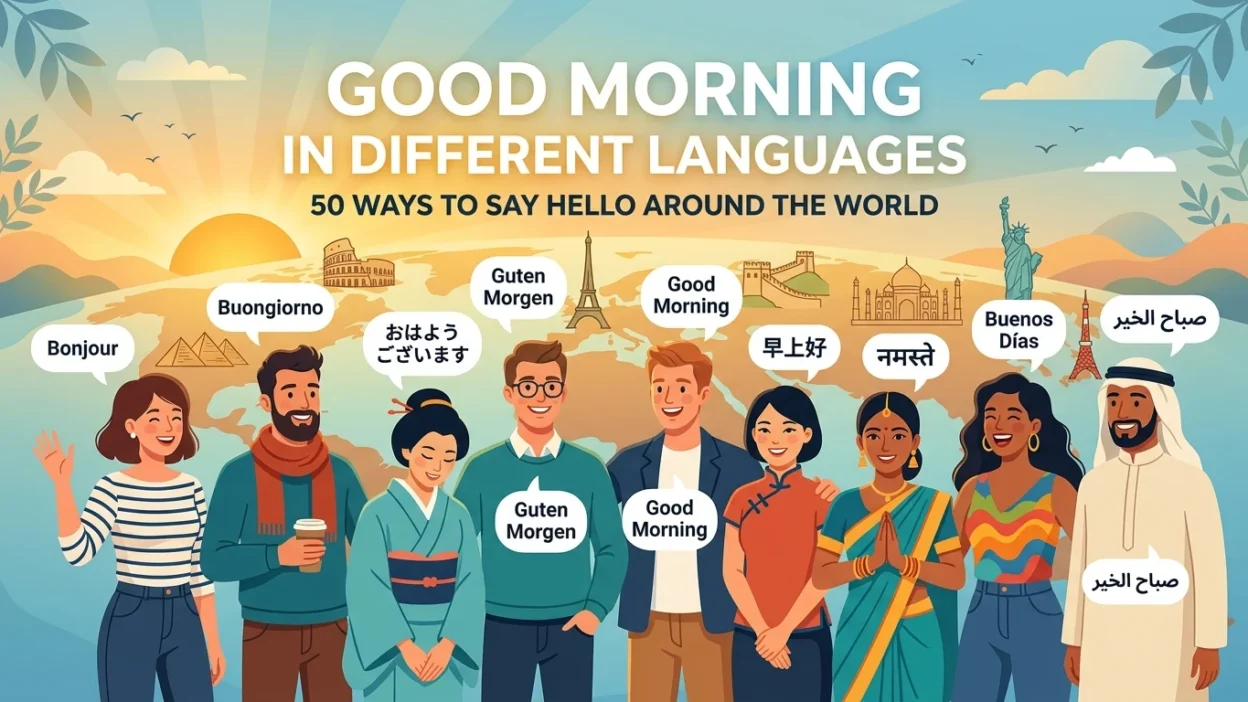
Learning good morning in different languages is a simple yet meaningful way to connect with people from different cultures. Whether you are traveling, studying a foreign language, or meeting international friends, knowing how to say good morning in different languages helps create positive first impressions and respectful conversations.
This guide introduces good morning in different languages with accurate native spellings, easy pronunciations, and practical tips for using these greetings confidently. You’ll also discover their cultural importance, pronunciation advice, and interesting facts that make language learning more enjoyable.
Quick Answer
The phrase good morning in different languages varies across cultures, from “Bonjour” in French and “Buenos días” in Spanish to “Ohayō gozaimasu” in Japanese. Learning these greetings improves communication, shows cultural respect, and makes international interactions more welcoming.
Good Morning in Different Languages Around the World
| Language | Native Word | Pronunciation |
| English | Good morning | Good MOR-ning |
| Spanish | Buenos días | BWEH-nos DEE-as |
| French | Bonjour | Bon-ZHOOR |
| German | Guten Morgen | GOO-ten MOR-gen |
| Italian | Buongiorno | Bwon-JOR-no |
| Portuguese | Bom dia | Bohm DEE-ah |
| Dutch | Goedemorgen | HOO-duh-MOR-ghen |
| Swedish | God morgon | Goo MOR-gon |
| Norwegian | God morgen | Goo MOR-gen |
| Danish | Godmorgen | Go MOR-gen |
| Finnish | Hyvää huomenta | HUU-va HUO-men-ta |
| Icelandic | Góðan morgun | GO-than MOR-gun |
| Irish | Maidin mhaith | MAJ-in wah |
| Welsh | Bore da | BOR-eh dah |
| Scottish Gaelic | Madainn mhath | MATCH-in vah |
| Polish | Dzień dobry | Jen DOB-ri |
| Czech | Dobré ráno | DO-breh RAA-no |
| Slovak | Dobré ráno | DO-breh RAA-no |
| Hungarian | Jó reggelt | Yo REG-gelt |
| Romanian | Bună dimineața | BOO-nuh dee-mi-NYAT-sa |
| Russian | Доброе утро | DOB-ra-ye OO-tra |
| Ukrainian | Доброго ранку | DOB-ro-ho RAN-koo |
| Bulgarian | Добро утро | DOB-ro OO-tro |
| Greek | Καλημέρα | Ka-lee-ME-ra |
| Turkish | Günaydın | Goo-NIGH-dun |
| Arabic | صباح الخير | Sa-bah al-KHAIR |
| Hebrew | בוקר טוב | BO-ker TOV |
| Persian | صبح بخیر | Sobh be-kheyr |
| Hindi | सुप्रभात | Su-pra-BHAAT |
| Urdu | صبح بخیر | Subah ba-khair |
| Punjabi | ਸਤਿ ਸ੍ਰੀ ਅਕਾਲ (Morning greeting) | Sat Sri Akaal |
| Bengali | সুপ্রভাত | Shu-pro-BHAT |
| Gujarati | સુપ્રભાત | Su-pra-BHAAT |
| Marathi | सुप्रभात | Su-pra-BHAAT |
| Tamil | காலை வணக்கம் | KAA-lai Va-nak-kam |
| Telugu | శుభోదయం | Shu-bho-da-yam |
| Kannada | ಶುಭೋದಯ | Shu-bho-da-ya |
| Malayalam | സുപ്രഭാതം | Su-pra-BHAA-tham |
| Chinese (Mandarin) | 早上好 | Zao Shang Hao |
| Japanese | おはようございます | O-ha-yo Go-zai-mas |
| Korean | 좋은 아침입니다 | Jo-eun A-chim-im-ni-da |
| Thai | สวัสดีตอนเช้า | Sa-wat-dee Ton Chao |
| Vietnamese | Chào buổi sáng | Chow Boo-ee Sang |
| Indonesian | Selamat pagi | Se-la-mat PA-gee |
| Malay | Selamat pagi | Se-la-mat PA-gee |
| Filipino | Magandang umaga | Ma-gan-DANG Oo-ma-ga |
| Swahili | Habari za asubuhi | Ha-BA-ri za A-su-BU-hi |
| Zulu | Sawubona | Sa-woo-BO-na |
| Afrikaans | Goeie môre | HOO-yuh MOR-uh |
| Esperanto | Bonan matenon | BO-nan Ma-te-NE-non |
Why Learn Good Morning in Different Languages?
Learning morning greetings is one of the easiest ways to begin understanding a new language. A simple greeting shows kindness, respect, and interest in another person’s culture. Whether you’re traveling, attending international meetings, or making friends online, using the local morning greeting often creates an immediate connection.
Starting with common phrases also builds confidence for beginners. Since greetings are used every day, they become easy to remember through regular practice. Over time, these small language skills encourage deeper learning and more meaningful conversations.
Cultural Significance of Morning Greetings
Morning greetings often carry cultural values beyond simple words. In many countries, saying good morning is considered polite and demonstrates respect, especially toward elders, teachers, colleagues, and strangers.
Some cultures prefer formal greetings in professional settings, while others use casual expressions among family and friends. Understanding these differences helps avoid misunderstandings and makes communication more natural. Learning local customs alongside vocabulary creates a richer appreciation for global cultures.
Pronunciation Tips for Better Communication
Correct pronunciation makes greetings sound natural and easier for native speakers to understand. Listen carefully to vowel sounds, word stress, and rhythm, as these vary between languages.
Practice by repeating short phrases slowly before increasing your speed. Recording yourself and comparing your pronunciation with native speakers is another effective method. Even if your accent isn’t perfect, speaking clearly and confidently is usually appreciated.
Related Greetings You Should Know
Besides saying good morning, learning a few related expressions improves everyday communication. Useful phrases include good afternoon, good evening, hello, goodbye, thank you, and please.
These basic greetings help you continue conversations naturally instead of stopping after the first interaction. They also provide a strong foundation for learning more vocabulary and building practical language skills over time.
Practical Uses in Daily Life
Knowing how to say good morning in multiple languages is useful in schools, workplaces, airports, hotels, restaurants, and online communities. International businesses often appreciate employees who understand simple multilingual greetings.
Travelers can also create friendlier interactions with local residents by beginning conversations respectfully. Even a small effort to speak someone’s language often receives a warm and positive response.
Easy Tips to Remember Different Greetings
Learning many greetings becomes easier when you group languages by region or language family. Flashcards, mobile apps, and daily repetition can improve memory significantly.
Try practicing five new greetings every week and review them regularly. Associating each phrase with a country, flag, or cultural tradition also helps strengthen long-term recall and makes learning more enjoyable.
Interesting Facts About Morning Greetings
Many languages have greetings that literally translate to “good day” rather than “good morning.” Others change greetings depending on the time of day, level of formality, or relationship between speakers.
Some cultures place great importance on greeting everyone individually before beginning work or social activities. These traditions highlight how greetings play an important role in building community and showing mutual respect.
Common Mistakes to Avoid
One common mistake is using formal greetings in casual situations or informal greetings in professional environments. Understanding context is just as important as knowing the words.
Another mistake involves incorrect pronunciation or using machine translations without checking accuracy. Taking a little time to learn authentic pronunciation helps avoid confusion and demonstrates genuine respect for the language.
Benefits of Learning Greetings in Multiple Languages
Learning greetings improves communication skills, cultural awareness, and confidence when interacting with people from around the world. It also supports travel experiences and international career opportunities.
Even memorizing simple daily expressions can motivate further language study. As your vocabulary grows, you’ll find it easier to understand different cultures and develop stronger personal and professional relationships.
Key Takeaways
- Learning greetings builds stronger cultural connections.
- Correct pronunciation improves communication.
- Morning greetings vary by language and tradition.
- Simple phrases make travel and work easier.
- Daily practice helps you remember new greetings faster.
Conclusion
Understanding good morning in different languages is more than memorizing words. It is a practical way to show courtesy, appreciate cultural diversity, and communicate confidently with people across the world. Whether you are traveling, learning a new language, or expanding your global knowledge, these greetings provide an excellent starting point. With regular practice and proper pronunciation, you’ll soon feel comfortable greeting people respectfully in many different languages.
Frequently Asked Questions
1. Why should I learn good morning in different languages?
Learning morning greetings helps you communicate respectfully with people from different cultures. It creates positive first impressions, supports travel experiences, improves language-learning confidence, and demonstrates appreciation for local customs. Even simple greetings can make conversations friendlier and more welcoming.
2. Which language has the most commonly recognized morning greeting?
English, Spanish, French, and Japanese greetings are among the most widely recognized due to their global influence. However, the most useful greeting depends on where you travel, work, or interact with international communities and colleagues.
3. Is pronunciation more important than perfect grammar?
Yes. For simple greetings, clear pronunciation usually matters more than perfect grammar. Native speakers generally appreciate genuine effort, and understandable pronunciation helps ensure your greeting is received positively, even if your accent differs from theirs.
4. Can learning greetings help with language learning?
Absolutely. Greetings are among the first phrases beginners learn because they are used every day. Mastering them builds confidence, improves pronunciation, and creates a strong foundation for expanding vocabulary and conversational skills.
5. How can I remember greetings in many different languages?
Practice a few greetings each week, use flashcards, repeat them aloud daily, and group languages by region. Associating each greeting with a country or cultural tradition also improves memory and makes learning more enjoyable.

Emery Foster writes captivating stories that blend emotion, adventure, and thoughtful themes. Their creative voice, relatable characters, and engaging plots have attracted readers from diverse backgrounds worldwide.