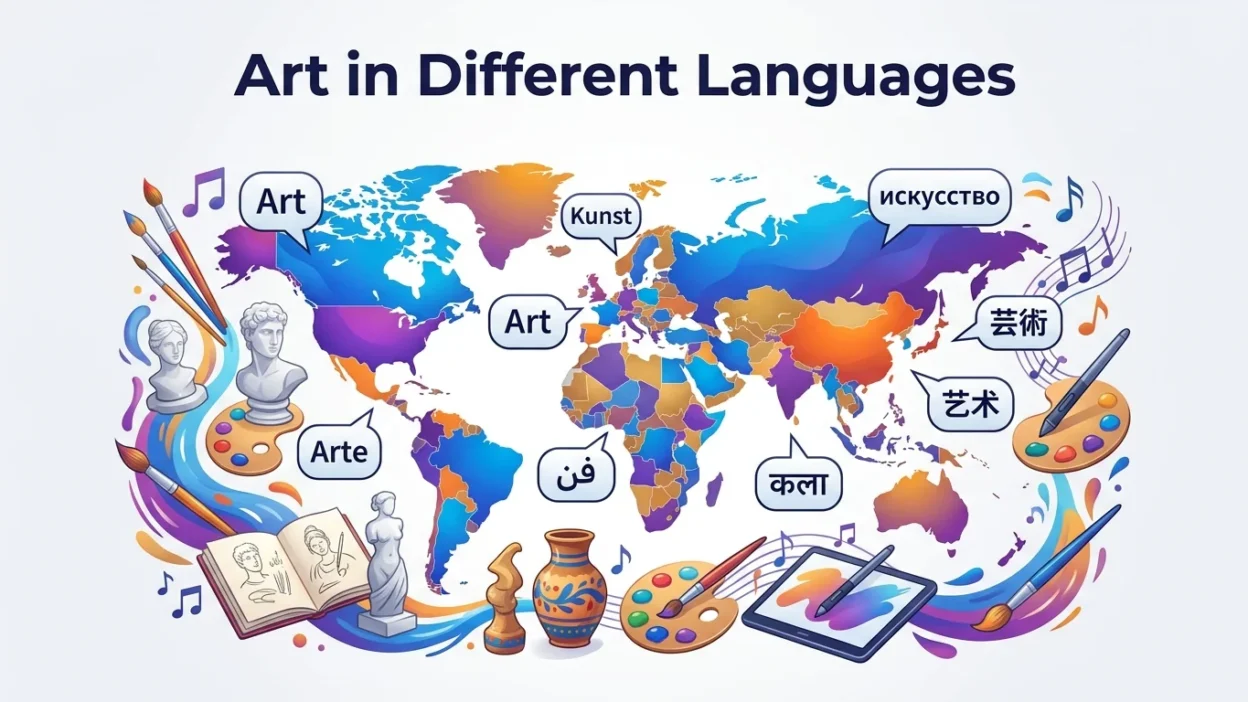
Art in different languages reflects how people around the world express creativity, beauty, and imagination. The phrase art in different languages is useful for learners, travelers, teachers, and writers who want to compare vocabulary across cultures. It also shows how one simple idea can sound very different from country to country.
In this guide, you will explore art in different languages through 50 translations, easy pronunciations, and practical usage tips. You will also learn why the word matters culturally, how to say it more naturally, and how language shapes the way people talk about creativity.
Quick Answer:
Art in different languages means the word for “art” across many world languages. Common examples include arte, Kunst, kunst, artă, and seni. Learning these forms helps with vocabulary, pronunciation, and cultural understanding.
Art in Different Languages Around the World
| Language | Native Word | Pronunciation |
| English | art | art |
| Spanish | arte | AHR-teh |
| French | art | ahr |
| German | Kunst | koontst |
| Italian | arte | AHR-teh |
| Portuguese | arte | AHR-chee |
| Dutch | kunst | kuh-nst |
| Swedish | konst | konst |
| Danish | kunst | koonst |
| Norwegian | kunst | koonst |
| Finnish | taide | TAI-deh |
| Polish | sztuka | SHTOO-kah |
| Czech | umění | OO-myeh-nee |
| Slovak | umenie | OO-meh-nee-eh |
| Hungarian | művészet | MOO-vay-set |
| Romanian | artă | AR-tuh |
| Russian | искусство | is-KOOS-stvo |
| Ukrainian | мистецтво | mis-TET-svo |
| Greek | τέχνη | TEKH-nee |
| Turkish | sanat | sah-NAHT |
| Arabic | فن | fan |
| Hebrew | אמנות | oh-ma-NOOT |
| Persian | هنر | ho-NAR |
| Urdu | فن | fun |
| Hindi | कला | ka-LAA |
| Bengali | শিল্প | shil-po |
| Gujarati | કલા | ka-LAA |
| Marathi | कला | ka-LAA |
| Tamil | கலை | ka-LAI |
| Telugu | కళ | ka-la |
| Kannada | ಕಲೆ | ka-le |
| Malayalam | കല | ka-la |
| Sinhala | කලාව | ka-laa-va |
| Chinese | 艺术 | yee-SHOO |
| Japanese | 芸術 | gei-JUTSU |
| Korean | 예술 | ye-SOOL |
| Vietnamese | nghệ thuật | ngeh THOOT |
| Thai | ศิลปะ | sin-la-pa |
| Indonesian | seni | SEH-nee |
| Malay | seni | SEH-nee |
| Filipino | sining | SEE-ning |
| Swahili | sanaa | sa-NAA |
| Zulu | ubuciko | oo-boo-SEE-ko |
| Amharic | ጥበብ | TI-beb |
| Latvian | māksla | MAAKS-la |
| Lithuanian | menas | MEH-nas |
| Estonian | kunst | koonst |
| Icelandic | list | list |
| Serbian | уметност | oo-MET-nost |
| Croatian | umjetnost | oo-MYEH-tnost |
Why Art Vocabulary Matters in Language Learning
Learning how to say art in different languages gives you more than one new word. It helps you connect with culture, museum labels, literature, film, and classroom discussions. Words linked to creativity often appear in everyday speech, so this vocabulary is practical as well as interesting.
It also builds confidence when you hear related terms in songs, documentaries, or travel conversations. Even when the spelling changes, many languages share similar roots or familiar sounds. That pattern recognition makes language learning easier and more memorable.
Cultural Meaning Behind the Word Art
The idea of art is not identical in every culture. In some languages, the word points mainly to painting, sculpture, and design. In others, it can include skill, craft, beauty, or even deep cultural expression. That is why translating art in different languages can reveal more than a simple dictionary meaning.
When you compare terms, you also see how each culture values creativity. Some languages use older classical roots, while others borrow from modern global vocabulary. This mix shows that art is both universal and local at the same time.
Pronunciation Tips for Common Versions
Pronunciation becomes easier when you break each word into smaller parts. For example, Spanish arte sounds like AHR-teh, while French art is short and smooth, closer to ahr. German Kunst ends with a crisp -st sound, and Japanese geijutsu uses clear syllables.
A good strategy is to listen for stress, then repeat slowly. Do not try to force your native accent onto every word. Instead, focus on rhythm and vowel length. That approach makes your pronunciation clearer and more natural when speaking about art in different languages.
Art-Related Words That Help You Sound Natural
Once you know the main word for art, it helps to learn related vocabulary. Useful words include artist, painting, sculpture, gallery, museum, creativity, and design. These terms often appear next to the main word in real conversations, so they create a strong vocabulary cluster.
For example, a learner may say “modern art,” “traditional art,” or “digital art.” In other languages, the same pattern usually works with local grammar. Building word groups like this makes your speech more flexible and helps you understand more of what people say in cultural settings.
How to Use the Word in Real Conversations
You can use the word for art when talking about school subjects, hobbies, travel, or creative work. A simple sentence like “I love art” becomes easy to adapt once you know the local version. This is especially helpful in museums, workshops, and language classes.
You may also hear it in titles, such as “art exhibition,” “art history,” or “art teacher.” These phrases are common in many languages. Practicing short sentences helps you remember the translation and use it correctly without overthinking grammar or pronunciation.
Common Mistakes Learners Make
A common mistake is assuming every language uses a direct one-word match with the English meaning. Some languages use a word that leans more toward “skill” or “craft,” while others use a broader cultural term. That difference matters when you translate art in different languages.
Another mistake is ignoring pronunciation marks or stress patterns. Even if a word looks similar to English, it may sound very different. Learners also sometimes confuse singular and plural forms, especially in languages where grammar changes the word depending on context.
Easy Ways to Remember These Translations
Memory works best when you connect each word to an image, a sound, or a personal example. You might link Spanish arte to a painting you saw, or Japanese geijutsu to a museum display. Small visual associations make vocabulary stick faster.
You can also group similar sounds together. For example, arte, artă, and arte are easy to compare. Repeating words in short intervals, using flashcards, and speaking them aloud all strengthen recall. These simple methods make learning art vocabulary feel natural and manageable.
Benefits of Learning Art Terms Across Languages
Studying art in different languages improves your cultural awareness and strengthens your general vocabulary. It helps you understand how creative ideas move across borders while still keeping local identity. That makes language learning more meaningful and more enjoyable.
It also supports travel, teaching, writing, and research. Whether you are reading museum labels or discussing a painting with someone from another country, knowing the term for art gives you a useful starting point. It is a small word with a surprisingly wide reach.
Key Takeaways
- “Art” has many translations, and each one reflects local language history.
- Pronunciation often matters as much as spelling.
- Related words like gallery, museum, and creativity make the vocabulary more useful.
- Some languages use words that mean more than just visual art.
- Learning this word helps with travel, culture, and everyday conversation.
Conclusion
Understanding art in different languages opens the door to richer communication and deeper cultural appreciation. It is more than a vocabulary list because each translation carries history, sound, and meaning. When you learn these words, you also learn how different communities describe creativity in their own way. That makes the topic useful for students, travelers, teachers, and curious language learners alike. With practice, the translations become easier to remember and more natural to use.
Frequently Asked Questions
1. What does art mean in different languages?
Art usually means creative expression, but the exact meaning can change by language. In some places, it refers mainly to visual works like painting or sculpture, while in others it may also include craft, skill, or cultural expression.
2. Why is art vocabulary useful for language learners?
It is useful because art words appear in museums, classrooms, books, and travel conversations. Learning them helps you understand cultural topics faster and gives you more confidence when discussing creativity, design, and visual expression in another language.
3. Are art translations always direct?
No, they are not always direct. Some languages use a term with a broader meaning, such as skill or craft. Others use a word closely tied to aesthetics or creative practice. This is why context matters when translating.
4. Which languages have similar words for art?
Many European languages share similar-looking forms such as arte, artă, and art. These similarities often come from historical language roots or borrowing. However, pronunciation and grammar can still differ a lot from one language to another.
5. How can I remember art in different languages more easily?
Use short flashcards, repeat the words aloud, and connect each translation to a picture or memory. Grouping similar words together also helps. When you practice in context, the translations become easier to recognize and use naturally.

Michael Wyatt creates compelling fiction featuring dynamic characters, emotional depth, and engaging plots. His storytelling combines creativity with relatable experiences, leaving readers entertained, inspired, and eager for more.