Apples are among the world’s most recognized fruits, making apple in different languages a popular topic for language learners, travelers, and culture enthusiasts. Learning how to say this simple word helps you communicate more naturally while expanding your vocabulary across many languages.
Whether you are studying a new language, preparing for international travel, or simply curious about global cultures, knowing apple in different languages makes learning enjoyable. This guide provides translations, pronunciations, and practical tips to help you remember the word with confidence.
Quick Answer
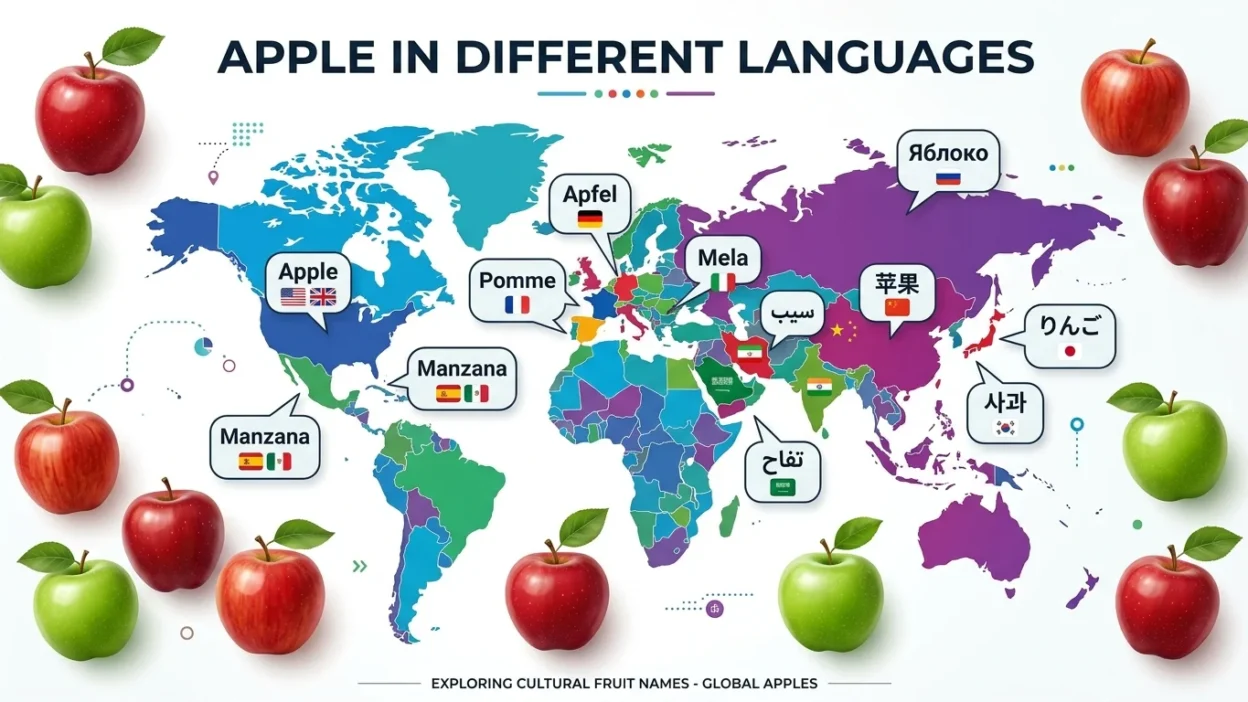
Apple in different languages varies across the world, including manzana in Spanish, pomme in French, Apfel in German, mela in Italian, and りんご (ringo) in Japanese. Learning these translations improves vocabulary, cultural awareness, and everyday communication.
Apple Around the World
| Language | Native Word | Pronunciation |
| English | Apple | AP-ul |
| Spanish | Manzana | man-SAH-nah |
| French | Pomme | pom |
| German | Apfel | AP-fel |
| Italian | Mela | MAY-lah |
| Portuguese | Maçã | mah-SAH |
| Dutch | Appel | AH-pul |
| Swedish | Äpple | EP-leh |
| Norwegian | Eple | EP-leh |
| Danish | Æble | EH-bleh |
| Finnish | Omena | OH-meh-nah |
| Icelandic | Epli | EP-li |
| Irish | Úll | ool |
| Welsh | Afal | AV-al |
| Scottish Gaelic | Ubhal | OO-al |
| Polish | Jabłko | YAB-ko |
| Czech | Jablko | YAB-lko |
| Slovak | Jablko | YAB-lko |
| Slovenian | Jabolko | yah-BOL-ko |
| Croatian | Jabuka | yah-BOO-kah |
| Serbian | Јабука | yah-BOO-kah |
| Bosnian | Jabuka | yah-BOO-kah |
| Romanian | Măr | muhr |
| Hungarian | Alma | AL-mah |
| Albanian | Mollë | MOL-luh |
| Greek | Μήλο | MEE-lo |
| Turkish | Elma | EL-mah |
| Russian | Яблоко | YAB-luh-kah |
| Ukrainian | Яблуко | YAB-loo-ko |
| Belarusian | Яблык | YAB-lik |
| Bulgarian | Ябълка | YA-bul-kah |
| Macedonian | Јаболко | YA-bol-ko |
| Lithuanian | Obuolys | oh-BOO-oh-lis |
| Latvian | Ābols | AH-bols |
| Estonian | Õun | uhn |
| Arabic | تفاح | tuf-TAH |
| Hebrew | תפוח | ta-POO-akh |
| Persian | سیب | seeb |
| Hindi | सेब | seb |
| Urdu | سیب | seeb |
| Punjabi | ਸੇਬ | seb |
| Bengali | আপেল | ah-pel |
| Tamil | ஆப்பிள் | AA-pil |
| Telugu | ఆపిల్ | AA-pil |
| Chinese (Simplified) | 苹果 | ping-gwo |
| Japanese | りんご | RIN-go |
| Korean | 사과 | sah-gwa |
| Vietnamese | Táo | tao |
| Thai | แอปเปิล | ap-pen |
| Indonesian | Apel | AH-pel |
| Malay | Epal | EH-pal |
Why Learn Apple in Different Languages?
Learning the word “apple” in many languages is a simple way to build your vocabulary. Since fruit names appear in everyday conversations, restaurants, grocery stores, and language lessons, they are practical words to know.
Mastering common vocabulary creates a strong language foundation. It also boosts confidence because learners can recognize familiar words in different situations. Starting with useful terms like apple makes language learning more enjoyable and memorable.
Cultural Significance of Apples
Apples hold symbolic meaning in many cultures around the world. They appear in folklore, literature, religion, festivals, and traditional stories. In some countries, apples represent knowledge, health, prosperity, or love.
Many cuisines also feature apples in desserts, drinks, salads, and seasonal celebrations. Understanding the cultural importance of apples adds depth to language learning and helps learners appreciate traditions beyond simple vocabulary.
How to Pronounce Apple in Different Languages
Every language has unique pronunciation rules. While some translations resemble English, others include unfamiliar sounds or accents. Listening to native speakers and repeating words aloud improves pronunciation accuracy.
Practice slowly at first, focusing on syllables instead of speed. Consistent repetition helps develop confidence and makes it easier to remember pronunciation over time.
Common Phrases Using the Word Apple
Knowing the word apple becomes even more useful when combined with everyday expressions. Examples include “I like apples,” “This apple is fresh,” or “Where can I buy apples?”
Learning complete phrases teaches grammar naturally while expanding vocabulary. It also prepares learners for real conversations instead of memorizing isolated words.
Practical Uses When Traveling
Travelers often visit local markets, grocery stores, and restaurants where fruit names are commonly used. Recognizing the local word for apple makes shopping easier and improves communication.
Even basic vocabulary helps visitors interact politely with local people. Small language efforts are often appreciated and create positive travel experiences.
Easy Tips to Remember Apple in Different Languages
Grouping similar languages together makes memorization easier. For example, many Slavic languages use similar versions of the word, while Romance languages often share related spellings.
Flashcards, pronunciation practice, language apps, and daily repetition all improve retention. Associating each translation with a country’s flag or culture also strengthens memory.
Common Mistakes to Avoid
Many learners assume words that look alike are pronounced the same. However, pronunciation differs greatly between languages even when spellings appear similar.
Another common mistake is ignoring accents or special characters. Paying attention to these details improves pronunciation and helps avoid misunderstandings during conversations.
Benefits of Learning Different Languages
Learning vocabulary from multiple languages improves memory, communication skills, and cultural awareness. It also strengthens pattern recognition, making future language learning faster.
Simple words like apple introduce learners to pronunciation, writing systems, and grammar without becoming overwhelming. Small vocabulary lessons often lead to greater confidence and long-term language success.
Interesting Facts About the Word Apple
Although the English word “apple” is widely recognized, many languages use completely different roots. Others share similarities because of historical language families and cultural exchanges.
Studying these differences reveals fascinating connections between languages. It also highlights how cultures develop unique ways of describing everyday objects while preserving their linguistic heritage.
Key Takeaways
- Apple has unique translations across dozens of world languages.
- Learning everyday vocabulary improves practical communication.
- Pronunciation practice helps build speaking confidence.
- Cultural context makes vocabulary easier to remember.
- Simple words provide a strong foundation for language learning.
Conclusion
Learning apple in different languages is an enjoyable way to expand your vocabulary while exploring cultures from around the world. From European and Asian languages to Middle Eastern and African language families, each translation offers a glimpse into local traditions and communication styles. By practicing pronunciation, using the word in everyday phrases, and understanding its cultural significance, you can strengthen your language skills and gain greater confidence in multilingual conversations.
Frequently Asked Questions
1. Why should I learn apple in different languages?
Learning common words like apple builds practical vocabulary that you can use during travel, shopping, and everyday conversations. It also helps beginners recognize language patterns and improve pronunciation while developing confidence in speaking multiple languages.
2. Which language has the easiest word for apple to remember?
This depends on your native language. English speakers often find Dutch, German, or Indonesian versions easier because they resemble the English word. Familiar spelling patterns usually make new vocabulary easier to memorize and pronounce.
3. Is the pronunciation of apple the same in every language?
No. Each language follows its own pronunciation rules. Even when two words look similar, their sounds may differ considerably. Listening to native speakers and practicing aloud is the best way to learn accurate pronunciation.
4. Can learning fruit names improve language skills?
Yes. Fruit names appear frequently in conversations, shopping, recipes, and educational materials. Learning these everyday words expands vocabulary naturally and provides useful building blocks for more advanced language study.
5. How can I remember apple in 50 different languages?
Use flashcards, language learning apps, spaced repetition, and regular speaking practice. Grouping similar languages together and connecting words with countries or cultures also makes long term memorization much easier.

Everly Bennett is recognized for imaginative storytelling and heartfelt writing. Their books explore relationships, resilience, and hope, delivering memorable reading experiences that resonate with audiences across generations.