
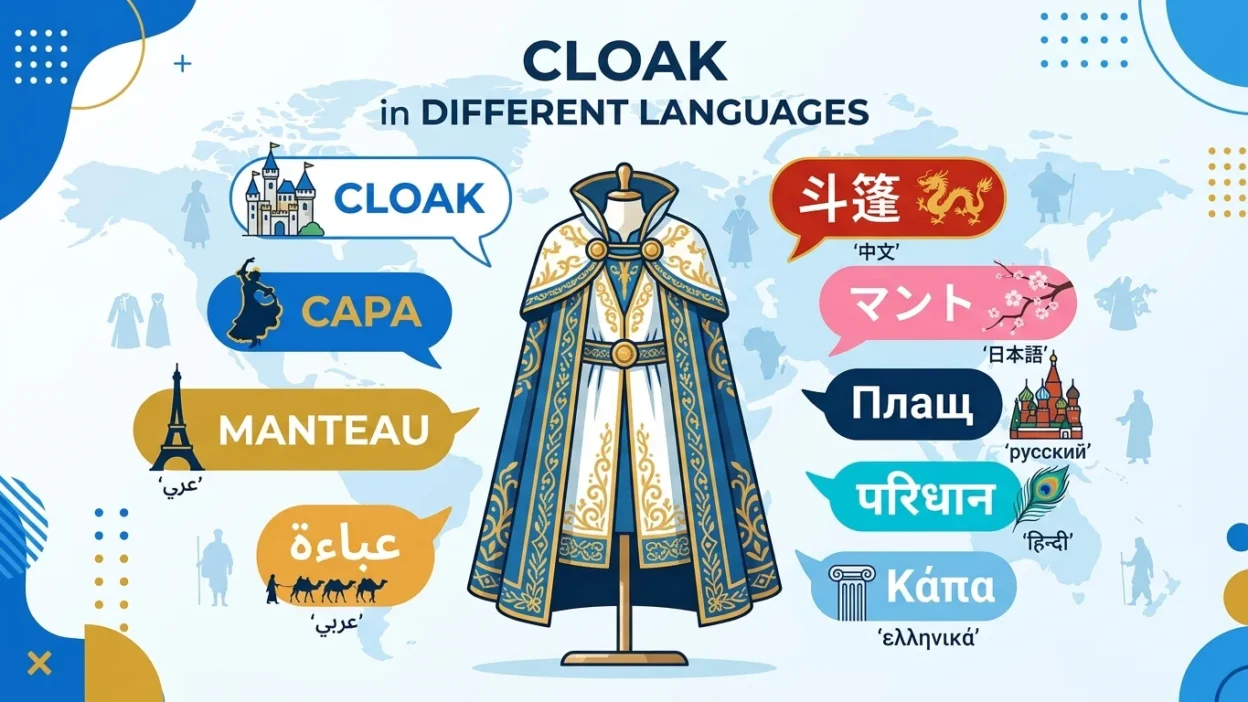
People often search for cloak in different languages when they are translating stories, studying vocabulary, or comparing fashion terms across cultures. A cloak can suggest mystery, protection, power, or tradition, so its meaning changes slightly from language to language.
This guide to cloak in different languages gives you a clear list of translations, simple pronunciations, and useful notes for everyday learning. Whether you need the word for writing, travel, research, or language study, cloak in different languages will help you understand how one clothing term appears around the world with confidence and without guessing in unfamiliar texts or captions.
Quick Answer
Cloak in different languages usually refers to a loose outer garment worn over clothes. Many languages use words close to cape, mantle, or robe, while others use borrowed forms with similar sounds and meanings.
Cloak in Different Languages Around the World
| Language | Native Word | Pronunciation |
| English | cloak | klohk |
| Spanish | capa | KAH-pah |
| French | cape | kahp |
| German | Umhang | Oom-hahng |
| Italian | mantello | man-TEL-loh |
| Portuguese | capa | KAH-pah |
| Dutch | mantel | MAHN-tel |
| Swedish | mantel | MAHN-tel |
| Norwegian | kappe | KAH-peh |
| Danish | kappe | KAH-peh |
| Finnish | viitta | VEE-tah |
| Icelandic | kápa | KOW-pah |
| Polish | płaszcz | pwah-shch |
| Czech | plášť | plahsht |
| Slovak | plášť | plahsht |
| Hungarian | köpönyeg | KEU-peu-nyeg |
| Romanian | pelerină | peh-leh-REE-nuh |
| Greek | μανδύας | man-DHEE-as |
| Russian | плащ | plashch |
| Ukrainian | плащ | plashch |
| Serbian | плашт | plasht |
| Croatian | plašt | plasht |
| Bulgarian | наметало | na-meh-TAH-loh |
| Turkish | pelerin | peh-leh-REEN |
| Arabic | عباءة | ‘a-BAA-ah |
| Hebrew | גלימה | glee-MAH |
| Persian | شنل | sheh-NEL |
| Hindi | चोगा | cho-GAA |
| Urdu | چوغہ | cho-GHAH |
| Bengali | চাদর | CHA-dor |
| Tamil | மேலங்கி | meh-LAHN-gee |
| Telugu | కేప్ | keyp |
| Marathi | चोगा | cho-GAA |
| Gujarati | ચોગો | cho-GOH |
| Punjabi | ਚੋਗਾ | cho-GAA |
| Chinese (Simplified) | 披风 | pee-FUNG |
| Japanese | マント | MAN-toh |
| Korean | 망토 | mang-TOH |
| Vietnamese | áo choàng | ow CHWANG |
| Thai | เสื้อคลุม | suea khloom |
| Indonesian | jubah | JOO-bah |
| Malay | jubah | JOO-bah |
| Filipino (Tagalog) | balabal | bah-lah-BAHL |
| Swahili | joho | JOH-ho |
| Afrikaans | mantel | MAHN-tel |
| Welsh | clogyn | KLOH-gin |
| Irish | clóca | KLOH-kah |
| Scottish Gaelic | clòca | KLOH-kah |
| Basque | kapa | KAH-pah |
| Esperanto | mantelo | mahn-TEH-loh |
Why Learn Cloak in Different Languages?
Learning cloak in different languages helps you understand vocabulary in books, films, games, and historical stories. Cloaks appear in fantasy writing, fashion history, religious clothing, and regional traditions, so the word is useful beyond simple translation. When you know the term in several languages, you can read labels, subtitles, and descriptions more accurately. It also improves your sense of how languages borrow from one another. Many modern terms for cloaks sound similar because cultures have shared clothing ideas for centuries. That makes this word a small but useful gateway into broader vocabulary study.
Cultural Significance of Cloaks
A cloak is not only a garment. In many cultures, it signals rank, identity, ceremony, or protection from weather. That is why translations can shift between cloak, cape, mantle, and robe depending on the language. In fantasy stories, cloaks often represent secrecy or travel. In older traditions, they may suggest authority, spirituality, or status. When you study the word across languages, you also learn how clothing reflects everyday life and social meaning. This adds depth to translation work and makes the vocabulary easier to remember because it connects to real cultural images.
Pronunciation Tips for Global Learners
The easiest way to pronounce cloak in different languages is to listen for the first syllable and then notice whether the ending is soft, hard, or nasal. Many European languages use similar sounds, but the stress may move to the middle or first syllable. In languages like Russian, Polish, or Hungarian, consonant clusters can look difficult at first, yet they become easier after a few practice rounds. Say the word slowly, then speed it up. Repeating it in short phrases, such as “a blue cloak” or “wear a cloak,” can also improve memory and pronunciation naturally.
Cloak, Cape, Mantle, and Robe: What Is the Difference?
English often uses cloak, cape, mantle, and robe in overlapping ways, but they are not always identical. A cloak usually suggests an outer garment worn over other clothes, often loose and flowing. A cape is often shorter and may fasten at the neck. A mantle can sound more formal or historical, while a robe often has a ceremonial or religious feel. When you see different translations in other languages, the best match depends on context. That is why one language may prefer a word similar to cape while another uses a term closer to mantle or coat.
Practical Uses in Writing, Travel, and Study
Knowing cloak in different languages is helpful in more places than a classroom. Writers use the word in fantasy scenes, historical novels, and costume descriptions. Travelers may see it in museum exhibits, clothing shops, or cultural festivals. Students benefit from it when reading bilingual books or memorizing object vocabulary. Even casual learners can use the word to practice comparison across languages. If you are building a vocabulary notebook, grouping cloak with coat, cape, robe, and mantle can make recall easier. A single word often leads to a whole family of related clothing terms.
Common Mistakes to Avoid
A common mistake is assuming every translation means the exact same style of clothing. In reality, one language may use a word that is closer to cape, shawl, or coat. Another mistake is ignoring pronunciation stress. A word can look familiar on the page but sound different in speech. Learners also mix up loanwords and native words, especially in languages that borrowed clothing terms from French, Latin, or English. To avoid confusion, check the context first. Ask whether the garment is decorative, functional, historical, or ceremonial, then choose the translation that fits best.
Easy Memory Tricks for the Word Cloak
A strong memory trick is to link the word with a mental image. Picture a traveler wearing a long flowing garment, then repeat the word in several languages at once. Similar-looking forms such as cape, capa, and kappe are easy to group together. Words like mantello, mantel, and mantelo also form a useful pattern. You can turn these into flashcards, color-code them, or recite them in sets by region. Visual memory works especially well for clothing vocabulary because the object is easy to imagine. The more clearly you picture the cloak, the faster the translations stick.
Benefits of Learning Object Vocabulary Across Languages
Learning object words like cloak builds a practical foundation for deeper language study. These words appear in daily life, literature, history, and travel, so they are useful in many contexts. They also help you notice language families and borrowing patterns. For example, several languages use forms that sound close to cape or mantle. That pattern can make future vocabulary easier to predict. Once you understand one clothing word well, you can move to related items such as coat, scarf, hood, and robe. Small vocabulary wins often lead to much stronger long-term language confidence.
Key Takeaways
- Cloak in different languages often overlaps with cape, mantle, robe, or coat-like words.
- Many languages use similar-sounding forms because clothing terms spread across cultures.
- Pronunciation matters as much as spelling when learning this vocabulary.
- Context helps you choose the best translation for fantasy, history, or everyday use.
- Object vocabulary is a simple way to expand language skills quickly.
Conclusion
Cloak in different languages is a useful phrase for learners who want practical vocabulary, cultural insight, and better translation skills. The word may change form from one language to another, but its core idea stays familiar: a garment worn for protection, style, or symbolism. By studying the translations, pronunciations, and related terms, you can recognize patterns faster and remember them more easily. This makes cloak in different languages a small topic with surprisingly wide value for reading, writing, and everyday language learning.
Frequently Asked Questions
What does cloak mean in different languages?
Cloak usually refers to a loose outer garment worn over clothing, but the exact translation can change by context. Some languages use words closer to cape, mantle, or robe. Others use borrowed forms that sound similar to the English word and keep a comparable meaning.
Why do some languages use words similar to cape or mantle?
Many languages use similar clothing terms because of historical borrowing, trade, and shared fashion traditions. A cloak, cape, and mantle can overlap in meaning, so translators often choose the closest local term rather than a strict one-to-one equivalent. Context helps decide the best match.
Is cloak the same as cape?
Not exactly. A cloak is usually longer and looser, while a cape is often shorter and fastens at the neck. In many languages, however, the same word may cover both ideas. That is why dictionary translations can differ depending on style, region, and sentence context.
How can I remember cloak translations more easily?
Group similar words together by sound and region. For example, cape, capa, and kappe form one useful pattern, while mantello, mantel, and mantelo form another. Repeating words with images, flashcards, or short sample phrases helps the vocabulary stay in long-term memory.
Where is the word cloak most useful?
The word is especially useful in fantasy stories, historical writing, museum labels, costume descriptions, and multilingual study notes. It also appears in travel and fashion contexts. Learning it across languages helps you understand related clothing vocabulary and recognize patterns in translation more easily.

Emery Foster writes captivating stories that blend emotion, adventure, and thoughtful themes. Their creative voice, relatable characters, and engaging plots have attracted readers from diverse backgrounds worldwide.