Click in different languages is a useful phrase for travelers, language learners, gamers, photographers, and technology users. Whether you are giving computer instructions, taking a picture, or describing the sound of pressing a button, learning click in different languages helps you communicate more naturally across cultures.
Understanding click in different languages also expands your vocabulary and improves your confidence when speaking with native speakers. While some languages use a direct translation, others borrow the English word or use context-specific expressions depending on whether you mean a computer click, camera click, or clicking sound.
Quick Answer
The phrase click in different languages varies by language and context. Some languages use native words, while others adopt “click” from English, especially in technology, photography, and digital communication.
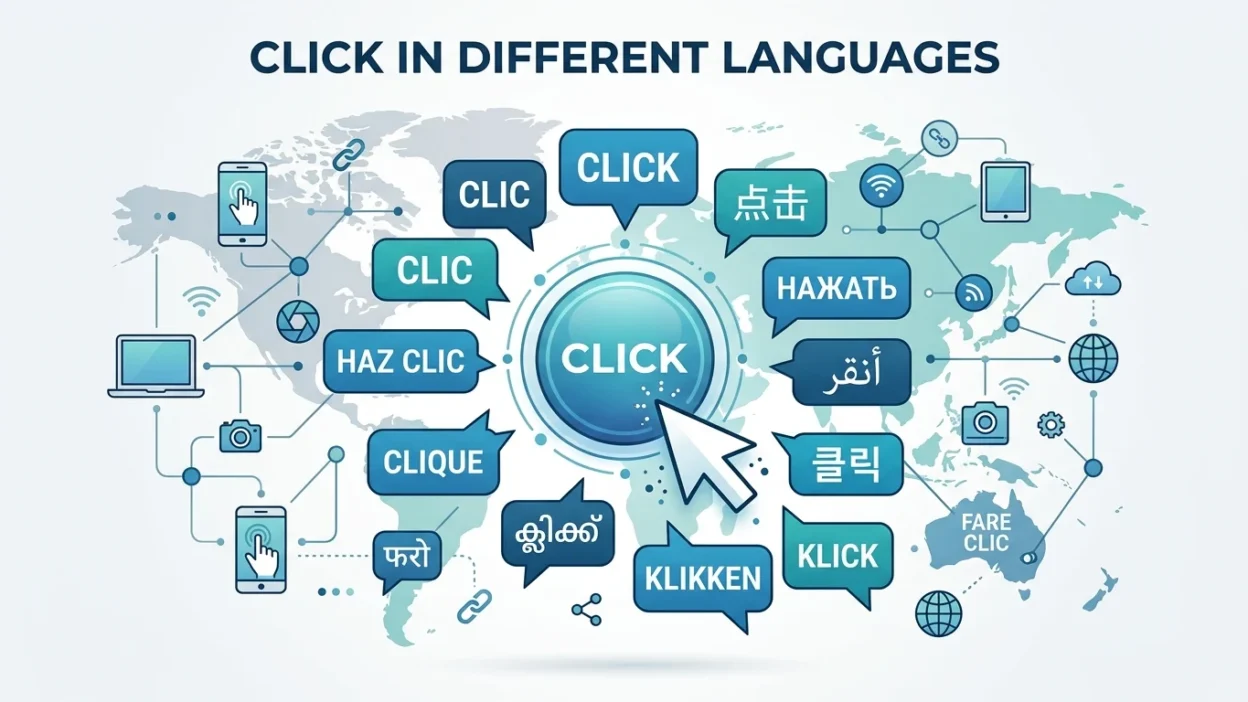
Click in Different Languages Around the World
| Language | Native Word | Pronunciation |
| English | Click | klik |
| Spanish | Clic | kleek |
| French | Clic | kleek |
| German | Klick | klik |
| Italian | Clic | kleek |
| Portuguese | Clique | KLEE-kee |
| Dutch | Klik | klik |
| Swedish | Klick | klik |
| Norwegian | Klikk | klik |
| Danish | Klik | klik |
| Finnish | Klikkaus | KLIK-kows |
| Icelandic | Smella | SMET-la |
| Polish | Klik | klik |
| Czech | Kliknutí | KLIK-noo-tee |
| Slovak | Kliknutie | KLIK-noo-tyeh |
| Hungarian | Kattintás | KOT-tin-tash |
| Romanian | Clic | kleek |
| Bulgarian | Клик | klik |
| Serbian | Клик | klik |
| Croatian | Klik | klik |
| Slovenian | Klik | klik |
| Ukrainian | Клік | klik |
| Russian | Клик | klik |
| Belarusian | Клік | klik |
| Greek | Κλικ | kleek |
| Turkish | Tıklama | TUHK-la-ma |
| Arabic | نقرة | naq-rah |
| Hebrew | לחיצה | le-khee-TSAH |
| Persian | کلیک | kleek |
| Urdu | کلک | kalik |
| Hindi | क्लिक | klik |
| Bengali | ক্লিক | klik |
| Punjabi | ਕਲਿੱਕ | klik |
| Gujarati | ક્લિક | klik |
| Marathi | क्लिक | klik |
| Tamil | கிளிக் | klik |
| Telugu | క్లిక్ | klik |
| Kannada | ಕ್ಲಿಕ್ | klik |
| Malayalam | ക്ലിക്ക് | klik |
| Sinhala | ක්ලික් | klik |
| Chinese (Simplified) | 点击 | dyen-jee |
| Japanese | クリック | ku-ri-ku |
| Korean | 클릭 | keul-lik |
| Vietnamese | Nhấp | nyup |
| Thai | คลิก | klik |
| Indonesian | Klik | klik |
| Malay | Klik | klik |
| Swahili | Bonyeza | boh-NYEH-zah |
| Filipino | I-click | ee-klik |
| Maori | Pāwhiri | PAA-fee-ree |
Why Learn Click in Different Languages?
Learning how to say “click” in different languages is practical in today’s digital world. The word appears in software instructions, websites, mobile applications, photography, and gaming. Knowing the correct translation helps you understand tutorials, user manuals, and conversations with native speakers.
It also improves communication while traveling or working internationally. Since technology is universal, recognizing this common term allows you to navigate devices, websites, and digital services more confidently regardless of the language.
Different Meanings of Click Across Languages
The meaning of “click” depends on context. It may describe pressing a mouse button, tapping a touchscreen, the sound made by a camera, or even an instant personal connection between people.
Many languages use different words depending on the situation. For example, one translation may describe a computer action, while another refers to a physical clicking sound. Understanding the intended meaning helps you choose the most natural expression.
Cultural Significance of Technology Vocabulary
Technology has influenced languages worldwide, and “click” is one of many English words that have become internationally recognized. In many countries, people simply adapt the English pronunciation instead of creating a completely new word.
At the same time, several languages preserve traditional native expressions for computer actions. This balance between borrowed and native vocabulary reflects how cultures embrace modern technology while maintaining their linguistic identity.
Pronunciation Tips for Saying Click
Pronouncing “click” correctly becomes easier when you listen to native speakers and practice slowly. Focus on individual syllables instead of trying to imitate the entire word immediately.
Many European languages pronounce borrowed versions almost identically to English. Languages such as Arabic, Chinese, and Japanese may require extra attention because their sounds and writing systems differ significantly from English pronunciation.
Practical Uses of Click in Everyday Life
The word “click” appears in countless daily situations. You may hear it while using a computer, browsing websites, editing photos, installing software, or following online learning materials.
Photographers also use the word when discussing camera shutters. In customer support and technology training, knowing the local translation helps users understand instructions quickly and complete tasks without confusion.
Related Technology Words to Learn
After learning “click,” it helps to expand your technology vocabulary. Useful related words include tap, press, select, open, download, upload, save, delete, search, and settings.
Learning these words together creates a stronger foundation for understanding software interfaces, online guides, and digital conversations. They are among the most frequently used terms in modern communication.
Common Mistakes When Translating Click
One common mistake is assuming every language uses exactly the same word. While many languages borrow “click,” others use completely different native expressions depending on the situation.
Another mistake is using a translation intended for a computer mouse when referring to a camera or mechanical sound. Paying attention to context ensures your communication remains accurate and natural.
Benefits of Learning Different Languages
Learning vocabulary across multiple languages strengthens memory, improves pronunciation skills, and builds confidence. Even simple technology words like “click” introduce learners to different writing systems and pronunciation patterns.
Multilingual vocabulary also supports international travel, business, education, and online collaboration. As technology connects people worldwide, understanding common digital terms makes communication faster and more effective.
Interesting Facts About the Word Click
The word “click” is an example of onomatopoeia because it imitates the sound it describes. Over time, it evolved from describing a physical sound to representing digital actions performed with computers and smartphones.
Today, millions of people use the word every day, regardless of their native language. Its widespread adoption highlights the global influence of technology and the growing exchange of vocabulary between cultures.
Key Takeaways
- Click has different translations depending on language and context.
- Many languages borrow the English word for technology.
- Native expressions still exist in numerous cultures.
- Learning digital vocabulary improves international communication.
- Context determines the most accurate translation of click.
Conclusion
Learning click in different languages is a simple yet valuable way to improve your global communication skills. Whether you are using technology, traveling, studying languages, or working internationally, understanding this common digital term helps you communicate more naturally. Because many cultures either translate or adapt the word differently, exploring these variations also provides insight into how languages evolve alongside technology. Expanding your multilingual vocabulary with everyday words like “click” makes learning more practical, enjoyable, and useful in everyday life.
Frequently Asked Questions
1. What is the meaning of click in different languages?
The translation of “click” depends on the language and the situation. Some languages use a native word for pressing a button, while many simply borrow the English word, especially in computer software, websites, and mobile applications.
2. Why do many languages use the English word click?
Technology has spread globally, and many software programs were originally developed in English. As a result, numerous languages adopted the word “click” because users already recognized it from computers, smartphones, and online platforms.
3. Does click always refer to using a computer mouse?
No. “Click” can describe pressing a mouse button, tapping a touchscreen, the sound of a camera shutter, or even a mechanical clicking sound. The correct translation often depends on the specific context in which it is used.
4. Is click difficult to pronounce in other languages?
Usually not. Many languages pronounce borrowed versions similarly to English. However, languages with different alphabets or sound systems may have unique pronunciations that require practice and listening to native speakers.
5. Why should I learn technology words in different languages?
Technology vocabulary appears in daily life, education, travel, and work. Learning words like “click” helps you understand software instructions, communicate with international users, and become more comfortable using digital tools across different languages.

Michael Wyatt creates compelling fiction featuring dynamic characters, emotional depth, and engaging plots. His storytelling combines creativity with relatable experiences, leaving readers entertained, inspired, and eager for more.