A clique is a small, close knit group that often feels exclusive, which is why people search for clique in different languages when learning vocabulary for social behavior, school life, and everyday conversation. Understanding clique in different languages also helps you notice how cultures describe friendship, popularity, and belonging.
This topic is useful for students, writers, translators, and language learners who want clearer, more natural wording. Whether you are studying social terms or comparing expressions across regions, clique in different languages gives you a practical way to expand your vocabulary with confidence.
Quick Answer
A clique usually means a small, exclusive social group. Translations vary by language, but many use words for “closed group,” “circle,” “gang,” or “select group,” depending on tone and context.
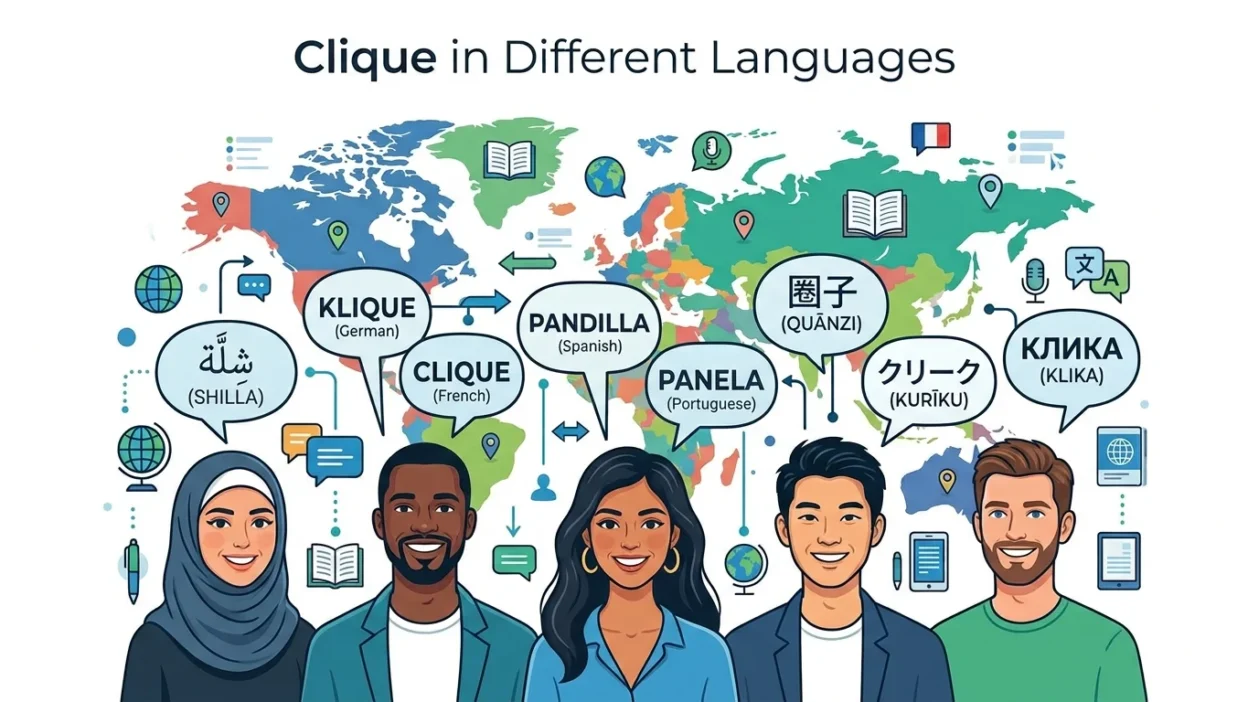
Clique Around the World
| Language | Native Word | Pronunciation |
| English | clique | kleek |
| Spanish | pandilla | pan-DEE-yah |
| French | clique | kleek |
| German | Clique | KLEE-keh |
| Italian | cricca | KREE-kah |
| Portuguese | panelinha | pah-neh-LEE-nyah |
| Dutch | kliek | kleek |
| Russian | клика | KLEE-kah |
| Arabic | زمرة | ZUM-rah |
| Chinese (Simplified) | 小圈子 | shyao chywen-zuh |
| Japanese | 派閥 | hah-bah-tsu |
| Korean | 파벌 | pah-beol |
| Hindi | गुट | goot |
| Bengali | গোষ্ঠী | ghosh-tee |
| Urdu | گروہ | groh |
| Turkish | klik | kleek |
| Persian | باند | baand |
| Hebrew | חבורה | hav-oo-RAH |
| Greek | κλίκα | KLEE-kah |
| Polish | klikа | KLEE-kah |
| Czech | parta | PAR-tah |
| Slovak | partia | PAR-tee-ah |
| Hungarian | klikk | kleek |
| Romanian | clică | KLEE-kuh |
| Swedish | klick | kleek |
| Norwegian | klikk | kleek |
| Danish | klik | kleek |
| Finnish | klikki | KLEEK-kee |
| Estonian | klikk | kleek |
| Latvian | kliķe | KLEE-kyeh |
| Lithuanian | klika | KLEE-kah |
| Ukrainian | клікa | KLEE-kah |
| Bulgarian | клика | KLEE-kah |
| Serbian | клика | KLEE-kah |
| Croatian | klika | KLEE-kah |
| Slovenian | klika | KLEE-kah |
| Macedonian | кликa | KLEE-kah |
| Indonesian | klik | kleek |
| Malay | klik | kleek |
| Filipino | grupo | GROO-poh |
| Thai | แก๊ง | gaeng |
| Vietnamese | bè phái | beh FAI |
| Swahili | kundi | KOON-dee |
| Amharic | ቡድን | boo-DIN |
| Tamil | குழு | koo-zhoo |
| Telugu | గుంపు | GOOM-poo |
| Marathi | टोळी | TOH-lee |
| Gujarati | જૂથ | joot |
| Punjabi | ਗਰੁੱਪ | group |
| Sinhala | කල්ලිය | KAL-lee-yah |
| Icelandic | klíka | KLEE-kah |
Why Learning “Clique” Matters
Learning how to say clique in different languages is helpful because the word appears in school stories, workplace discussions, and social media conversations. It often describes a group that is friendly to insiders but difficult for outsiders to enter. That makes it more nuanced than a simple “group.”
Knowing the term in many languages improves reading comprehension and translation accuracy. It also helps you understand tone, because some languages use neutral words while others sound more negative. This small vocabulary lesson can make your communication more precise and culturally aware.
Cultural Meaning Behind the Word
The idea of a clique is not identical everywhere. In some cultures, the word suggests social exclusivity and closed circles. In others, it can simply mean a close friend group with shared interests. That difference matters when you are translating or speaking carefully.
When studying clique in different languages, pay attention to whether the local term sounds neutral, informal, or critical. A word like “circle,” “group,” or “gang” may carry different emotional weight depending on the setting. Cultural context helps you choose the right expression and avoid sounding harsh or inaccurate.
Pronunciation Tips for Language Learners
Pronouncing clique in different languages becomes easier when you focus on stress, vowel length, and familiar sound patterns. Some languages use a soft “klee” sound, while others prefer words that sound more like “group,” “circle,” or “gang.” Do not force one English pronunciation onto every language.
A good method is to break the word into syllables and repeat it slowly. Listen for how native speakers use it in context. When a language has no direct equivalent, learn the closest natural phrase instead. That approach sounds more fluent and more respectful.
Related Words and Close Alternatives
Many languages do not use a single direct match for clique. Instead, they may use words meaning “circle,” “crew,” “gang,” “faction,” “group,” or “exclusive set.” These alternatives are useful because they show the tone of the original idea more clearly.
When you study clique in different languages, compare nearby words too. For example, one term may describe a friendly group, while another suggests a secretive or competitive one. Learning these shades of meaning helps you write better descriptions and understand social situations more accurately.
Practical Uses in Real Life
You may use the term “clique” when talking about school friendships, office politics, neighborhood groups, or online communities. It often appears in comments about inclusion, popularity, and social boundaries. That is why this vocabulary is useful in everyday conversation and writing.
Understanding clique in different languages also helps when reading news articles, novels, or subtitles. Translators often choose a different word depending on whether the meaning is positive, neutral, or negative. Learning practical usage gives you more control over your tone and message.
Common Mistakes to Avoid
A common mistake is using the same translation for every situation. Not every close group is a clique, and not every clique is hostile. In some contexts, the best word may be “circle,” “set,” or “community” instead. Choosing the wrong term can distort the meaning.
Another mistake is ignoring cultural tone. Some words sound playful in one language but rude in another. When working with clique in different languages, always check whether the word implies exclusivity, disapproval, or just a tight social bond. Context is more important than literal matching.
Easy Ways to Remember the Word
The easiest way to remember translations is to connect them with a scene. Picture a small group standing together, sharing inside jokes, and keeping others at a distance. That image captures the core meaning of a clique in many languages.
You can also use flashcards with one language per card. Add a short example sentence, not just the translation. Repeating the word in context helps your memory. If you compare clique in different languages regularly, patterns will start to feel familiar, and recall becomes much faster.
Key Takeaways
- A clique is usually a small, exclusive social group.
- Different languages may use words for circle, group, gang, or faction.
- Context matters more than literal translation.
- Some translations sound neutral, while others sound critical.
- Learning these words improves reading, speaking, and translation accuracy.
Conclusion
Learning clique in different languages gives you a deeper view of how cultures describe friendship, exclusivity, and social boundaries. The word can carry different shades of meaning depending on the language and context, so it is worth studying carefully. With the right translations, pronunciation practice, and cultural awareness, you can use this vocabulary naturally in conversation, writing, and translation work. That makes the topic both practical and easy to remember.
Frequently Asked Questions
1. What does “clique” mean?
A clique is a small social group that often feels closed or selective. It may refer to friends who prefer to stay together and avoid outsiders. Depending on the context, the word can sound neutral, slightly negative, or strongly critical.
2. Is “clique” translated the same way in every language?
No. Many languages use different words depending on the tone and situation. Some use a term for “circle” or “group,” while others use words closer to “gang” or “faction.” The best choice depends on context and cultural meaning.
3. Why is it useful to learn “clique in different languages”?
It helps with translation, vocabulary building, and cultural understanding. You will recognize the word in books, subtitles, articles, and conversations. It also teaches you how social relationships are described differently across languages and regions.
4. Does “clique” always have a negative meaning?
Not always. It can describe a close group of friends, but it often suggests exclusivity or separation from others. In some languages, the word is more negative than in others, so context is important when translating or speaking.
5. What is the best way to remember these translations?
Use flashcards, short example sentences, and visual scenes of small groups. Repetition works best when you learn the word in context. Comparing several languages side by side also helps you notice patterns and remember the meaning faster.

Brooklyn Walker is a contemporary writer known for engaging storytelling, memorable characters, and emotionally rich narratives. Their work inspires readers through creativity, imagination, meaningful themes, and compelling literary style.