
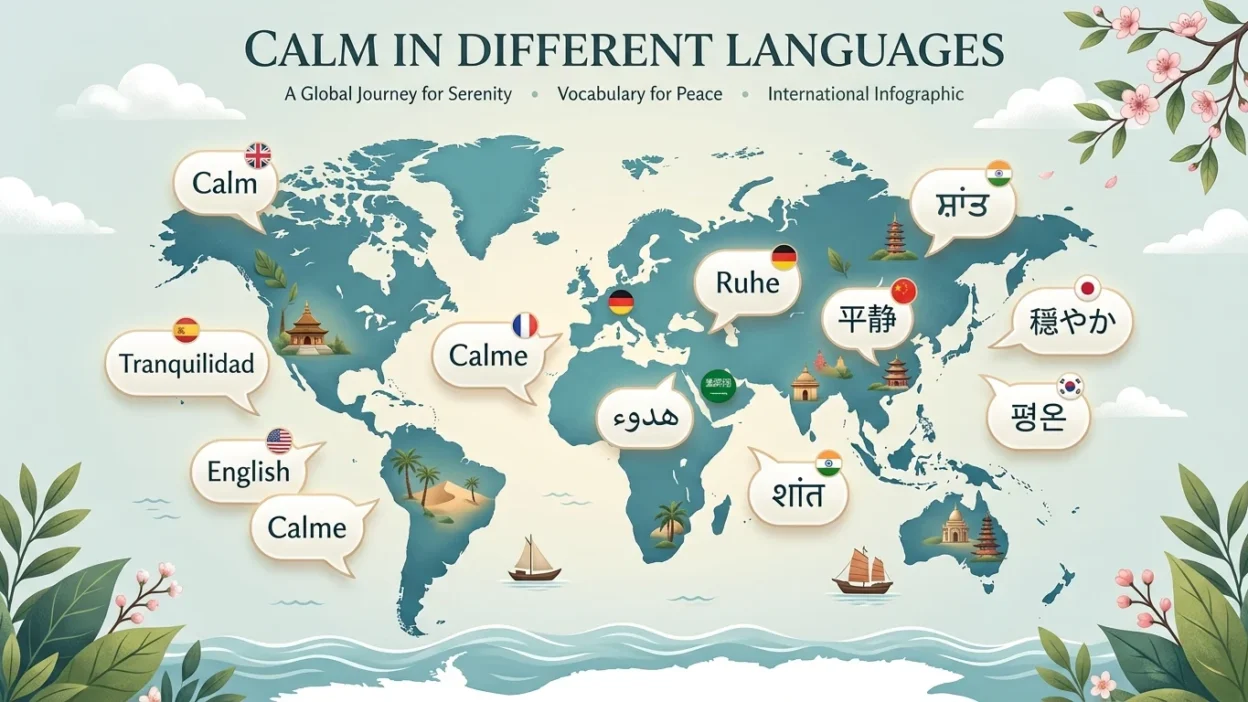
Finding the right way to express calm can make conversations feel warmer, clearer, and more meaningful. Whether you are learning vocabulary, exploring cultures, or choosing a peaceful word for writing, knowing how to say calm in different languages offers useful insight into how people describe peace and tranquility.
The phrase calm in different languages can refer to a person’s peaceful nature, a quiet atmosphere, or the feeling of inner stillness. Because languages express these ideas differently, some translations work as adjectives while others function as nouns or related concepts. Learning these distinctions helps you use each word naturally and respectfully.
Quick Answer
“Calm” has different translations worldwide, including calme in French, ruhig in German, tranquilo in Spanish, calmo in Italian, and 平静 (píngjìng) in Chinese. Exact usage depends on context and grammar.
Calm in Different Languages Around the World
| Language | Native Word | Pronunciation |
| English | calm | kahm |
| Spanish | tranquilo | trahn-KEE-loh |
| French | calme | kahlm |
| German | ruhig | ROO-ikh |
| Italian | calmo | KAHL-moh |
| Portuguese | calmo | KAHL-moo |
| Dutch | kalm | kahlm |
| Swedish | lugn | loogn |
| Norwegian | rolig | ROO-lee |
| Danish | rolig | ROH-lee |
| Finnish | rauhallinen | ROW-hah-lee-nen |
| Icelandic | rólegur | ROH-leh-gur |
| Irish | socair | SUH-ker |
| Welsh | tawel | TOW-el |
| Polish | spokojny | spoh-KOY-nih |
| Czech | klidný | KLEED-nee |
| Slovak | pokojný | poh-KOY-nee |
| Slovenian | miren | MEE-ren |
| Croatian | miran | MEE-rahn |
| Serbian | miran | MEE-rahn |
| Bulgarian | спокоен | spoh-KOH-yen |
| Russian | спокойный | spah-KOY-nih |
| Ukrainian | спокійний | spoh-KEE-nee |
| Belarusian | спакойны | spah-KOY-nih |
| Lithuanian | ramus | RAH-moos |
| Latvian | mierīgs | MYEH-rigs |
| Estonian | rahulik | RAH-hoo-lik |
| Hungarian | nyugodt | NYOO-goht |
| Romanian | calm | kahlm |
| Albanian | i qetë | ee CHEH-tuh |
| Greek | ήρεμος | EE-reh-mos |
| Turkish | sakin | sah-KEEN |
| Arabic | هادئ | HAA-dee |
| Hebrew | רגוע | reh-GOO-ah |
| Persian | آرام | aa-RAAM |
| Hindi | शांत | shaant |
| Urdu | پُرسکون | pur-suh-KOON |
| Bengali | শান্ত | shanto |
| Punjabi | ਸ਼ਾਂਤ | shaant |
| Gujarati | શાંત | shaant |
| Marathi | शांत | shaant |
| Nepali | शान्त | shaant |
| Sanskrit | शान्त | shānta |
| Tamil | அமைதியான | uh-MY-dee-yaa-nuh |
| Telugu | ప్రశాంతమైన | prash-AHN-thuh-MY-nuh |
| Kannada | ಶಾಂತ | shaanta |
| Malayalam | ശാന്തമായ | shaan-tha-MAA-ya |
| Chinese (Mandarin) | 平静 | píngjìng |
| Japanese | 穏やか | o-day-a-ka |
| Korean | 차분한 | cha-boon-han |
Why Learn the Word Calm in Different Languages?
Learning how to say calm in different languages is useful for travelers, language students, writers, and anyone interested in cultural communication. A single English word may have several related expressions depending on whether you describe a person, place, voice, mood, or situation.
Multilingual vocabulary also helps you recognize emotional concepts across cultures. Words associated with peace, stillness, patience, and tranquility often appear in everyday conversations, literature, songs, and personal descriptions. Learning them can make your vocabulary more expressive.
Even memorizing a few translations can strengthen your language-learning skills. Comparing pronunciation and sentence structure encourages you to notice how different languages organize similar ideas.
How Different Cultures Express Calm
Calm is a universal human experience, but languages do not always package the concept in exactly the same way. Some languages emphasize peaceful behavior, while others focus on quietness, serenity, or freedom from disturbance.
For example, a word translated as calm may describe someone’s personality in one language but sound more natural for an environment in another. Context therefore matters as much as vocabulary.
Cultural awareness helps learners avoid treating translations as perfect one-to-one replacements. Instead, think of each word as a doorway into a broader meaning. This approach makes multilingual communication more natural and gives you a better understanding of cultural expression.
Pronunciation Tips for Saying Calm Naturally
Pronunciation varies significantly across the 50 languages listed above. Some words are relatively simple for English speakers, while others contain unfamiliar sounds or syllable patterns. Listening to native speakers is one of the best ways to improve accuracy.
Pay attention to vowel length, stress, and consonant sounds rather than relying entirely on English spelling. For example, German ruhig has a pronunciation that differs considerably from its written form, while Mandarin píngjìng requires attention to tones.
Practice each word slowly before using it in conversation. Repeating a word aloud several times can help your mouth become familiar with unfamiliar sounds and improve your confidence.
Calm, Peaceful, Quiet, and Serene: Are They the Same?
Although calm, peaceful, quiet, and serene are closely related, they do not always mean exactly the same thing. Calm often describes emotional control or the absence of agitation. Peaceful can suggest harmony, while quiet usually emphasizes a lack of noise.
Serene often carries a stronger sense of deep tranquility or beauty. Similar distinctions appear in other languages, where several related words may be used for different situations.
When translating calm, consider the sentence rather than replacing the English word mechanically. A description of a calm person may require a different expression from a calm sea, calm weather, or calm atmosphere. Context determines the most natural choice.
Everyday Situations Where Calm Is Useful
The word calm appears in many everyday situations. You might describe a calm person, a calm conversation, calm weather, a calm sea, or a calm environment. It can also describe the emotional state someone wants to achieve during a stressful moment.
Learning these expressions in another language can make practical communication easier. Travelers may encounter them in conversations, signs, wellness content, or cultural materials.
For language learners, creating short example sentences is especially effective. Instead of memorizing an isolated translation, practice phrases such as “Stay calm,” “The room is calm,” or “She remained calm.” This gives the vocabulary a clear grammatical and practical context.
Easy Ways to Remember Calm in Multiple Languages
Start by choosing five languages that interest you rather than trying to memorize all 50 words immediately. Write each native word alongside its pronunciation and create a short sentence using it.
Visual associations can make vocabulary easier to remember. Imagine a quiet lake, peaceful room, or relaxed person whenever you review the word. Repetition then connects the meaning with a memorable mental image.
You can also group languages by region or linguistic similarity. Reviewing related vocabulary together may reveal patterns in spelling and sound. Finally, revisit the words regularly instead of studying them once. Short, frequent practice sessions usually make vocabulary easier to retain.
Common Mistakes When Translating Calm
One common mistake is assuming that every language has one universal word that matches every meaning of calm. Translation depends on grammar, context, gender, number, and the type of situation being described.
Another mistake involves pronunciation. Reading a transliteration as though it were ordinary English can produce sounds that native speakers may find difficult to recognize. It is better to use transliteration as a starting point and then listen to authentic pronunciation.
Learners should also avoid confusing calm with completely different concepts such as silence or sleepiness. Check how native speakers use a word in real sentences. Contextual examples are often more reliable than a dictionary definition alone.
Interesting Facts About the Word Calm
The concept of calm appears in nearly every culture because people everywhere experience peaceful and stressful moments. Yet languages can highlight different aspects of that experience, including quietness, emotional control, harmony, and inner peace.
English calm is especially interesting because the written “l” is silent, making pronunciation different from what spelling might suggest. Other languages use very different sounds and structures for the same broad concept.
Several languages in South Asia use forms related to Sanskrit śānta, expressing ideas of peace, tranquility, or stillness. Exploring these connections shows how vocabulary can reflect historical relationships between languages and cultures.
Benefits of Learning Different Languages
Learning vocabulary across languages can improve more than your word bank. It encourages cultural curiosity, strengthens memory, and helps you recognize that familiar concepts can be expressed in many different ways.
Studying emotional vocabulary such as calm, happy, peaceful, or grateful can also make communication more nuanced. You begin to notice distinctions that a basic translation may hide.
Language learning additionally develops attention to pronunciation and grammar. Comparing words from different language families can reveal fascinating patterns in sound and structure. Even if you never become fluent in every language, learning a few meaningful words from several languages can broaden your perspective and make communication more thoughtful.
Key Takeaways
- “Calm” has different forms and meanings across the world’s languages.
- Context determines whether a translation describes a person, place, mood, or situation.
- Pronunciation should be practiced rather than guessed from English spelling.
- Related concepts include peaceful, quiet, tranquil, serene, and relaxed.
- Learning multilingual emotional vocabulary supports language skills and cultural understanding.
Conclusion
Learning calm in different languages is a simple way to explore vocabulary, pronunciation, and cultural expression at the same time. While translations may share a general meaning, each language can use its word differently depending on context and grammar. From French calme and German ruhig to Hindi शांत and Mandarin 平静, these expressions reveal diverse ways of describing peace and emotional stillness. Whether you are studying languages, traveling, writing, or simply curious about global communication, learning these words can make your vocabulary richer and your cultural understanding deeper.
Frequently Asked Questions
What is the word for calm in different languages?
The word for calm varies by language. Examples include calme in French, ruhig in German, tranquilo in Spanish, calmo in Italian, sakin in Turkish, هادئ in Arabic, and 平静 in Mandarin Chinese. The most natural translation depends on the specific sentence and context.
How do you say calm in Spanish?
In Spanish, “calm” can commonly be translated as tranquilo for masculine forms and tranquila for feminine forms. The related noun calma means calmness or tranquility. Spanish speakers choose the appropriate form according to grammatical gender and the context in which the expression appears.
How do you say calm in French?
The French word for calm is calme. It can describe a person, environment, or situation depending on context. For example, une personne calme means “a calm person,” while une mer calme describes a calm sea. The pronunciation is approximately “kahlm,” with the final consonant not strongly pronounced.
What is calm in Hindi and Urdu?
In Hindi, calm is commonly expressed as शांत (shaant). Urdu uses پُرسکون (pur-sukoon) for peaceful or tranquil, while پُرسکون can describe a person, atmosphere, or state of mind. Exact word choice depends on whether you mean emotionally calm, peaceful, quiet, or tranquil.
Why are translations of calm different across languages?
Translations differ because languages divide meanings in different ways. One language may use separate words for emotional calmness, quiet surroundings, peacefulness, and serenity, while another may use a broader term. Grammar, cultural usage, and sentence context also influence which translation sounds most natural to native speakers.

Brooklyn Walker is a contemporary writer known for engaging storytelling, memorable characters, and emotionally rich narratives. Their work inspires readers through creativity, imagination, meaningful themes, and compelling literary style.