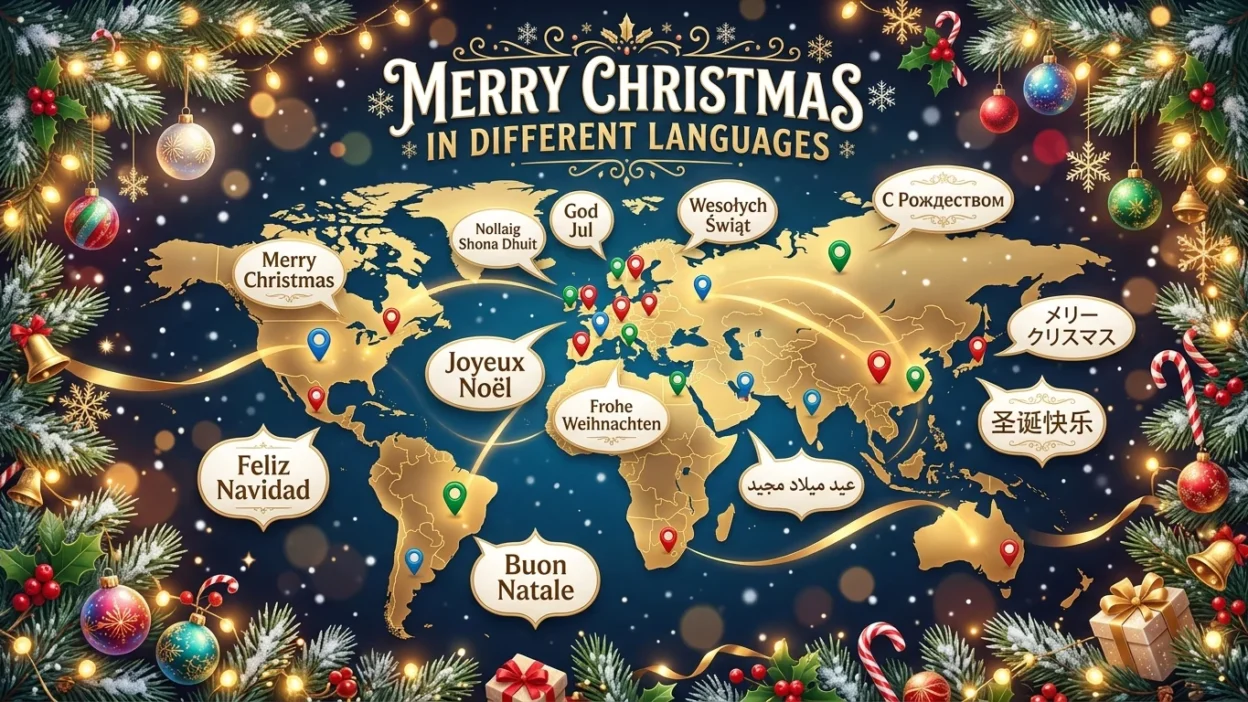
Learning how to say merry christmas in different languages is a simple way to connect with people across cultures. It helps you sound more thoughtful during the holidays, whether you are writing cards, sending messages, or greeting friends online. The phrase merry christmas in different languages also makes gift notes, classroom projects, and travel conversations feel warmer and more personal.
This guide gives you clear native spellings, easy pronunciations, and practical usage tips. If you have ever wanted to say merry christmas in different languages with confidence, you will find everything you need here in one easy-to-scan article.
Quick Answer
Merry Christmas is expressed differently around the world, but the meaning stays the same: a warm holiday greeting. Learning local versions helps you connect respectfully, sound natural, and share festive cheer in a more personal way.
merry christmas in different languages Around the World
| Language | Native Word | Pronunciation |
| Spanish | Feliz Navidad | feh-LEEZ nah-vee-DAHD |
| French | Joyeux Noël | zhwah-YUH noh-EL |
| German | Frohe Weihnachten | FROH-uh VY-nakh-ten |
| Italian | Buon Natale | bwon nah-TAH-leh |
| Portuguese | Feliz Natal | feh-LEEZ nah-TAHL |
| Dutch | Vrolijk Kerstfeest | FROH-likh KERST-fayst |
| Swedish | God Jul | goh YOOL |
| Norwegian | God Jul | goo YOOL |
| Danish | Glædelig Jul | GLAY-duh-lee YOOL |
| Finnish | Hyvää joulua | HYV-ah YOH-loo-ah |
| Icelandic | Gleðileg jól | GLEH-dih-lehg yohl |
| Polish | Wesołych Świąt | veh-SOH-wikh SHVYONT |
| Czech | Veselé Vánoce | VEH-seh-leh VAH-no-tseh |
| Slovak | Veselé Vianoce | VEH-seh-leh VYA-no-tseh |
| Hungarian | Boldog Karácsonyt | BOL-dog kah-RAH-cho-nyt |
| Romanian | Crăciun fericit | kruh-choon feh-ree-CHEET |
| Greek | Καλά Χριστούγεννα | kah-LAH hris-TOO-yeh-nah |
| Turkish | Mutlu Noeller | moot-LOO noh-EL-ler |
| Russian | С Рождеством | s razhd-EST-vom |
| Ukrainian | З Різдвом | z ree-ZDVOM |
| Bulgarian | Весела Коледа | veh-SEH-lah KOH-leh-dah |
| Serbian | Срећан Божић | SREH-chahn BOH-zhich |
| Croatian | Sretan Božić | SREH-tahn BOH-zhich |
| Slovenian | Vesel božič | veh-SEHL BOH-zhich |
| Albanian | Gëzuar Krishtlindjet | guh-ZOO-ar krish-TLEEN-dyet |
| Arabic | عيد ميلاد مجيد | eed mee-LAAD ma-JEED |
| Hebrew | חג מולד שמח | khag mo-LAD sa-ME-AKH |
| Persian | کریسمس مبارک | ke-REE-smas mo-BAH-rak |
| Hindi | क्रिसमस की शुभकामनाएँ | KRIH-smas kee shubh-kahm-NAA-en |
| Bengali | শুভ বড়দিন | shuh-bho BO-ro-din |
| Urdu | کرسمس مبارک | KER-smas mu-BAH-rak |
| Tamil | கிறிஸ்துமஸ் வாழ்த்துக்கள் | kris-TOO-mas vaazh-THU-kal |
| Telugu | క్రిస్మస్ శుభాకాంక్షలు | KRIS-mas shoo-bhaa-KAN-sha-lu |
| Marathi | ख्रिसमसच्या शुभेच्छा | KHRI-smas-chya shoo-bech-chhaa |
| Gujarati | ક્રિસમસની શુભેચ્છાઓ | KRI-smas-nee shoo-bech-chhaa-o |
| Thai | สุขสันต์วันคริสต์มาส | sook-SAN wan kris-MAAT |
| Vietnamese | Giáng Sinh vui vẻ | zyang sin VOOI veh |
| Indonesian | Selamat Natal | suh-LAH-mat NAH-tahl |
| Malay | Selamat Hari Krismas | suh-LAH-mat HA-ree KRIS-mas |
| Filipino | Maligayang Pasko | mah-lee-GAH-yang PAH-sko |
| Japanese | メリークリスマス | meh-REE ku-rih-su-mah-su |
| Korean | 메리 크리스마스 | meh-ree keu-ri-seu-ma-seu |
| Chinese (Simplified) | 圣诞快乐 | sheng-dahn kwai-luh |
| Chinese (Traditional) | 聖誕快樂 | sheng-dahn kwai-luh |
| Vietnamese | Chúc Mừng Giáng Sinh | chook moong zyang sin |
| Swahili | Krismasi Njema | kris-MAH-see NYEH-mah |
| Afrikaans | Geseënde Kersfees | geh-SAY-en-duh KERSS-fays |
| Zulu | Merry Christmas | meh-ree KRIH-smas |
| Maori | Meri Kirihimete | meh-ree kee-ree-hee-meh-teh |
| Hawaiian | Hauʻoli Kalikimaka | how-oh-LEE kah-lee-kee-MAH-kah |
Why Learn Merry Christmas in Different Languages?
Learning holiday greetings is a fast way to build cultural awareness. It shows respect for the people you are speaking to and helps you sound more thoughtful in messages, cards, and conversations. Even a simple greeting can make a big difference.
It is also useful for families, teachers, travelers, and content creators. If you celebrate with international friends or work with global audiences, knowing merry christmas in different languages adds warmth and authenticity. It is a small skill, but it creates a meaningful impression during the holiday season.
Cultural Significance of Holiday Greetings
Holiday greetings carry more than words. They reflect local traditions, religion, family customs, and community values. In some countries, Christmas greetings are deeply tied to religious celebration. In others, they are part of a broader winter festival season.
That is why translations can vary in tone. Some are direct equivalents of “Merry Christmas,” while others mean “Happy Christmas,” “Joyful Christmas,” or simply “Christmas Greetings.” When you understand the cultural context, you use each phrase more accurately and respectfully. That makes your greeting feel genuine instead of copied.
Pronunciation Tips for Better Results
Pronunciation matters because a greeting sounds friendlier when it is clear and natural. Start by breaking each phrase into smaller parts and saying it slowly. Then repeat it at normal speed until the rhythm feels comfortable.
Focus on stress, not perfection. Native speakers usually understand when the overall sound is close. For tricky words, listen for vowel length, soft consonants, and syllable emphasis. With phrases like Joyeux Noël, Frohe Weihnachten, or Gëzuar Krishtlindjet, a careful pace helps more than speaking quickly. A calm, warm delivery often matters most.
Useful Variations and Related Greetings
Not every language uses the same exact Christmas phrase. Some cultures prefer a greeting that means “Happy Holidays” or “Season’s Greetings,” especially when messages need to be more inclusive. That is useful in mixed settings.
Related phrases can also help you build fuller holiday messages. Words like peace, joy, blessings, and celebration appear often in cards and greetings. If you know the local version of “Merry Christmas,” you can also add a second phrase such as “Happy New Year” or “Warm wishes” to make your message feel more complete and personal.
Practical Uses for Travel, Cards, and Social Media
These greetings are useful in many everyday situations. You can add them to holiday cards, email signatures, classroom activities, family messages, and social media captions. They also help when you are traveling and want to greet someone politely in their language.
For businesses, multilingual greetings can improve customer connection during the holiday season. For students, they make language learning more memorable. For families, they can become a fun tradition. The phrase merry christmas in different languages is not just for study; it is practical, friendly, and easy to use in real life.
Easy Learning Tips to Remember Them
The easiest way to remember greetings is to group them by language family or by sound pattern. For example, many Romance languages have similar forms, while several Germanic languages use short, direct holiday phrases. That makes learning faster.
Use flashcards, spaced repetition, or simple voice notes to practice. Say the greeting out loud, then pair it with the country or language name. You can also choose five favorites and master those first. Small, repeated practice works better than trying to memorize all 50 at once.
Interesting Facts About Christmas Greetings
Many Christmas greetings are influenced by religion, regional history, and older winter traditions. That is why some languages keep a Christian reference while others use a broader festive expression. Both are correct in the right context.
Another interesting point is that some cultures use the same phrase for Christmas and New Year season greetings, while others separate them clearly. In multilingual communities, people may switch between local and international versions depending on who they are speaking to. That flexibility shows how living languages adapt to modern holiday communication.
Common Mistakes to Avoid
A common mistake is assuming every greeting translates word for word. Holiday phrases often change slightly to match grammar, culture, and local custom. Using the wrong form can sound awkward, even if the meaning is understandable.
Another mistake is ignoring pronunciation and using a rough English reading only. That can make a greeting harder to recognize. It is also smart to avoid using a religious phrase in a setting where a more general seasonal greeting is expected. Matching the phrase to the audience is the safest choice.
Key Takeaways
- Christmas greetings change by language, but the holiday message stays warm and friendly.
- Native spellings and simple pronunciations make greetings easier to use.
- Cultural context matters as much as translation.
- Multilingual greetings work well in cards, travel, teaching, and social media.
- A little practice goes a long way toward speaking naturally.
Conclusion
Learning merry christmas in different languages is a simple way to make holiday communication more thoughtful and memorable. It helps you connect across cultures, choose the right tone, and share festive warmth in a more personal way. Whether you are writing a card, greeting a friend, or posting online, these phrases add charm and authenticity. With a few easy pronunciation tips and regular practice, you can use merry christmas in different languages with confidence and ease.
Frequently Asked Questions
1. Why should I learn merry christmas in different languages?
Learning these greetings helps you connect with people from different cultures in a respectful and friendly way. It is useful for travel, classroom projects, holiday cards, and social media. Even a short greeting can make your message feel more personal and thoughtful.
2. Is Merry Christmas always translated the same way?
No. Many languages use a direct equivalent, but some prefer a phrase that means “Happy Christmas” or “Joyful Christmas.” Local grammar, culture, and tradition affect the final wording. That is why native spellings and pronunciation matter as much as the English meaning.
3. What is the best way to pronounce foreign Christmas greetings?
Start slowly, syllable by syllable, and focus on rhythm before speed. Listen for stress patterns, soft consonants, and vowel sounds. Repeating the phrase aloud a few times usually helps more than memorizing silently. Clear, friendly delivery matters more than perfect accent.
4. Can I use these greetings in professional messages?
Yes, as long as the greeting fits your audience. Multilingual holiday messages work well in customer emails, team notes, newsletters, and international posts. For mixed audiences, a neutral seasonal greeting may be safer. Match the tone to the relationship and the setting.
5. How many greetings should I learn first?
Start with five to ten greetings that matter most to you. Focus on languages you hear often, use at work, or see in your community. Once those feel natural, add more. Learning a few well is better than trying to memorize too many at once.

Paisley Cooper is celebrated for expressive writing and imaginative narratives. Their stories emphasize courage, friendship, and personal growth, creating meaningful connections with readers through engaging and inspiring literature.