
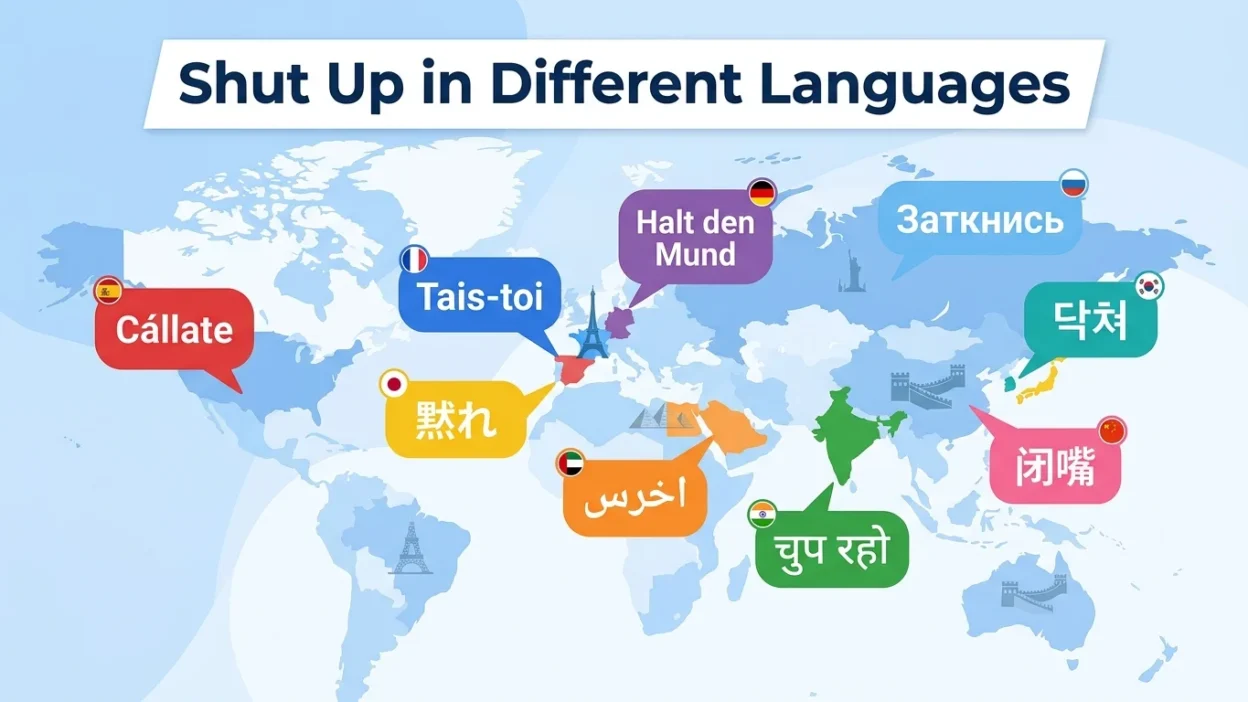
People search for shut up in different languages for travel, translation, or curious conversations. The phrase can sound funny, direct, or rude depending on the culture, so knowing the right version matters. This guide makes shut up in different languages easy to understand and useful in real life situations.
You will find clear native spellings, simple pronunciations, and practical context so you can use each phrase carefully. Whether you are learning languages, writing content, or comparing expressions, shut up in different languages is more than a translation list—it is a quick look at tone, meaning, and cultural nuance everywhere today.
Quick Answer
“Shut up” in different languages is usually expressed with a direct command, but many cultures prefer softer phrases like “be quiet.” The best choice depends on tone, relationship, and situation, because the phrase can be playful, rude, or deeply disrespectful.
Shut Up in Different Languages Around the World
| Language | Native Word | Pronunciation |
| Spanish | Cállate | KAH-yah-teh |
| French | Tais-toi | teh-TWA |
| German | Halt den Mund | halt dayn moont |
| Italian | Stai zitto | sty ZEE-toh |
| Portuguese | Cala a boca | KAH-lah ah BOH-kah |
| Dutch | Hou je mond | how yuh mond |
| Russian | Заткнись | zat-KNEES’ |
| Mandarin Chinese | 闭嘴 | bee-jway |
| Japanese | 黙れ | da-ma-reh |
| Korean | 닥쳐 | dak-chuh |
| Arabic | اخرس | ikh-ris |
| Hindi | चुप रहो | choop reh-ho |
| Bengali | চুপ করো | choop koh-roh |
| Urdu | چپ رہو | chup rah-ho |
| Turkish | Sus | soos |
| Greek | Σκάσε | SKA-seh |
| Swedish | Håll tyst | hohl tyst |
| Norwegian | Hold kjeft | hohl kyeft |
| Danish | Hold kæft | hohl kyefd |
| Finnish | Ole hiljaa | OH-le HIL-yah |
| Polish | Zamknij się | zahm-kny shyeh |
| Czech | Zmlkni | zmlk-nee |
| Slovak | Mlč | mlch |
| Hungarian | Fogd be | fogd beh |
| Romanian | Taci | tah-chee |
| Bulgarian | Млъкни | mluk-NEE |
| Serbian | Ćuti | chyoo-tee |
| Croatian | Šuti | shoo-tee |
| Ukrainian | Замовкни | zah-MOV-knee |
| Hebrew | תשתוק | tishtok |
| Thai | หุบปาก | hoob-bpahk |
| Vietnamese | Im đi | eem dee |
| Indonesian | Diam | dee-ahm |
| Malay | Diamlah | dee-ahm-lah |
| Filipino | Tumahimik ka | too-ma-hee-mik kah |
| Swahili | Nyamaza | nyah-MAH-zah |
| Zulu | Thula | too-lah |
| Afrikaans | Hou jou mond | how yow mond |
| Persian | ساکت شو | sa-ket shoh |
| Tamil | அமை | ah-mai |
| Telugu | నోరు మూయి | noo-roo moo-yee |
| Kannada | ಬಾಯಿ ಮುಚ್ಚು | bah-ee moo-chu |
| Malayalam | അടങ്ങ് | a-dang-uh |
| Gujarati | ચૂપ રહો | choop reh-ho |
| Marathi | गप्प बसा | gup bah-sah |
| Punjabi | ਚੁੱਪ ਰਹੋ | chup reh-ho |
| Nepali | चुप लाग | choop laag |
| Sinhala | කතා නොකරන්න | kah-taa noh-kah-ran-nah |
| Irish | Dún do bhéal | doon duh vayl |
| Welsh | Taw | tah-oo |
Why People Search for “Shut Up” in Different Languages
People often look up this phrase for travel, language learning, social media captions, or curiosity. It is short, memorable, and easy to compare across languages. At the same time, it is also emotionally charged, which makes tone important.
Some learners want a direct translation. Others want a softer version that sounds natural in conversation. That is why searches for shut up in different languages usually lead to more than one correct answer. In some places, the phrase is playful among friends. In others, it is harsh, impolite, or even offensive.
Cultural Meaning and Tone Matters
A literal translation does not always carry the same feeling. In one language, the phrase may sound like a joke. In another, it may be a serious insult. That difference is one of the biggest reasons context matters.
When you study shut up in different languages, pay attention to relationships, age, and setting. A phrase used between close friends may not work in formal speech. Many cultures also prefer expressions that mean “be quiet” instead of a blunt command, especially in polite conversation or public settings.
Pronunciation Tips for Clearer Delivery
Pronunciation matters because a rough translation can still sound unnatural if the stress is wrong. Start by listening for the main syllable in each word. Many languages shorten the phrase, while others use a softer rhythm.
To speak these expressions more naturally, copy the pace of native speakers rather than reading each word too slowly. For Romanized forms, keep vowel sounds simple and clear. If you are learning shut up in different languages for study or content creation, practice with audio examples and repeat the phrase in full sentences, not just in isolation.
Polite Alternatives Worth Knowing
Not every situation needs a harsh phrase. In real life, “be quiet,” “please be quiet,” or “keep it down” often sounds better and more respectful. These softer options are useful in schools, family settings, offices, and travel.
Many languages have both direct and polite versions, and the polite one is usually the safer choice. When people ask about shut up in different languages, they often actually need a version that fits everyday conversation without sounding aggressive. Choosing a gentler expression helps you communicate clearly while avoiding unnecessary conflict.
When to Use the Phrase Carefully
This phrase should be used very carefully because it can offend people quickly. Even in casual speech, the tone can make a huge difference. A joking version among close friends may be acceptable, but the same words can sound rude in public.
If you are unsure, avoid saying it at all. That is especially important when speaking to teachers, coworkers, older adults, or strangers. Learning shut up in different languages is useful, but knowing when not to use it is even more important. Respectful communication always creates a better impression than a direct insult.
Practical Uses for Travel, Content, and Study
This phrase appears often in movies, memes, subtitles, and language posts, so knowing it can help you understand pop culture more easily. It is also useful for translators, writers, and social media creators who need natural phrasing.
Travelers may encounter it in casual dialogue, while students may see it in vocabulary lists or informal conversations. If you are building content around shut up in different languages, focus on tone and clarity rather than shock value. That approach makes your writing more helpful, accurate, and engaging for readers.
Common Mistakes Learners Make
One common mistake is assuming every language uses one exact equivalent. In reality, some languages prefer a direct command, while others lean toward a phrase that means “be quiet.” Another mistake is ignoring the level of politeness.
Learners also mix up spelling and pronunciation, especially when a language uses a non-Latin script. For example, a phrase may look simple in English letters but sound very different in speech. When studying shut up in different languages, always check whether the phrase is rude, playful, or formal before using it in real conversation.
Interesting Facts About This Expression
This phrase shows how languages handle emotion in very different ways. Some cultures use a short command, while others use an expression that sounds softer and more controlled. That variety makes the topic interesting for language lovers and content creators alike.
Another fascinating point is that several languages have a common everyday phrase for “be quiet” that people use far more often than the blunt version. So, when you explore shut up in different languages, you are also learning how cultures manage politeness, urgency, and social boundaries through language.
Key Takeaways
- “Shut up” can sound very different depending on the language and the situation.
- Many cultures prefer softer phrases like “be quiet” in polite conversation.
- Pronunciation and tone matter as much as the native spelling.
- The phrase is useful for travel, content, and language learning.
- Knowing when not to use it is just as important as knowing the translation.
Conclusion
Shut up in different languages is more than a simple translation topic. It reveals how cultures express irritation, humor, politeness, and social boundaries. Some phrases are direct, while others are softened to fit everyday conversation. If you are learning languages or creating content, focus on tone, context, and pronunciation instead of memorizing only one version. That approach will help you understand shut up in different languages more accurately and use it more responsibly in real situations.
Frequently Asked Questions
1. What does “shut up” mean in different languages?
It usually means the same basic command, but the tone can change a lot. In some languages, it sounds rude and harsh. In others, it may feel playful, casual, or less aggressive, especially when compared with a softer phrase like “be quiet.”
2. Is “shut up” rude in every culture?
No, but it is often considered rude or impolite. Some languages have a direct equivalent that sounds stronger than others. In many places, people prefer gentler expressions, especially in formal settings, so the social context matters as much as the words themselves.
3. Which phrase should I use in polite conversation?
A softer expression is usually better, such as “be quiet,” “please be quiet,” or a local equivalent with a gentler tone. These choices work well in schools, homes, workplaces, and travel situations where respect and calm communication are important.
4. Why do pronunciations look so different across languages?
Each language has its own sounds, stress patterns, and writing system. Some use Roman letters, while others use scripts such as Arabic, Cyrillic, or Devanagari. That is why the same idea can look and sound very different from one language to another.
5. How can I remember these phrases faster?
Group them by region, repeat the audio aloud, and connect each phrase with a real context. Flashcards, subtitles, and short practice sentences also help. Learning the native spelling and pronunciation together makes the phrase easier to recognize and recall.

Everly Bennett is recognized for imaginative storytelling and heartfelt writing. Their books explore relationships, resilience, and hope, delivering memorable reading experiences that resonate with audiences across generations.