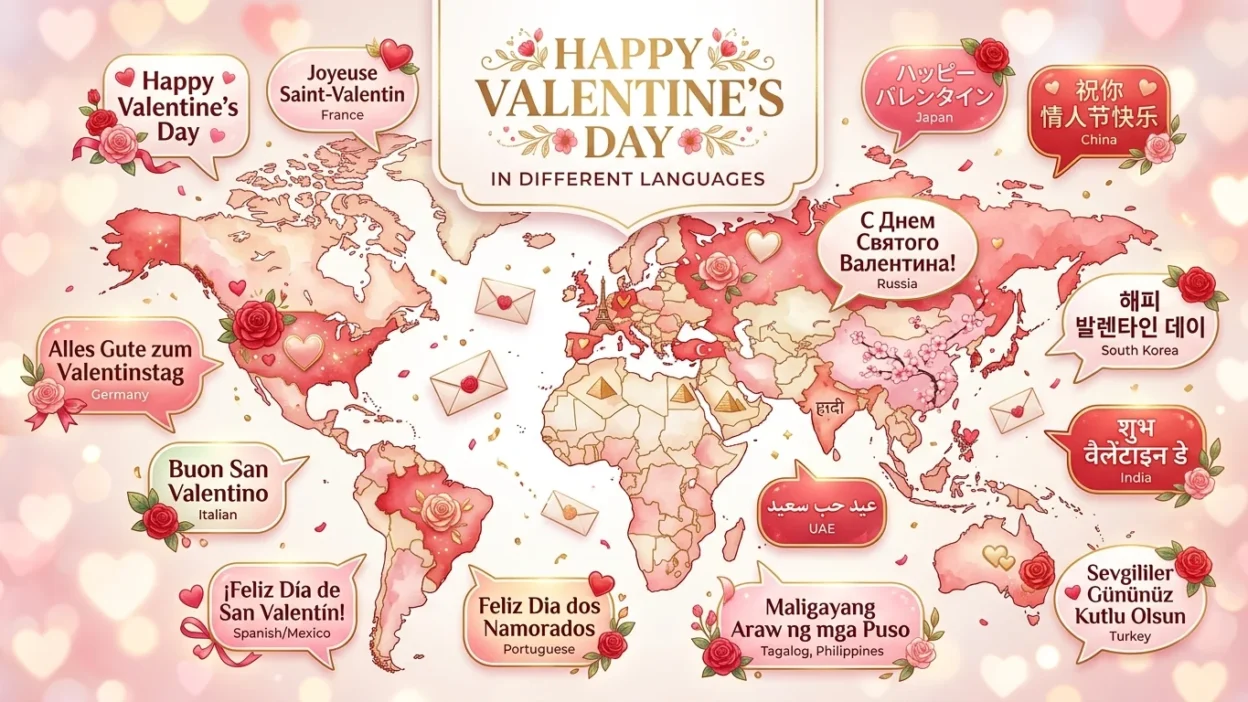
Learning happy valentines day in different languages is a simple way to make your message feel warmer, more personal, and more memorable. Whether you are writing a card, posting on social media, or sending a thoughtful text, the right phrase can create an instant connection.
This guide to happy valentines day in different languages gives you clear translations, easy pronunciations, and practical tips for using them naturally. It is perfect for anyone who wants to celebrate love across cultures with confidence and style.
Quick Answer
Happy Valentine’s Day in different languages means using local greetings to share love around the world. This article gives 50 translations, pronunciation help, and useful tips for cards, messages, and romantic posts.
Happy Valentines Day in Different Languages Around the World
| Language | Native Word | Pronunciation |
| English | Happy Valentine’s Day | HAP-ee VAL-uhn-tines day |
| Spanish | Feliz Día de San Valentín | feh-LEES DEE-ah deh sahn vah-len-TEEN |
| French | Joyeuse Saint-Valentin | zhwa-YUHz san val-an-TAHN |
| German | Alles Gute zum Valentinstag | AH-les GOO-teh tsoom VAH-len-tins-tag |
| Italian | Buon San Valentino | bwon san vah-leen-TEE-no |
| Portuguese | Feliz Dia dos Namorados | feh-LEEZ JEE-ah dooz nah-moh-RAH-doos |
| Dutch | Fijne Valentijnsdag | FINE-uh vah-len-TINES-dahg |
| Russian | С Днём святого Валентина | s dnyom svya-TOH-vuh vah-lyen-TEE-nah |
| Ukrainian | З Днем святого Валентина | z dnem svya-TOH-ho vah-lyen-TEE-nah |
| Polish | Wesołych Walentynek | veh-SOH-wikh vah-len-TI-nek |
| Czech | Šťastného Valentýna | shtyas-NEH-ho vah-len-TEE-nah |
| Slovak | Šťastného Valentína | shtyas-NEH-ho vah-len-TEE-nah |
| Hungarian | Boldog Valentin-napot | BOHL-dohg VAH-len-teen nah-pot |
| Romanian | La mulți ani de Ziua Îndrăgostiților | lah moolts ahn dee ZEE-wah een-druh-gohs-TEE-loor |
| Greek | Χαρούμενη Ημέρα του Αγίου Βαλεντίνου | kha-ROO-meh-nee ee-MEH-rah too ah-YOO vah-len-TEE-noo |
| Turkish | Mutlu Sevgililer Günü | moot-LOO sev-gee-LEE-ler goo-NOO |
| Arabic | عيد حب سعيد | eed hub sa-eed |
| Hebrew | יום ולנטיין שמח | yom va-len-TINE sah-ME-AKH |
| Persian | روز ولنتاین مبارک | rooz vah-len-TAHN mo-BAH-rak |
| Urdu | یومِ ولنتائن مبارک | yawm-e val-en-TYNE mubarak |
| Hindi | हैप्पी वेलेंटाइन डे | heh-pee veh-len-TAIN day |
| Bengali | শুভ ভ্যালেন্টাইনস ডে | shubho val-en-TAINS day |
| Tamil | காதலர் தின வாழ்த்துகள் | kaa-tha-lar di-na vaazh-thu-gal |
| Telugu | ప్రేమికుల దినోత్సవ శుభాకాంక్షలు | pre-mi-ku-la di-no-tsa-va shubha-kaankshalu |
| Malayalam | പ്രണയദിനാശംസകൾ | pra-naya-di-naa-sham-sa-kal |
| Kannada | ಪ್ರೇಮಿಗಳ ದಿನದ ಶುಭಾಶಯಗಳು | pre-mi-ga-la dina-da shubha-sha-ga-lu |
| Marathi | व्हॅलेंटाइन डेच्या शुभेच्छा | valentine dechya shubhechha |
| Gujarati | વેલેન્ટાઇન ડે ની શુભેચ્છાઓ | valentine day ni shubh-echhao |
| Punjabi | ਵੈਲੈਂਟਾਈਨ ਡੇ ਦੀਆਂ ਮੁਬਾਰਕਾਂ | valentine day dian mubarakaan |
| Chinese (Simplified) | 情人节快乐 | qíng rén jié kuài lè |
| Japanese | ハッピーバレンタインデー | happii barentain dee |
| Korean | 해피 발렌타인데이 | hae-pi bal-len-ta-in-de-i |
| Vietnamese | Chúc mừng Ngày lễ Tình nhân | chook moong ngai lay tinh nyan |
| Thai | สุขสันต์วันวาเลนไทน์ | sùk-săn wan waa-len-thai |
| Indonesian | Selamat Hari Valentine | seh-lah-mat HA-ree va-len-tayn |
| Malay | Selamat Hari Kekasih | seh-lah-mat HA-ree keh-kah-seh |
| Filipino (Tagalog) | Maligayang Araw ng mga Puso | mah-lee-GAH-yang ah-ROW ng ma-nga POO-so |
| Swahili | Siku ya Wapendanao Njema | see-koo ya wa-pen-dah-NAY-oh NJEH-mah |
| Afrikaans | Gelukkige Valentynsdag | heh-LOOK-ikh-uh vah-len-TINES-dakh |
| Zulu | Usuku oluhle luka-Valentine | oo-SOO-koo oh-LOO-leh LOO-kah va-len-TAIN |
| Amharic | የፍቅረኞች ቀን መልካም ይሁን | ye-fee-kur-ENYoch ken mel-kam yih-HOON |
| Somali | Maalinta Jacaylka Farxadda leh | mah-LIN-ta ja-CHAYL-ka far-HA-da leh |
| Icelandic | Gleðilegan Valentínusardag | gleh-thee-LEH-gan vah-len-TEE-nus-ar-dag |
| Finnish | Hyvää ystävänpäivää | HUY-vaa yus-ta-van-pee-VAA |
| Swedish | Glad Alla Hjärtans Dag | glahd ah-lah yair-tans dahg |
| Norwegian | God Valentinsdag | goh vah-len-tins-dahg |
| Danish | Glædelig Valentinsdag | glay-duh-lig vah-len-tins-dahg |
| Latvian | Priecīgu Valentīna dienu | pryeh-TSEE-goo vah-len-TEE-nah dee-EN-oo |
| Lithuanian | Su Valentino diena | soo vah-len-TEE-no dee-EH-nah |
| Serbian | Срећан Дан заљубљених | SREH-tchan dan zah-lyoo-BLJEEH-nikh |
Why Learn Happy Valentines Day in Different Languages?
Learning how to say happy valentines day in different languages helps you sound thoughtful instead of generic. A translated greeting can make a card, post, or message feel more personal and emotionally rich. It also shows respect for other cultures, especially when you are speaking to someone who values language and tradition.
This kind of phrase is useful because Valentine’s Day is celebrated in many different ways around the world. A greeting in someone’s native language can create a stronger bond than a standard English message. It is a small detail, but it often leaves a lasting impression.
Cultural Significance of Valentine’s Day Greetings
Valentine’s Day is not celebrated the same way everywhere, which makes language even more meaningful. In some places, the day is romantic. In others, it also includes friendship, appreciation, or family affection. Using a local phrase shows that you understand the celebration is part of a bigger cultural picture.
When you use happy valentines day in different languages, you are not just translating words. You are also acknowledging how love is expressed in different societies. That adds warmth and sincerity to your message, especially when you are greeting someone from another background or sharing content with a global audience.
Pronunciation Tips for Saying It Naturally
Pronunciation matters because a beautiful greeting can lose its charm if it feels difficult to say. The easiest way to learn is to break each phrase into smaller parts and read it slowly. Focus on the stressed syllables first, then repeat the full expression at a natural pace.
Do not worry about sounding perfect right away. Many languages in this list have sounds that do not exist in English, so a close approximation is often enough for a card or caption. If you practice aloud a few times, you will sound more confident and much more natural.
Common Mistakes to Avoid
A common mistake is using a direct translation that sounds unnatural in the target language. Some phrases are closer to “Happy Valentine’s Day,” while others are more like “Happy Day of Lovers” or “Happy Lovers’ Day.” That difference matters because native speakers may use a more natural cultural version.
Another mistake is copying spelling without checking pronunciation. A phrase may look simple on screen but sound very different when spoken. Also, avoid overusing the same greeting everywhere. Matching the language to the person or audience makes your message feel more thoughtful and accurate.
Practical Uses for Cards, Messages, and Social Posts
These greetings work well in handwritten cards, digital messages, email signatures, and romantic social media captions. A multilingual Valentine’s Day message can make your content stand out, especially if you are writing for friends, followers, or customers from different regions.
You can also use these phrases in classroom activities, language learning projects, or themed designs. A short greeting in another language adds personality without taking up much space. That makes it ideal for posters, invitations, product packaging, and love notes that need a warm international touch.
Related Words and Romantic Greetings
If you want to make your message richer, pair the greeting with simple romantic words like love, sweetheart, heart, kiss, or forever. These extra words help build a warmer tone and make your message feel more complete. In many languages, even one small phrase can make the whole greeting feel more heartfelt.
You can also use affectionate alternatives depending on the relationship. Some people prefer a romantic message, while others want something sweet and friendly. Adding a name, a nickname, or a personal memory can make the greeting feel much more special than a plain phrase alone.
Easy Learning Tips for Better Memory
The best way to remember happy valentines day in different languages is to group similar languages together. For example, Spanish, Portuguese, and French have forms that are easier to compare. This helps your brain connect sounds, spelling, and meaning faster.
You can also use flashcards, pronunciation repetition, or short daily practice. Reading the phrase aloud while looking at the native script improves memory quickly. If you are learning for a card or post, write the phrase three times by hand. That small habit often makes the wording stick.
Benefits of Learning Different Languages
Learning greetings in different languages does more than help with Valentine’s Day. It improves cultural awareness, strengthens communication, and builds confidence when speaking with people from different backgrounds. Even a few simple phrases can make travel, social media, and everyday conversations feel more personal.
It also helps you appreciate how languages carry emotion differently. Some languages sound soft and lyrical, while others are direct and expressive. When you explore happy valentines day in different languages, you are also learning how people around the world share affection, respect, and joy in unique ways.
Key Takeaways
- Happy Valentine’s Day can be shared in many beautiful languages around the world.
- Native spellings and pronunciations help you use greetings more confidently.
- Cultural meaning matters as much as the translation itself.
- These phrases are useful for cards, messages, captions, and classroom projects.
- Learning greetings in other languages makes your message more personal and memorable.
Conclusion
Using happy valentines day in different languages is a simple way to make your greetings feel warmer, more thoughtful, and more personal. With 50 translations, pronunciation help, and practical usage tips, you can choose the right phrase for cards, captions, and messages with ease. Whether you are writing to one person or sharing with a global audience, these greetings help you express affection in a more meaningful way. A few words in another language can turn a simple message into something memorable.
Frequently Asked Questions
1. Why should I say Happy Valentine’s Day in another language?
Saying it in another language adds a personal touch and shows care. It can make a card, message, or post feel more thoughtful, especially when the person appreciates their culture, language, or heritage.
2. Which language is easiest for beginners to use?
Languages such as Spanish, French, and Italian are often easier for beginners because their Valentine’s Day greetings are short and familiar looking. The best choice depends on who you are greeting and how natural you want it to sound.
3. Is it okay to use English based spellings for pronunciation?
Yes, especially for social messages, captions, and cards. English based pronunciations are useful when you want to say the phrase aloud without learning a new script. They are a practical learning aid, not a perfect replacement for native speech.
4. Can I use these phrases in social media captions?
Absolutely. Multilingual Valentine’s greetings work very well in captions because they are short, attractive, and easy to pair with photos or romantic posts. They help your content stand out while keeping the tone warm and meaningful.
5. What is the best way to remember these translations?
Group similar languages together, repeat them aloud, and write them down a few times. Flashcards and short daily practice help a lot. If you only need one or two phrases, memorizing them in context works even faster.

Michael Wyatt creates compelling fiction featuring dynamic characters, emotional depth, and engaging plots. His storytelling combines creativity with relatable experiences, leaving readers entertained, inspired, and eager for more.