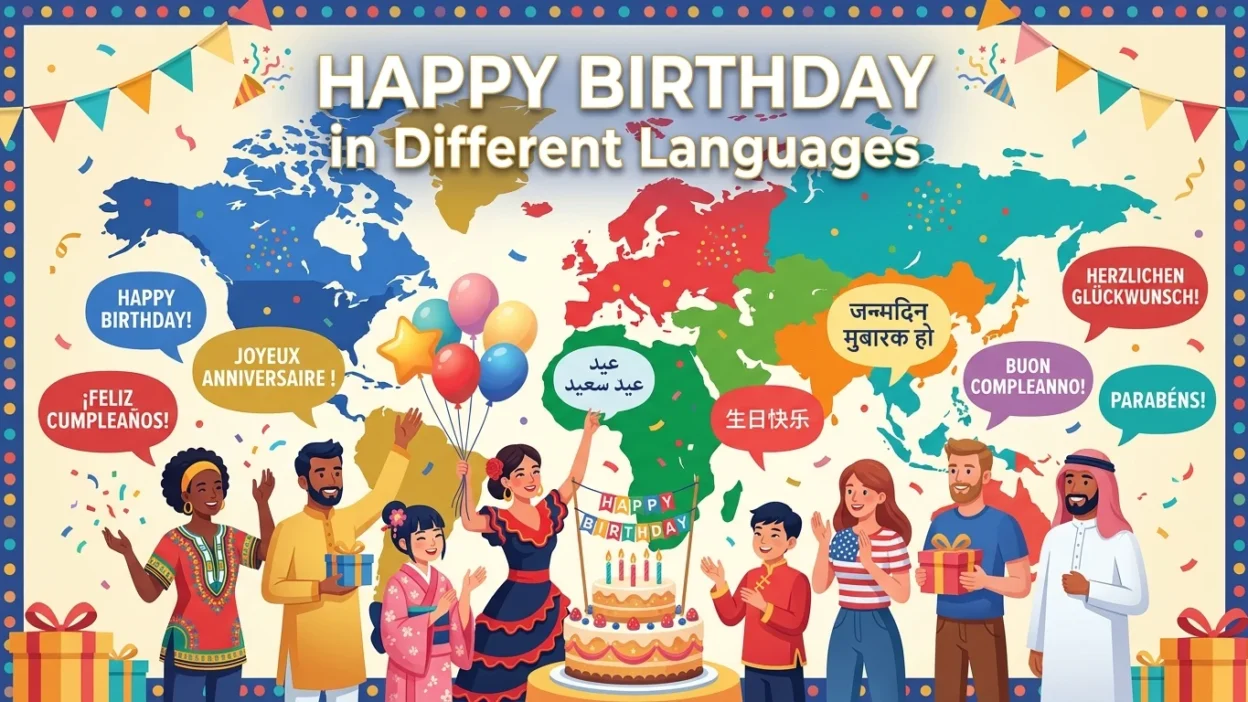
Birthdays are celebrated across the globe, but the words used to express birthday wishes vary from one language to another. Learning happy birthday in different languages is a fun way to connect with people from diverse cultures and make your greetings more meaningful. Whether you’re traveling, making international friends, or simply curious, knowing these phrases adds a personal touch.
This guide explores happy birthday in different languages with accurate native spellings, simple pronunciations, and cultural insights. By the end, you’ll confidently say happy birthday in different languages while appreciating the traditions and languages behind each unique greeting.
Quick Answer
Happy birthday in different languages refers to the unique birthday greeting used in various cultures around the world. While each language has its own wording and pronunciation, they all share the same heartfelt meaning of celebrating someone’s special day with happiness and good wishes.
Happy Birthday in Different Languages Around the World
| Language | Native Word | Pronunciation |
| English | Happy Birthday | HAP-ee BURTH-day |
| Spanish | Feliz Cumpleaños | feh-LEES koom-play-AHN-yos |
| French | Joyeux Anniversaire | zhwa-YUH ah-nee-ver-SAIR |
| German | Alles Gute zum Geburtstag | AH-les GOO-te tsoom geh-BOORTS-tag |
| Italian | Buon Compleanno | BWOHN kom-pleh-AHN-no |
| Portuguese | Feliz Aniversário | feh-LEEZ ah-nee-ver-SAH-ree-oh |
| Dutch | Gefeliciteerd | heh-feh-lih-see-TEERD |
| Swedish | Grattis på födelsedagen | GRAT-iss paw FUR-del-seh-dah-gen |
| Norwegian | Gratulerer med dagen | grah-too-LEH-rer meh DAH-gen |
| Danish | Tillykke med fødselsdagen | tih-LOO-ke meh FUH-sels-day-en |
| Finnish | Hyvää Syntymäpäivää | HOO-vaa SOON-too-mah-pie-vaa |
| Icelandic | Til hamingju með afmælið | til HAH-ming-yu meth AV-my-lith |
| Irish | Lá Breithe Shona Duit | law BREH-ha HUH-na ditch |
| Welsh | Pen-blwydd Hapus | pen-BLOOTH HAP-is |
| Scottish Gaelic | Co-là Breith Sona Dhuit | koh-la BREH shona gwich |
| Polish | Wszystkiego Najlepszego | fshist-KYE-go nye-LEP-she-go |
| Czech | Všechno nejlepší | FSHEH-khno NYE-lep-shee |
| Slovak | Všetko najlepšie | FSHET-ko NYE-lep-shee |
| Hungarian | Boldog Születésnapot | BOL-dog SOO-leh-tays-nah-pot |
| Romanian | La Mulți Ani | lah MOOLTS anee |
| Russian | С днём рождения | s DNYOM rozh-DEH-nee-ya |
| Ukrainian | З днем народження | z dnem nah-ROD-zhen-nya |
| Belarusian | З днём нараджэння | z dnyom na-rad-ZHEN-nya |
| Bulgarian | Честит Рожден Ден | ches-TEET ROZH-den den |
| Serbian | Срећан рођендан | SREH-chan ROJ-en-dan |
| Croatian | Sretan Rođendan | SREH-tan ROJ-en-dan |
| Slovenian | Vse najboljše | vse nai-BOL-she |
| Greek | Χρόνια Πολλά | HRO-nya po-LA |
| Turkish | Doğum Günün Kutlu Olsun | doh-OOM goo-NOON KOOT-lo OL-soon |
| Arabic | عيد ميلاد سعيد | EED mee-LAD sa-EED |
| Hebrew | יום הולדת שמח | yom hoo-LE-det sa-MAY-ach |
| Persian | تولدت مبارک | tava-lod-et mo-BA-rak |
| Hindi | जन्मदिन मुबारक हो | jan-ma-din moo-BA-rak ho |
| Urdu | سالگرہ مبارک | saal-gi-RAH moo-BA-rak |
| Punjabi | ਜਨਮਦਿਨ ਮੁਬਾਰਕ | janam-din moo-BA-rak |
| Bengali | শুভ জন্মদিন | shoo-bho jon-mo-din |
| Tamil | பிறந்தநாள் வாழ்த்துக்கள் | pi-ran-tha-naal vaazh-thu-kal |
| Telugu | పుట్టినరోజు శుభాకాంక్షలు | poo-tee-na ROH-joo shoo-bha |
| Kannada | ಹುಟ್ಟುಹಬ್ಬದ ಶುಭಾಶಯಗಳು | हूट-टू-hub-ba-da shoo-bha |
| Malayalam | ജന്മദിനാശംസകൾ | jan-ma-di-na shum-sa-kal |
| Marathi | वाढदिवसाच्या शुभेच्छा | vaadh-di-va-sa-cha shoo-BHE-cha |
| Gujarati | જન્મદિવસની શુભેચ્છાઓ | jan-ma-di-vas-ni shoo-BHE-chao |
| Chinese (Mandarin) | 生日快乐 | sheng-ri kwai-le |
| Japanese | お誕生日おめでとう | o-tan-joe-bee oh-meh-deh-toh |
| Korean | 생일 축하합니다 | seng-il chook-ha-ham-ni-da |
| Vietnamese | Chúc Mừng Sinh Nhật | chook moong sin nyut |
| Thai | สุขสันต์วันเกิด | sook-san wan gert |
| Indonesian | Selamat Ulang Tahun | suh-LAH-mat oo-LANG tah-HOON |
| Malay | Selamat Hari Jadi | suh-LAH-mat ha-ree jah-dee |
| Swahili | Heri ya Kuzaliwa | HEH-ree ya koo-za-LEE-wa |
Why Learn Happy Birthday in Different Languages?
Learning birthday greetings in multiple languages is a simple yet meaningful way to show respect for different cultures. Even a short phrase in someone’s native language can make them feel valued and appreciated.
It is also useful for travelers, students, language learners, and professionals who interact with people from around the world. Remembering just a few birthday greetings improves communication, strengthens friendships, and demonstrates cultural awareness. Since birthdays are universal celebrations, these phrases are practical and enjoyable to learn.
Cultural Significance of Birthday Greetings
Although birthdays are celebrated worldwide, traditions vary greatly between cultures. Some countries focus on family gatherings, while others celebrate with friends, religious customs, or community events.
Using the local birthday greeting reflects respect for those traditions. In many cultures, saying the phrase in the native language is considered more thoughtful than using English. Understanding these differences helps build stronger relationships and encourages greater appreciation for cultural diversity.
How to Pronounce Birthday Greetings Correctly
Correct pronunciation makes your greeting sound more natural and respectful. Instead of translating word by word, try listening to native speakers whenever possible and repeat the phrase several times.
Focus on the rhythm and stress rather than trying to perfect every sound immediately. Learning one language at a time helps build confidence. Even if your pronunciation is not perfect, most people appreciate the effort you make to speak their language.
Related Birthday Words and Greetings
Besides saying “Happy Birthday,” many languages include additional expressions that wish health, happiness, success, and long life. These phrases often accompany birthday cards, speeches, and celebrations.
Learning related greetings expands your vocabulary and allows you to express more heartfelt wishes. You can also combine birthday greetings with thank you messages, congratulations, or blessings depending on the occasion and cultural traditions.
Practical Uses of Birthday Greetings in Different Languages
Knowing birthday greetings is useful in everyday life. You can use them while traveling, sending greeting cards, posting on social media, participating in multicultural events, or celebrating international coworkers and friends.
Businesses also benefit from personalized birthday wishes when serving global customers. Small gestures like greeting someone in their native language often leave a lasting positive impression and strengthen personal or professional relationships.
Easy Tips for Remembering Birthday Greetings
Learning fifty greetings may seem challenging, but simple techniques make the process easier. Group languages by region or language family so similar words become easier to recognize.
Practice a few greetings each day using flashcards, repetition, or conversation. Writing the native spelling alongside pronunciation also improves memory. Consistent practice helps you remember phrases naturally without feeling overwhelmed.
Interesting Facts About Birthday Wishes Worldwide
Many birthday greetings sound completely different, yet they all express kindness and celebration. Some languages translate directly to “Happy Birthday,” while others literally mean “Many Happy Years” or “Congratulations on Your Birthday.
Several neighboring countries share similar expressions because of historical and linguistic connections. These similarities make learning multiple languages more enjoyable and reveal fascinating links between cultures around the world.
Common Mistakes When Saying Birthday Greetings
One common mistake is assuming that direct translations always work. Some languages have formal and informal versions, while others use completely different phrases depending on the situation.
Another mistake is ignoring pronunciation. Mispronouncing a word may change its meaning or make it difficult to understand. Learning both the native spelling and pronunciation together helps avoid confusion and improves communication.
Benefits of Learning Different Languages Through Simple Greetings
Simple greetings are often the first step toward language learning. Birthday wishes introduce learners to pronunciation, vocabulary, and cultural customs without requiring advanced grammar.
These small phrases also build confidence for future conversations. As your interest grows, you may begin exploring additional greetings, everyday expressions, and complete conversations. Learning languages through meaningful occasions makes the experience enjoyable and memorable.
Key Takeaways
- Birthday greetings differ across languages but share the same positive meaning.
- Learning native greetings shows respect for different cultures.
- Correct pronunciation makes your wishes more natural and appreciated.
- Birthday phrases are useful for travel, friendships, and international communication.
- Practicing simple greetings is an enjoyable way to begin learning new languages.
Conclusion
Learning happy birthday in different languages is a rewarding way to connect with people from diverse backgrounds while gaining insight into global cultures. Whether you want to surprise a friend, communicate while traveling, or expand your language skills, these greetings offer a thoughtful and memorable way to celebrate birthdays. With fifty languages, native spellings, and easy pronunciations, you now have a practical resource for sharing warm birthday wishes anywhere in the world.
Frequently Asked Questions
1. Why should I learn happy birthday in different languages?
Learning birthday greetings in different languages helps you communicate respectfully with people from various cultures. It makes your wishes more personal, strengthens friendships, and shows appreciation for cultural diversity. These simple phrases are also useful during travel, international business, and language learning.
2. Which language has the easiest birthday greeting to pronounce?
English, Spanish, Italian, and Indonesian are generally considered easy for beginners because their birthday greetings have straightforward pronunciation. However, pronunciation difficulty depends on your native language and familiarity with similar sounds. Regular practice makes any greeting easier to remember and pronounce.
3. Is it polite to wish someone a happy birthday in their native language?
Yes. Most people appreciate hearing birthday wishes in their own language because it shows effort, respect, and cultural awareness. Even if your pronunciation is not perfect, your willingness to learn usually makes the greeting more meaningful and memorable.
4. Are birthday greetings the same in every country that speaks the same language?
Not always. While the main birthday greeting is often the same, pronunciation, accents, and additional expressions can vary by country or region. Cultural traditions surrounding birthdays may also differ even when people share the same language.
5. What is the best way to remember birthday greetings in multiple languages?
The most effective method is practicing a few greetings each day using flashcards, repetition, and pronunciation exercises. Grouping similar languages together and using the phrases in real conversations also improves long term memory and makes learning more enjoyable.

Everly Bennett is recognized for imaginative storytelling and heartfelt writing. Their books explore relationships, resilience, and hope, delivering memorable reading experiences that resonate with audiences across generations.