
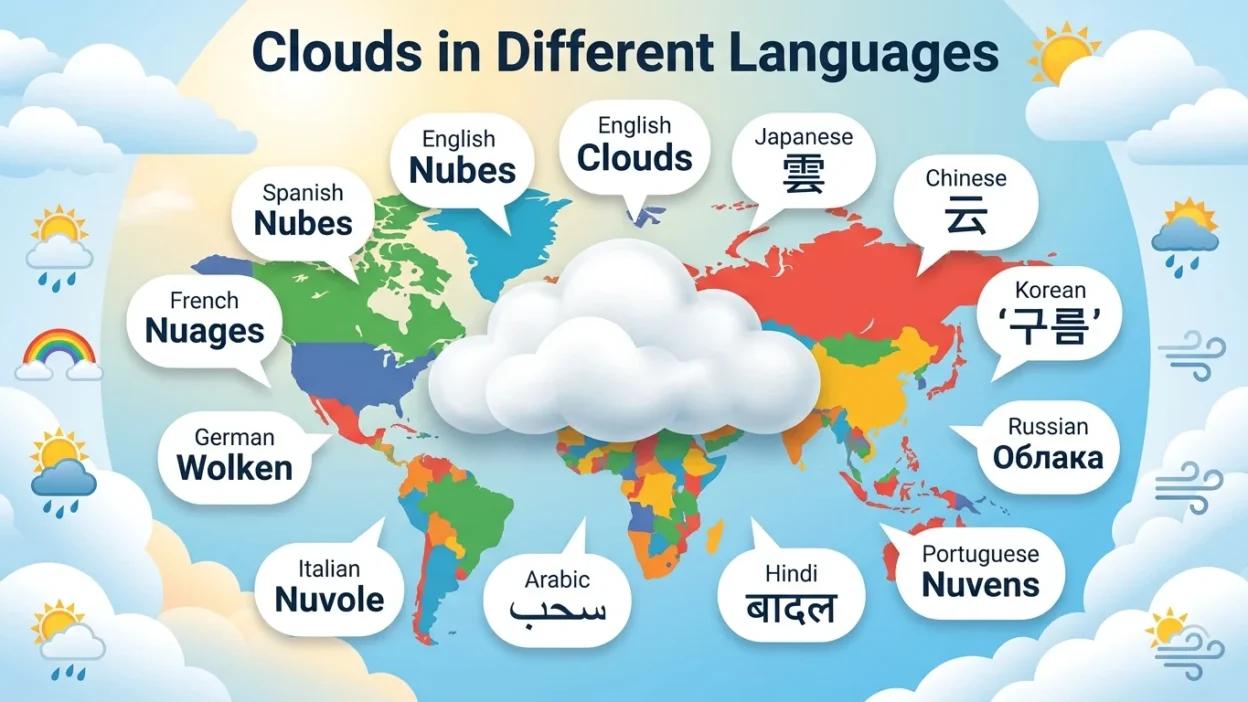
Clouds in different languages are fascinating because they reveal how people across cultures describe one of nature’s most beautiful sights. Whether you are learning a new language, travelling, or expanding your vocabulary, understanding clouds in different languages helps you connect with people and appreciate linguistic diversity.
From everyday conversations to weather forecasts and poetry, clouds in different languages appear in many situations. Learning these words also improves cultural awareness, making language study more enjoyable and practical for beginners and experienced learners alike.
Quick Answer
The word clouds in different languages varies across the world, from nubes in Spanish and nuages in French to Wolken in German and 雲 (kumo) in Japanese. Learning these translations improves vocabulary, travel communication, and cultural understanding.
Clouds in Different Languages Around the World
| Language | Native Word | Pronunciation |
| English | Clouds | klowdz |
| Spanish | Nubes | NOO-bes |
| French | Nuages | nwee-AHZH |
| German | Wolken | VOL-ken |
| Italian | Nuvole | NOO-vo-leh |
| Portuguese | Nuvens | noo-VENGS |
| Dutch | Wolken | VOL-ken |
| Danish | Skyer | SKOO-er |
| Swedish | Moln | MOHLN |
| Norwegian | Skyer | SHOO-er |
| Finnish | Pilvet | PEEL-vet |
| Icelandic | Ský | SKEE |
| Irish | Scamaill | SKAM-il |
| Welsh | Cymylau | kuh-MUH-lie |
| Scottish Gaelic | Sgòthan | SKOH-han |
| Polish | Chmury | HMU-ri |
| Czech | Mraky | MRA-kee |
| Slovak | Oblaky | OB-la-kee |
| Slovenian | Oblaki | ob-LAH-kee |
| Croatian | Oblaci | ob-LA-tsee |
| Serbian | Облаци | ob-LA-tsee |
| Bosnian | Oblaci | ob-LA-tsee |
| Romanian | Nori | NOR-ee |
| Hungarian | Felhők | FEL-hook |
| Greek | Σύννεφα | SEE-ne-fa |
| Turkish | Bulutlar | boo-LOOT-lar |
| Russian | Облака | ab-la-KA |
| Ukrainian | Хмари | HMA-ry |
| Belarusian | Воблакі | vab-la-KEE |
| Bulgarian | Облаци | ob-LA-tsee |
| Albanian | Retë | REH-tuh |
| Arabic | سحب | soo-HUB |
| Hebrew | עננים | a-na-NEEM |
| Persian | ابرها | abr-HA |
| Hindi | बादल | BAA-dal |
| Urdu | بادل | BAA-dal |
| Punjabi | ਬੱਦਲ | BAD-dal |
| Bengali | মেঘ | MEGH |
| Gujarati | વાદળો | VAA-da-lo |
| Marathi | ढग | DHUG |
| Tamil | மேகங்கள் | MAY-gang-gal |
| Telugu | మేఘాలు | MAY-gha-loo |
| Kannada | ಮೋಡಗಳು | MO-da-ga-loo |
| Malayalam | മേഘങ്ങൾ | MAY-ghang-gal |
| Chinese (Simplified) | 云 | yoon |
| Japanese | 雲 | koo-MOH |
| Korean | 구름 | goo-room |
| Vietnamese | Mây | MY |
| Thai | เมฆ | MAYK |
| Indonesian | Awan | AH-wan |
Why Learn the Word for Clouds in Different Languages?
Learning the word for clouds in multiple languages is useful for everyday communication, especially while travelling or discussing weather. Since weather is one of the most common conversation topics worldwide, knowing this vocabulary helps you interact naturally with native speakers.
It also strengthens your memory by connecting familiar natural objects with new words. Language learners often remember practical vocabulary faster because they encounter it frequently in conversations, books, and media.
Cultural Importance of Clouds Around the World
Clouds hold symbolic meaning in many cultures. They often represent hope, change, mystery, peace, or even spiritual guidance. Many traditional stories and poems describe clouds as signs of seasonal changes or emotional expression.
Different languages also reflect local climates. Communities living in mountainous or tropical regions may have richer weather-related vocabulary because clouds play an important role in daily life, farming, and navigation.
How to Pronounce Clouds Correctly
Good pronunciation begins by listening carefully and repeating words aloud. Focus on syllables rather than trying to imitate an entire sentence immediately. Speaking slowly builds confidence and accuracy.
Recording your own voice is another helpful technique. Comparing your pronunciation with native speakers allows you to identify sounds that need improvement while developing a more natural accent over time.
Related Weather Words You Should Learn
Once you know the word for clouds, expanding your weather vocabulary becomes much easier. Consider learning words such as rain, sun, wind, snow, storm, thunder, lightning, fog, sky, and rainbow.
These related terms appear frequently in conversations, travel situations, school lessons, and weather forecasts. Learning them together creates stronger vocabulary connections and improves speaking confidence.
Practical Uses of Clouds in Different Languages
Knowing how to say clouds helps during travel, language classes, international business, and casual conversations. You can better understand weather reports, ask about changing conditions, or describe the scenery around you.
Photographers, hikers, pilots, and nature lovers also benefit from weather vocabulary. Even simple words like clouds can make conversations more engaging and meaningful across different cultures.
Easy Tips to Remember Weather Vocabulary
Practice a few weather words every day instead of memorising long vocabulary lists. Short, consistent study sessions improve long-term retention more effectively than occasional intensive learning.
Flashcards, labelled images, language apps, and simple conversations all reinforce memory. Using new words while describing today’s weather also makes learning enjoyable and practical.
Common Mistakes When Learning Cloud Translations
One common mistake is assuming every language uses a direct translation identical to English. Some languages distinguish between singular and plural forms or use context-specific expressions.
Another mistake is ignoring pronunciation. Correct pronunciation helps listeners understand you more easily, even if your grammar is still developing. Practising both spelling and pronunciation leads to better communication.
Benefits of Learning Different Languages Through Nature Words
Nature vocabulary offers an excellent starting point for language learners because these words are familiar and frequently used. They help build confidence before moving to more complex grammar and conversations.
Learning words related to nature also introduces cultural perspectives. Comparing how different languages describe clouds, rain, and the sky deepens appreciation for both linguistic diversity and the natural world.
Interesting Facts About the Word for Clouds
Many languages share similar cloud-related words because of historical connections between language families. Romance languages, for example, often have similar vocabulary derived from Latin origins.
Meanwhile, Asian, African, and Indigenous languages frequently use unique words that reflect their own linguistic history. Exploring these differences makes language learning more interesting and memorable.
Key Takeaways
- Clouds have unique names across many languages and cultures.
- Weather vocabulary is practical for travel and daily conversations.
- Correct pronunciation improves communication and confidence.
- Learning related weather words strengthens language skills.
- Nature vocabulary provides an enjoyable foundation for language learning.
Conclusion
Learning clouds in different languages is a simple yet effective way to expand your vocabulary and appreciate global cultures. Whether your goal is travelling, studying, or communicating with people from different backgrounds, knowing these translations makes conversations more meaningful.
Because weather is discussed everywhere, this vocabulary remains useful in everyday life. Continue exploring nature-related words to strengthen your language skills, improve pronunciation, and build confidence while discovering the beauty of languages around the world.
Frequently Asked Questions
1. Why should I learn clouds in different languages?
Learning cloud translations improves your everyday vocabulary while helping you communicate about weather, travel, and nature. Since weather is a universal conversation topic, these words are practical for beginners and advanced learners. They also introduce cultural differences and make language learning more engaging through familiar, real-world vocabulary.
2. Which language has the easiest word for clouds to remember?
The easiest word depends on your native language. English speakers often find words like nubes, nuages, or Wolken memorable because they appear frequently in language courses. Repetition, pronunciation practice, and daily use make any translation easier to remember over time.
3. Are cloud translations always direct equivalents?
Not always. Some languages have separate singular and plural forms, while others use words that change according to grammar or context. Although the basic meaning remains the same, pronunciation, spelling, and sentence structure may differ significantly between languages.
4. How can I memorise weather vocabulary faster?
Practice weather-related words every day using flashcards, labelled pictures, and simple conversations. Describing the day’s weather aloud helps reinforce memory naturally. Combining listening, reading, speaking, and writing creates stronger vocabulary retention and improves pronunciation at the same time.
5. Is learning nature vocabulary useful for beginners?
Yes. Nature words such as clouds, rain, sun, wind, and sky appear frequently in conversations and educational materials. Because they describe familiar objects, beginners understand and remember them more easily, making them an excellent foundation for building broader language skills.

Emery Foster writes captivating stories that blend emotion, adventure, and thoughtful themes. Their creative voice, relatable characters, and engaging plots have attracted readers from diverse backgrounds worldwide.