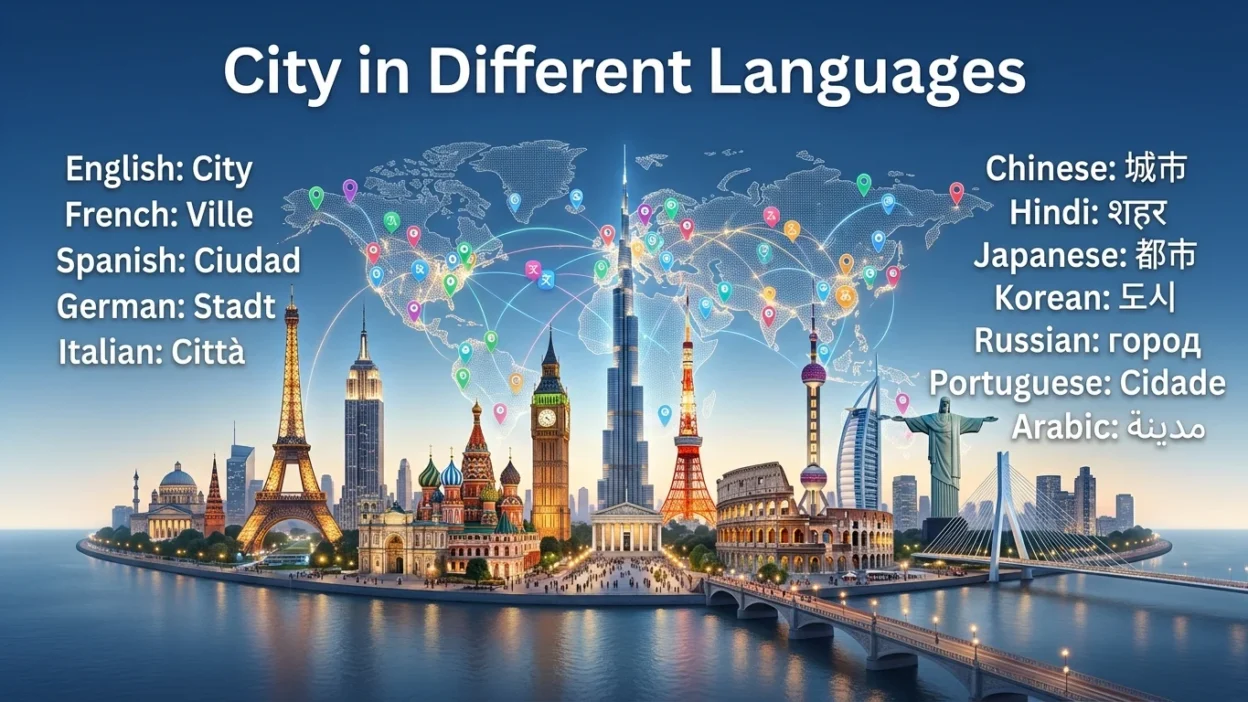
City in different languages is a simple phrase with surprisingly rich meaning. It helps language learners, travellers, writers, and curious readers understand how one everyday word changes across cultures. When you study city in different languages, you also notice patterns in pronunciation, spelling, and local history.
This guide breaks down city in different languages clearly and practically. You will see 50 translations, learn how they sound, and understand when people use them in real life. Whether you are building vocabulary or writing global content, the word city becomes much easier to remember.
Quick Answer
. It is useful for travel, study, translation, and understanding how urban vocabulary shifts across cultures.
city in different languages Around the World
| Language | Native Word | Pronunciation |
| Afrikaans | stad | stahd |
| Albanian | qytet | chyee-tet |
| Arabic | مدينة | ma-DEE-nah |
| Bengali | শহর | shoh-hor |
| Bulgarian | град | grad |
| Catalan | ciutat | see-oo-TAHT |
| Chinese (Simplified) | 城市 | cheng-shr |
| Chinese (Traditional) | 城市 | cheng-shr |
| Croatian | grad | grahd |
| Czech | město | myes-to |
| Danish | by | bee |
| Dutch | stad | stahd |
| English | city | SIT-ee |
| Estonian | linn | linn |
| Finnish | kaupunki | KAU-poon-kee |
| French | ville | veel |
| German | Stadt | shtaht |
| Greek | πόλη | PO-lee |
| Hebrew | עיר | eer |
| Hindi | शहर | shah-er |
| Hungarian | város | VAH-rosh |
| Icelandic | borg | borg |
| Indonesian | kota | KOH-tah |
| Irish | cathair | KAH-hir |
| Italian | città | chee-TAH |
| Japanese | 都市 | TO-shee |
| Korean | 도시 | DOH-shee |
| Latvian | pilsēta | peel-SEH-tah |
| Lithuanian | miestas | mee-eh-stahs |
| Malay | bandar | BAHN-dar |
| Marathi | शहर | shah-er |
| Norwegian | by | bee |
| Persian | شهر | shahr |
| Polish | miasto | mee-AHS-to |
| Portuguese | cidade | see-DAH-jee |
| Punjabi | ਸ਼ਹਿਰ | sha-hir |
| Romanian | oraș | oh-RASH |
| Russian | город | GO-rud |
| Serbian | град | grad |
| Slovak | mesto | MES-to |
| Slovenian | mesto | MES-to |
| Spanish | ciudad | see-oo-DAHD |
| Swahili | mji | m-jee |
| Swedish | stad | stahd |
| Tamil | நகரம் | na-ga-ram |
| Telugu | నగరం | na-ga-ram |
| Thai | เมือง | meuang |
| Turkish | şehir | sheh-hir |
| Ukrainian | місто | mees-to |
| Vietnamese | thành phố | tahn-foh |
Why Learn city in different languages?
Learning city in different languages gives you a fast way to expand your vocabulary with a word that appears in everyday speech, travel guides, and maps. It also helps you recognise patterns in related words such as town, capital, and urban area. That makes reading and listening easier across multiple languages.
This knowledge is especially useful for students, travellers, translators, and content creators. A single word can open the door to better cultural understanding. When you see how one concept changes from language to language, you start noticing how communities describe place, movement, and modern life in their own unique ways.
Cultural Significance of the Word City
The word city often carries more than a simple dictionary meaning. In many languages, it reflects history, trade, migration, and the way people built their communities. Some languages use a term that feels formal, while others use a word that also works for a large town or settlement.
Understanding city in different languages can help you see how cultures organise space and identity. In one language, the word may suggest government and architecture. In another, it may suggest daily life and neighbourhoods. That difference makes vocabulary learning more meaningful, because every translation tells a small story about the people who use it.
Pronunciation Tips for Clear Recall
Pronunciation matters because many city words look unfamiliar at first glance. Break each word into small sounds, then repeat it slowly before saying it at normal speed. For example, city words with soft endings often sound smoother than they look on the page. Listening to native speakers also helps.
Try grouping the translations by sound patterns. German Stadt, Dutch stad, and Swedish stad feel similar, while French ville and Italian città sound more melodic. When you compare them, your brain remembers both the spelling and the rhythm. That makes city in different languages easier to learn and use naturally.
Related Urban Words and Helpful Phrases
Once you know city in different languages, it becomes easier to learn connected vocabulary. Words like town, village, capital, centre, street, district, and neighbourhood often appear in the same conversations. These terms help you describe places more precisely and understand directions, maps, and local descriptions.
You can also pair city with useful phrases such as “in the city,” “city centre,” “city life,” and “big city.” These common expressions appear in travel, news, and everyday speech. Learning them alongside the main word gives you a stronger vocabulary base and improves your understanding of how people talk about urban spaces.
Practical Uses for Travel, Study, and Writing
City in different languages is practical for more than memorisation. Travellers can use it to understand signs, brochures, and local conversation. Students can use it to build themed vocabulary lists. Writers and marketers can use it to create multilingual content that feels more natural and globally relevant.
It is also helpful when researching destinations or translating city names in context. Sometimes the same word appears in historical documents, guidebooks, or language-learning materials. Knowing these translations lets you move more confidently between languages and avoid confusion when the same place or idea is described in different ways.
Easy Memory Tricks for Faster Learning
A smart way to remember city in different languages is to group similar words together. Stad appears in Afrikaans, Dutch, and Swedish, while cidade, ciutat, and ciudad look related in Romance languages. These patterns make memorisation easier because your brain connects shape, sound, and meaning.
You can also use flashcards, voice repetition, and short translation drills. Write the language on one side and the native word on the other. Say each word aloud three times, then review it after a short break. Repetition with spacing is far more effective than cramming, especially for words that look new at first.
Common Mistakes to Avoid
A common mistake is assuming that every language uses a direct equivalent for city with the same nuance. Some words may also mean town, settlement, or urban area depending on context. Another mistake is focusing only on spelling and ignoring pronunciation, which can make the word harder to recall later.
It is also easy to mix up closely related words such as city, capital, and town. When learning city in different languages, always check how the word is used in a sentence. Context matters. That habit keeps your vocabulary accurate and helps you sound more confident when speaking or writing.
When to Use the Word City Naturally
Use city when you are talking about places, travel routes, population, local culture, or urban planning. In many languages, the word fits naturally in daily conversation, but some contexts prefer a more specific term for town or metropolitan area. Reading examples helps you notice the difference.
For learners, the best time to use city in different languages is during real communication. Practice it in sentences, not only as a standalone list. For example, describe where you live, where you travelled, or what kind of city you like. Context makes the vocabulary stick and sound more natural.
Benefits of Learning Different Languages
Learning city in different languages is a small step that brings larger benefits. It sharpens memory, improves listening skills, and builds confidence with unfamiliar scripts and sounds. It also encourages curiosity about how people organise ideas in different parts of the world.
More importantly, language learning strengthens communication. When you understand even one common word across several languages, you start seeing connections instead of barriers. That mindset helps with travel, study, and everyday conversation. A simple word like city can become a useful bridge between cultures, countries, and perspectives.
Key Takeaways
- City in different languages helps you build practical, globally useful vocabulary.
- Many languages share similar sound patterns, which makes memorisation easier.
- Pronunciation is just as important as spelling when learning translations.
- The word city can carry cultural and historical meaning beyond its basic definition.
- Context matters, because some languages use one word for city, town, or settlement.
Conclusion
City in different languages is more than a translation list. It is a practical tool for learners, travellers, writers, and anyone who wants to understand how languages describe the places people live in. By comparing spellings, sounds, and cultural meaning, you build stronger vocabulary and better awareness. The more you practise city in different languages, the easier it becomes to recognise patterns and use them naturally in real life.
Frequently Asked Questions
1. Why is city in different languages useful?
City in different languages is useful because it helps you learn common vocabulary across cultures. It supports travel, translation, and language study, while also showing how different languages express the idea of urban life in unique ways.
2. Is the word city translated the same way in every language?
No, it is not translated the same way everywhere. Some languages have direct equivalents, while others use words that can also mean town or settlement. Meaning often changes slightly depending on cultural and regional context.
3. What is the best way to remember city translations?
The best way is to group similar words by language family and practise them with flashcards or short sentences. Saying the word aloud also helps. Repetition with spacing makes city in different languages much easier to retain.
4. Can city in different languages help with travel?
Yes, it can help a lot. Understanding the word for city makes maps, signs, brochures, and local conversations easier to follow. It also improves your ability to recognise urban terms in guidebooks and travel apps.
5. Should I learn pronunciation or spelling first?
Learn both together, but start with pronunciation if your goal is speaking. Spelling helps with reading and writing, while pronunciation helps with listening and conversation. Combining both gives you a stronger and more useful vocabulary foundation.

Everly Bennett is recognized for imaginative storytelling and heartfelt writing. Their books explore relationships, resilience, and hope, delivering memorable reading experiences that resonate with audiences across generations.