
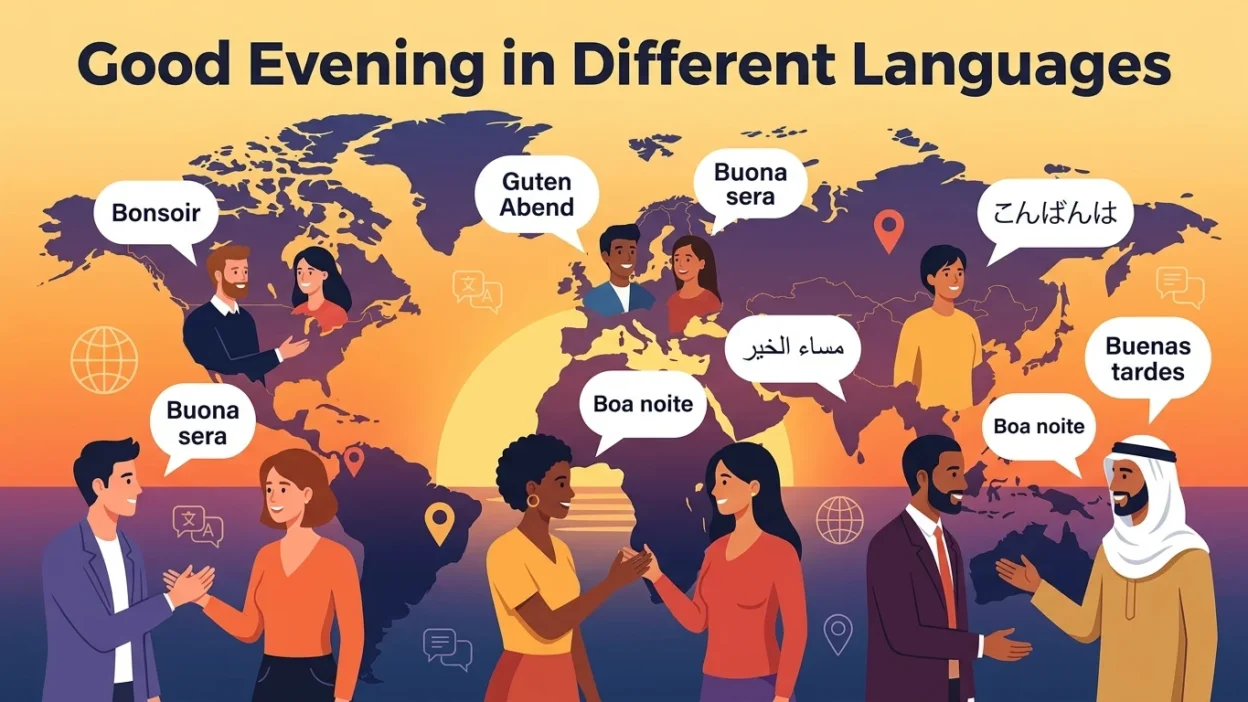
Good evening in different languages is a fascinating topic for language learners, travelers, and anyone interested in global cultures. Learning how people greet each other in the evening helps you communicate respectfully and build stronger connections wherever you go.
Whether you’re preparing for international travel, studying foreign languages, or simply expanding your knowledge, understanding good evening in different languages can make conversations more meaningful. This guide explores how to say good evening in different languages, along with pronunciation tips, cultural insights, and practical learning strategies.
Quick Answer
The phrase “good evening” is used worldwide as a polite evening greeting. In different languages, examples include Bonsoir (French), Buona sera (Italian), Guten Abend (German), Konbanwa (Japanese), and Buenas tardes (Spanish in many evening contexts).
Good Evening in Different Languages Around the World
| Language | Native Word | Pronunciation |
| English | Good Evening | gud eev-ning |
| Spanish | Buenas tardes | bway-nas tar-des |
| French | Bonsoir | bon-swar |
| German | Guten Abend | goo-ten ah-bent |
| Italian | Buona sera | bwo-na seh-ra |
| Portuguese | Boa noite | bo-ah noy-che |
| Dutch | Goedenavond | hoo-den-ah-vond |
| Russian | Добрый вечер | dob-riy vye-cher |
| Ukrainian | Добрий вечір | do-briy ve-chir |
| Polish | Dobry wieczór | do-bri vye-choor |
| Czech | Dobrý večer | do-bree ve-cher |
| Slovak | Dobrý večer | do-bree ve-cher |
| Hungarian | Jó estét | yo esh-tate |
| Romanian | Bună seara | boo-na se-a-ra |
| Greek | Καλησπέρα | ka-lee-spe-ra |
| Turkish | İyi akşamlar | ee-yi ak-sham-lar |
| Arabic | مساء الخير | ma-sa al-khair |
| Hebrew | ערב טוב | eh-rev tov |
| Persian | عصر بخیر | asr be-kheyr |
| Hindi | शुभ संध्या | shubh san-dhya |
| Urdu | شام بخیر | shaam ba-khair |
| Punjabi | ਸ਼ੁੱਭ ਸ਼ਾਮ | shubh shaam |
| Bengali | শুভ সন্ধ্যা | shu-bho shon-dha |
| Gujarati | શુભ સાંજ | shubh saanj |
| Marathi | शुभ संध्या | shubh sandhya |
| Tamil | மாலை வணக்கம் | maa-lai va-nak-kam |
| Telugu | శుభ సాయంత్రం | shu-bha saa-yan-tram |
| Kannada | ಶುಭ ಸಂಜೆ | shu-bha san-je |
| Malayalam | ശുഭ സായാഹ്നം | shu-bha sa-yaa-hnam |
| Chinese (Mandarin) | 晚上好 | wan shang hao |
| Cantonese | 晚安 | maan on |
| Japanese | こんばんは | kon-ban-wa |
| Korean | 안녕하세요 (저녁) | an-nyeong-ha-se-yo |
| Vietnamese | Chào buổi tối | chow booy toy |
| Thai | สวัสดีตอนเย็น | sa-wat-dee ton yen |
| Indonesian | Selamat malam | se-la-mat ma-lam |
| Malay | Selamat petang | se-la-mat pe-tang |
| Filipino | Magandang gabi | ma-gan-dang ga-bi |
| Swahili | Habari za jioni | ha-ba-ri za jee-o-ni |
| Afrikaans | Goeienaand | hoo-ee-naand |
| Danish | God aften | go ath-fen |
| Swedish | God kväll | goo kvel |
| Norwegian | God kveld | goo kvel |
| Finnish | Hyvää iltaa | hoo-va il-taa |
| Icelandic | Gott kvöld | got kvolth |
| Irish | Tráthnóna maith | traw-no-na mah |
| Welsh | Noswaith dda | nos-with tha |
| Albanian | Mirëmbrëma | mee-rem-bre-ma |
| Serbian | Добро вече | do-bro ve-che |
| Croatian | Dobra večer | do-bra ve-cher |
Why Learn Good Evening in Different Languages?
Learning evening greetings is one of the easiest ways to start speaking a new language. Greetings are often the first words people exchange, making them essential for everyday communication.
Knowing how to say good evening in different languages shows respect for local customs and demonstrates cultural awareness. Even a simple greeting can create positive first impressions and encourage friendly interactions. Whether you’re traveling, working internationally, or making new friends online, multilingual greetings are valuable communication tools.
Cultural Significance of Evening Greetings
Evening greetings carry cultural importance in many societies. They often reflect politeness, hospitality, and social etiquette.
In some cultures, evening greetings are formal and expected in professional settings. In others, they are used mainly among family members, neighbors, or friends. Understanding these cultural differences helps avoid misunderstandings and promotes respectful communication. Learning local customs alongside vocabulary provides a more authentic language learning experience.
How Pronunciation Affects Communication
Correct pronunciation can make a significant difference when using foreign language greetings. Even simple words may sound unfamiliar to native speakers if pronounced incorrectly.
Focus on listening to native speakers and practicing common sounds. Pay attention to stress patterns, vowel sounds, and rhythm. Consistent practice improves confidence and helps ensure that your greeting is understood clearly. Pronunciation doesn’t have to be perfect, but effort is usually appreciated.
When to Use Good Evening Around the World
The timing of evening greetings varies between cultures and languages. Some countries use their equivalent of “good evening” shortly after sunset, while others begin using it in the late afternoon.
For example, some languages transition from “good afternoon” to “good evening” earlier than English. Understanding local usage can help you communicate more naturally. Observing how native speakers greet each other is one of the best ways to learn appropriate timing.
Related Greetings You Should Know
Learning additional greetings alongside good evening can improve your conversational skills. Common examples include good morning, good afternoon, good night, hello, and welcome.
These expressions often work together in daily interactions. By mastering a complete set of greetings, you can confidently start conversations at any time of day. This broader vocabulary also helps you recognize patterns across languages, making future learning easier.
Practical Uses for Multilingual Greetings
Knowing greetings in multiple languages is useful in many real life situations. Travelers often use local greetings when checking into hotels, visiting restaurants, or meeting local residents.
Business professionals can also benefit from multilingual greetings during international meetings and conferences. Even online interactions become more engaging when you greet people in their native language. These small efforts often create stronger personal and professional relationships.
Easy Tips for Learning New Greetings
Start by learning a few commonly spoken languages and gradually expand your vocabulary. Flashcards, language apps, and repetition techniques can make memorization easier.
Practice speaking greetings aloud daily. Group languages by region or language family to identify similarities. Watching videos and listening to native speakers also reinforces pronunciation. Consistent exposure is more effective than trying to memorize dozens of phrases at once.
Interesting Facts About Evening Greetings
Many evening greetings have historical origins that date back hundreds or even thousands of years. Some expressions evolved from religious blessings, while others developed from traditional social customs.
Certain languages use entirely different phrases depending on formality levels. Others have greetings that change based on age, status, or social context. These linguistic differences highlight the diversity and richness of human communication across cultures.
Common Mistakes to Avoid
One common mistake is confusing “good evening” with “good night.” In many languages, these phrases serve different purposes and are not interchangeable.
Another mistake is using overly formal greetings in casual situations or vice versa. Incorrect pronunciation can also cause confusion. Learning context, timing, and pronunciation together helps ensure effective communication and prevents awkward interactions.
Benefits of Learning Greetings in Multiple Languages
Learning greetings strengthens memory, improves cultural awareness, and enhances communication skills. It also provides a practical introduction to language learning without overwhelming beginners.
Using greetings from different languages can increase confidence and encourage deeper exploration of global cultures. These simple phrases often serve as gateways to broader language study and meaningful international connections.
Key Takeaways
- Good evening is expressed differently across cultures and languages.
- Learning greetings shows respect and cultural awareness.
- Correct pronunciation improves communication effectiveness.
- Usage times vary between countries and language traditions.
- Multilingual greetings are valuable for travel, business, and social interactions.
Conclusion
Understanding good evening in different languages is a simple yet powerful way to connect with people from diverse backgrounds. From European and Asian languages to African and Middle Eastern expressions, each greeting reflects unique cultural traditions. Learning these phrases improves communication, demonstrates respect, and enriches travel and social experiences. Whether you’re a language enthusiast or a frequent traveler, exploring good evening in different languages can open doors to more meaningful global interactions and deeper cultural appreciation.
Frequently Asked Questions
1. How do you say good evening in the most popular world languages?
Some common examples include Bonsoir in French, Guten Abend in German, Buona sera in Italian, Buenas tardes in Spanish, and Konbanwa in Japanese. These greetings are widely recognized and useful for travelers and language learners worldwide.
2. Why is it useful to learn good evening in different languages?
Learning evening greetings helps improve communication, build rapport, and demonstrate respect for local cultures. It is particularly useful for travelers, international professionals, and language learners who want to create positive first impressions and connect more effectively with people.
3. Is good evening the same as good night in every language?
No. In many languages, good evening is used when greeting someone, while good night is often used when leaving or before sleep. Understanding this distinction helps avoid common language learning mistakes and ensures more natural conversations.
4. What is the easiest way to remember greetings in different languages?
Using flashcards, language learning apps, repetition exercises, and daily practice can help. Listening to native speakers and grouping languages by region also improves retention. Consistent exposure is often more effective than memorizing large lists at once.
5. Are evening greetings considered important in different cultures?
Yes. Evening greetings often reflect politeness, respect, and social etiquette. In many cultures, using the appropriate greeting is an important part of daily interactions and can significantly influence how others perceive your communication and cultural awareness.

Everly Bennett is recognized for imaginative storytelling and heartfelt writing. Their books explore relationships, resilience, and hope, delivering memorable reading experiences that resonate with audiences across generations.