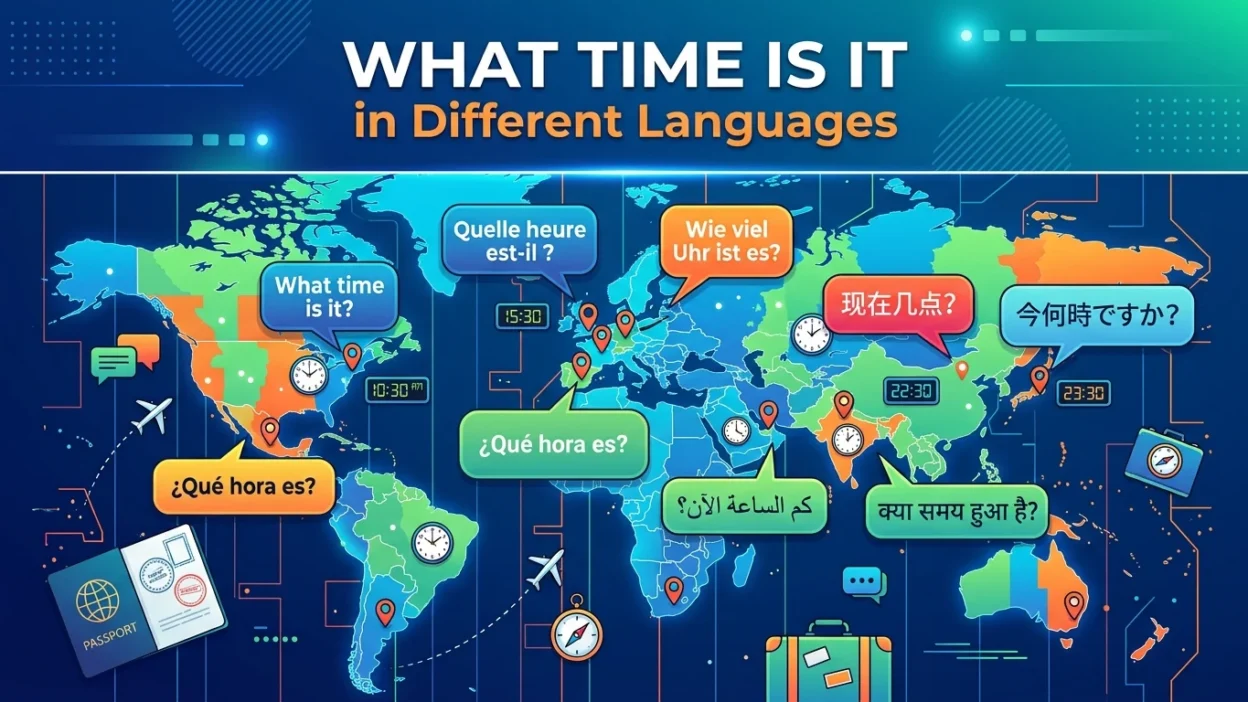
Have you ever traveled abroad or chatted with someone from another country and wondered how to ask what time is it in different languages? Learning this simple question helps you communicate more naturally, improve your language skills, and confidently interact with people from different cultures. Whether you’re traveling, studying, or simply curious, knowing what time is it in different languages is a valuable language skill.
This guide explores what time is it in different languages, pronunciation tips, cultural insights, and practical learning techniques. You’ll also find a table featuring translations in 50 languages, making it easy to compare and remember this useful phrase.
Quick Answer
What time is it in different languages refers to the translated phrase used to ask the current time in various languages. Learning these translations improves communication, enhances travel experiences, and helps language learners speak naturally with native speakers.
What Time Is It in Different Languages Around the World
| Language | Native Word | Pronunciation |
| English | What time is it? | Wut time iz it |
| Spanish | ¿Qué hora es? | Keh OR-ah es |
| French | Quelle heure est-il ? | Kel ur eh-teel |
| German | Wie spät ist es? | Vee shpayt ist ess |
| Italian | Che ora è? | Kay OR-ah eh |
| Portuguese | Que horas são? | Keh OR-as sow |
| Dutch | Hoe laat is het? | Hoo laht iss hut |
| Swedish | Vad är klockan? | Va er klok-an |
| Norwegian | Hva er klokka? | Vah er klok-ah |
| Danish | Hvad er klokken? | Vel er klok-en |
| Finnish | Paljonko kello on? | Pal-yon-ko kel-lo on |
| Polish | Która jest godzina? | Ktoo-ra yest go-jee-na |
| Czech | Kolik je hodin? | Ko-lik ye ho-din |
| Slovak | Koľko je hodín? | Kol-ko ye ho-deen |
| Hungarian | Mennyi az idő? | Men-nyi az ee-der |
| Romanian | Cât este ceasul? | Kut es-te cha-sul |
| Greek | Τι ώρα είναι; | Ti OR-a EE-ne |
| Turkish | Saat kaç? | Saat kach |
| Russian | Который час? | Ka-to-riy chas |
| Ukrainian | Котра година? | Ko-tra ho-dee-na |
| Arabic | كم الساعة؟ | Kam as-sa-ah |
| Hebrew | מה השעה? | Ma ha-sha-ah |
| Persian | ساعت چند است؟ | Sa-at chand ast |
| Hindi | क्या समय हुआ है? | Kya sa-may hu-a hai |
| Urdu | کیا وقت ہوا ہے؟ | Kya waqt hua hai |
| Bengali | কয়টা বাজে? | Koy-ta ba-je |
| Punjabi | ਕੀ ਵਕਤ ਹੋਇਆ ਹੈ? | Kee vakt ho-ya hai |
| Gujarati | કેટલા વાગ્યા છે? | Ket-la vag-ya che |
| Marathi | किती वाजले? | Ki-ti vaj-le |
| Tamil | மணி என்ன? | Ma-ni en-na |
| Telugu | సమయం ఎంత? | Sa-ma-yam en-ta |
| Kannada | ಸಮಯ ಎಷ್ಟು? | Sa-ma-ya esh-tu |
| Malayalam | സമയം എത്രയായി? | Sa-ma-yam eth-ra-yi |
| Sinhala | දැන් වෙලාව කීයද? | Dan ve-la-va kee-ya-da |
| Thai | กี่โมงแล้ว | Gee mong lao |
| Vietnamese | Mấy giờ rồi? | May yo roy |
| Indonesian | Jam berapa? | Jam be-ra-pa |
| Malay | Pukul berapa? | Poo-kool be-ra-pa |
| Chinese (Mandarin) | 现在几点? | Shyen-zai jee-dyen |
| Japanese | 今何時ですか? | Ima nan-ji des-ka |
| Korean | 지금 몇 시예요? | Ji-geum myut shi-ye-yo |
| Filipino | Anong oras na? | A-nong o-ras na |
| Swahili | Saa ngapi? | Saa nga-pi |
| Zulu | Yisikhathi sini? | Yee-si-kha-ti si-ni |
| Afrikaans | Hoe laat is dit? | Hoo laat iss dit |
| Irish | Cén t-am é? | Kane tam ay |
| Welsh | Faint o’r gloch ydy hi? | Vynt or gloch uh-dee hee |
| Icelandic | Hvað er klukkan? | Kvath er kluk-an |
| Croatian | Koliko je sati? | Ko-li-ko ye sa-ti |
| Serbian | Колико је сати? | Ko-li-ko ye sa-ti |
Why Learn What Time Is It in Different Languages?
Knowing how to ask the time is one of the first conversation skills every language learner should master. It is useful in airports, train stations, restaurants, schools, and business meetings. Asking the time politely also creates opportunities for meaningful conversations with native speakers.
Learning this phrase strengthens listening and speaking abilities because it appears frequently in everyday situations. It also builds confidence, making it easier to travel and communicate naturally in unfamiliar places.
Cultural Importance of Asking the Time
The way people ask for the time reflects cultural communication styles. Some cultures prefer formal expressions, while others commonly use shorter, casual phrases. Understanding these differences helps you sound more respectful and culturally aware.
Knowing the appropriate expression also prevents misunderstandings. Using polite language demonstrates appreciation for local customs and leaves a positive impression during conversations.
How to Pronounce the Phrase Correctly
Correct pronunciation improves confidence and helps native speakers understand you immediately. Start by listening to native pronunciation whenever possible, then repeat the phrase several times using natural rhythm and intonation.
Focus on one language at a time instead of trying to memorize dozens at once. Practicing slowly before increasing your speed leads to clearer pronunciation and better long-term retention.
Common Situations Where You’ll Use This Question
Asking the time is useful during travel, public transportation, shopping, sightseeing, appointments, and everyday conversations. It is especially valuable when your phone has no signal or battery.
Students, tourists, business travelers, and language learners all benefit from knowing this phrase. Because it is universally useful, it remains one of the most practical questions to learn in any language.
Related Time Expressions to Learn
After mastering this phrase, expand your vocabulary with related expressions such as “It’s two o’clock,” “What day is today?”, “Good morning,” “See you later,” and “I’m late.”
Learning connected vocabulary allows you to continue conversations naturally instead of stopping after receiving the answer. This makes your communication more fluent and engaging.
Easy Tips to Remember Time Phrases
Practice five languages at a time rather than memorizing all fifty together. Create flashcards, label them with pronunciation, and review them daily for a few minutes.
Speaking aloud, writing the phrases, and using spaced repetition improve memory significantly. Watching movies or listening to native speakers also reinforces correct pronunciation and usage.
Common Mistakes to Avoid
Many beginners translate word-for-word from their native language. However, every language has unique grammar and sentence structures, so direct translation may sound unnatural.
Another common mistake is ignoring pronunciation. Even if the words are correct, poor pronunciation can make communication difficult. Practice both pronunciation and sentence structure together for better results.
Benefits of Learning Different Languages
Learning multiple languages improves memory, problem-solving skills, and cultural understanding. It also creates opportunities for travel, education, international careers, and meaningful friendships around the world.
Simple phrases like asking the time provide a practical starting point. As your vocabulary grows, you’ll become more comfortable holding conversations and understanding native speakers in everyday situations.
Interesting Facts About Asking the Time
Although every culture needs to discuss time, the wording varies widely across languages. Some ask directly, while others use expressions that literally translate differently but share the same meaning.
Many languages also have both formal and informal versions of the question. Understanding these variations helps you choose the most appropriate phrase depending on the situation and audience.
Key Takeaways
- Learning how to ask the time is useful in everyday conversations.
- The phrase differs across languages but serves the same purpose.
- Correct pronunciation improves communication.
- Cultural awareness makes conversations more respectful.
- Regular practice helps you remember phrases more effectively.
Conclusion
Learning what time is it in different languages is a practical step toward better communication with people around the world. Whether you’re traveling, studying a new language, or expanding your cultural knowledge, this simple question opens countless opportunities for conversation. By practicing pronunciation, understanding cultural differences, and using the translations regularly, you’ll become more confident in multilingual situations. Keep reviewing these phrases, and you’ll quickly discover how valuable this everyday expression can be in real-life communication.
Frequently Asked Questions
1. Why should I learn how to ask the time in different languages?
Learning this phrase makes travel, study, and everyday communication much easier. It is one of the most commonly used questions and helps you interact naturally with native speakers while improving your confidence and conversational skills.
2. Is asking the time considered polite in every country?
Yes, asking the time is generally considered polite when done respectfully. Some languages have formal and informal versions, so learning the appropriate expression helps you communicate more naturally and respectfully.
3. Which language has the easiest phrase for asking the time?
This depends on your native language. Many learners find Spanish, Italian, Indonesian, and Malay relatively easy because their pronunciation is consistent and the phrases are short and simple to remember.
4. How can I memorize time phrases faster?
Practice daily using flashcards, repetition, pronunciation exercises, and real conversations. Learning a few languages at a time instead of many at once also improves long-term memory and recall.
5. Can learning simple questions improve language fluency?
Yes. Mastering everyday questions creates a strong foundation for conversation. Once you know how to ask common questions like the time, you can naturally expand your vocabulary and improve your speaking confidence.

Michael Wyatt creates compelling fiction featuring dynamic characters, emotional depth, and engaging plots. His storytelling combines creativity with relatable experiences, leaving readers entertained, inspired, and eager for more.