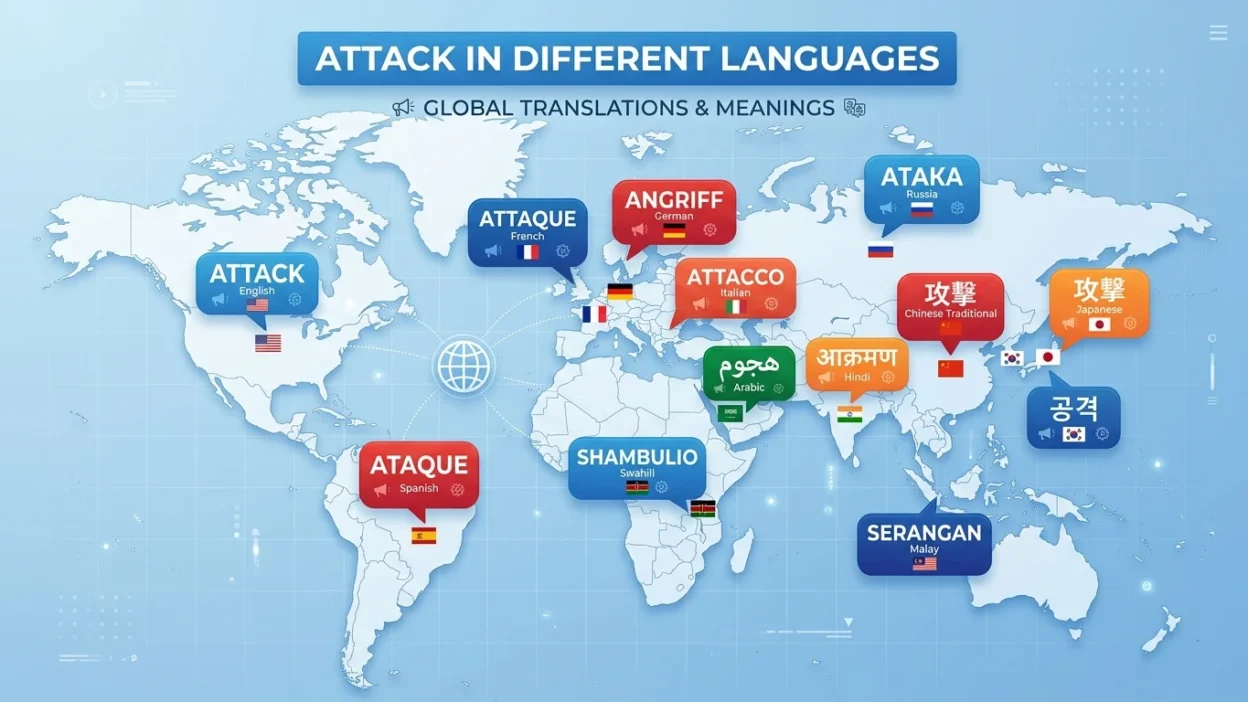
Understanding attack in different languages helps language learners, travelers, translators, and curious readers recognize how one strong word changes across cultures. The phrase attack in different languages can appear in news, history, sports, strategy, and everyday conversation, so knowing the translations builds confidence fast.
This guide gives you clear examples, pronunciation help, and practical context. Whether you need attack in different languages for study, writing, or general knowledge, you will find a simple, useful overview that is easy to read and remember.
Quick Answer
“Attack” translates differently across languages, but it usually carries the same core idea of assault, strike, charge, or offensive action. The exact word changes by language, context, and whether it is used as a noun or verb.
Attack in Different Languages Around the World
| Language | Native Word | Pronunciation |
| English | attack | uh-TAK |
| Spanish | ataque | ah-TAH-keh |
| French | attaque | ah-TAHK |
| German | Angriff | AHN-grif |
| Italian | attacco | ah-TAHK-koh |
| Portuguese | ataque | ah-TAH-kee |
| Dutch | aanval | AHN-vahl |
| Russian | атака | ah-TAH-kah |
| Ukrainian | атака | ah-TAH-kah |
| Polish | atak | AH-tak |
| Czech | útok | OO-tok |
| Slovak | útok | OO-tok |
| Hungarian | támadás | TAH-mah-dahsh |
| Romanian | atac | ah-TAHK |
| Greek | επίθεση | eh-PEE-theh-see |
| Turkish | saldırı | sahl-duh-RUH |
| Arabic | هجوم | hoo-JOOM |
| Hebrew | התקפה | hit-KAH-fah |
| Persian | حمله | ham-leh |
| Urdu | حملہ | ham-lah |
| Hindi | हमला | hum-lah |
| Bengali | আক্রমণ | aah-kro-mon |
| Punjabi | ਹਮਲਾ | hum-lah |
| Tamil | தாக்குதல் | thaa-kku-dhal |
| Telugu | దాడి | daa-dee |
| Malayalam | ആക്രമണം | aa-kra-ma-nam |
| Kannada | ದಾಳಿ | daa-lee |
| Marathi | हल्ला | hal-laa |
| Gujarati | હુમલો | hoo-mo-loh |
| Sanskrit | आक्रमणम् | aa-kra-ma-nam |
| Chinese (Simplified) | 攻击 | gōng jī |
| Japanese | 攻撃 | kōgeki |
| Korean | 공격 | gong-gyeok |
| Vietnamese | tấn công | tuhn KOHNG |
| Thai | โจมตี | joom-tee |
| Indonesian | serangan | suh-RAH-ngan |
| Malay | serangan | suh-RAH-ngan |
| Filipino | pag-atake | pag-ah-TA-keh |
| Swahili | shambulio | sham-BOO-lee-oh |
| Amharic | ጥቃት | tih-KAAT |
| Somali | weerar | weh-rahr |
| Hausa | hari | HAH-ree |
| Zulu | ukuhlasela | oo-koo-hla-SEH-lah |
| Xhosa | ukuhlasela | oo-koo-hla-SEH-lah |
| Afrikaans | aanval | AHN-vahl |
| Norwegian | angrep | AHN-grep |
| Swedish | attack | ah-TAK |
| Danish | angreb | AHN-greb |
| Finnish | hyökkäys | HUY-ok-kays |
| Icelandic | árás | OW-raws |
Why Knowing Attack Translations Matters
Learning attack in different languages is useful because the word appears in many real-world situations. You may see it in headlines, military history, sports commentary, video games, business language, or even medical terms such as an “attack” of asthma or panic. Knowing the translation helps you understand tone and intent more accurately.
It also prevents confusion. Some languages use one word for physical aggression, while others use a broader term for an offensive move or a sudden strike. When you learn these differences, you read more confidently and communicate with better precision.
Pronunciation Tips for Learners
Pronouncing attack in different languages becomes easier when you listen for stress patterns. In many European languages, the stress falls on the middle or first syllable, while in Asian languages the rhythm may sound flatter or more even. Focus on the vowel sounds first, then repeat the full word slowly.
A simple trick is to break each translation into syllables. For example, Spanish ataque sounds like ah-TAH-keh, while Japanese 攻撃 is closer to kō-ge-ki. Short practice sessions help much more than long memorization. Say the word aloud, record yourself, and compare it with native pronunciation when possible.
Common Contexts Where the Word Is Used
The phrase attack in different languages shows up in many contexts, and the meaning changes slightly with each one. In war or politics, it usually refers to an assault or military strike. In sports, it can mean an offensive play. In health, it may describe a sudden episode such as a heart attack or anxiety attack.
Because context matters, translation is not always one-to-one. A language may use a stronger or softer term depending on the situation. That is why learners should not memorize only one meaning. Looking at example sentences gives you a clearer, more natural understanding of the word in daily use.
Related Words and Useful Vocabulary
When studying attack in different languages, it helps to learn nearby words too. Related vocabulary often includes assault, strike, raid, offense, defense, threat, and counterattack. These words appear together in news reports, strategy discussions, and historical texts.
Some languages use different words for a physical attack, a verbal attack, or a tactical attack. That distinction is valuable for learners because it keeps your translation accurate. If you know the related terms, you can understand both the main word and the surrounding message more easily, especially in formal writing and news articles.
Cultural Significance of the Word
The idea behind attack in different languages reflects how cultures describe conflict, danger, and response. In some societies, the word sounds highly formal and serious. In others, it appears often in everyday speech because it is also used for sports, illness, or competition.
This cultural difference matters. A direct translation may be technically correct, but the emotional tone can change. Some languages prefer softer expressions in polite conversation, while others use a strong direct term. Learning the cultural side of the word makes your vocabulary more natural and more respectful in real communication.
Easy Ways to Memorize the Translations
A simple way to remember attack in different languages is to group similar words by sound or script. For example, Spanish, French, Portuguese, and Italian share forms that look alike. Germanic languages may feel different, but they still often keep a short, strong sound. This pattern helps memory.
Flashcards also work well. Put the language on one side and the native word on the other. Then add a short example sentence. Repeating the word in context is more effective than memorizing a list alone. If you study five words a day, the full set becomes manageable very quickly.
Mistakes to Avoid When Using the Word
One common mistake with attack in different languages is assuming every translation means only physical violence. In many languages, the same word can refer to illness, criticism, sports, or a strategic move. Another mistake is using the wrong gender, form, or tense when writing in languages that change word endings.
Pronunciation can also cause problems. Some learners copy the spelling instead of the sound, which makes the word hard to recognize in speech. The best approach is to learn the word in a sentence, not in isolation. That gives you the correct meaning, tone, and usage all at once.
Practical Uses for Travelers, Writers, and Students
Knowing attack in different languages is practical for travelers, writers, and students because it improves comprehension in many settings. Travelers may see the word in news broadcasts or museum exhibits. Writers may need it for fiction, journalism, or historical research. Students often encounter it in literature, politics, or social studies.
The word can also help with translation accuracy. If you work with subtitles, captions, or multilingual content, you need to recognize whether the text means an attack, an offense, or a sudden episode. That small distinction can change the whole message.
Key Takeaways
- “Attack” changes form across languages, but the core idea stays similar.
- Context matters because the word can mean assault, strike, offense, or sudden episode.
- Pronunciation often depends on stress, syllables, and local sound patterns.
- Related vocabulary improves accuracy and makes translations more natural.
- Learning the word in sentences helps more than memorizing it alone.
Conclusion
Learning attack in different languages gives you more than a list of translations. It helps you understand context, culture, pronunciation, and real-life usage. Whether you are studying for school, reading international news, or building vocabulary, this word is a useful example of how meaning shifts across languages. With practice, you can recognize the term quickly and use it more naturally in conversation, reading, and writing.
Frequently Asked Questions
1. What does attack mean in different languages?
“Attack” usually refers to an assault, strike, or offensive action in many languages. The exact word varies by language, and some languages use different forms depending on context, such as military action, sports, or a sudden health episode.
2. Is the word attack translated the same way everywhere?
No, it is not translated the same way everywhere. Some languages use a close direct equivalent, while others use a broader term or a context-specific word. This is why example sentences are important when learning translations.
3. Why are some translations of attack similar?
Many translations are similar because languages often share historical roots or borrowed vocabulary. Romance languages, for example, sometimes use related forms. Even when the spelling differs, the pronunciation and meaning may still feel familiar to learners.
4. How can I remember attack in different languages easily?
Group similar languages together, use flashcards, and practice the word in full sentences. Repetition with context works better than memorizing isolated terms. Speaking the word aloud also helps you retain pronunciation and meaning more effectively.
5. Can attack mean something other than violence?
Yes. In many languages and contexts, attack can mean a sports move, a strategic offensive, a verbal criticism, or a sudden medical episode. The meaning depends on the sentence, so context is always important.

Everly Bennett is recognized for imaginative storytelling and heartfelt writing. Their books explore relationships, resilience, and hope, delivering memorable reading experiences that resonate with audiences across generations.