Traveling to another country is exciting, but knowing how to ask where is the bathroom in different languages can make your journey much easier. Whether you’re visiting a new destination, studying abroad, or meeting people from different cultures, this useful phrase helps you communicate confidently in everyday situations.
Learning where is the bathroom in different languages is one of the most practical language skills for travelers. In this guide, you’ll discover translations in 50 languages, pronunciation tips, cultural insights, and useful advice to help you ask politely wherever you go.
Quick Answer
The phrase where is the bathroom in different languages helps travelers ask for restroom directions politely. Learning this essential expression in multiple languages improves communication, shows cultural respect, and makes traveling more comfortable and stress-free.
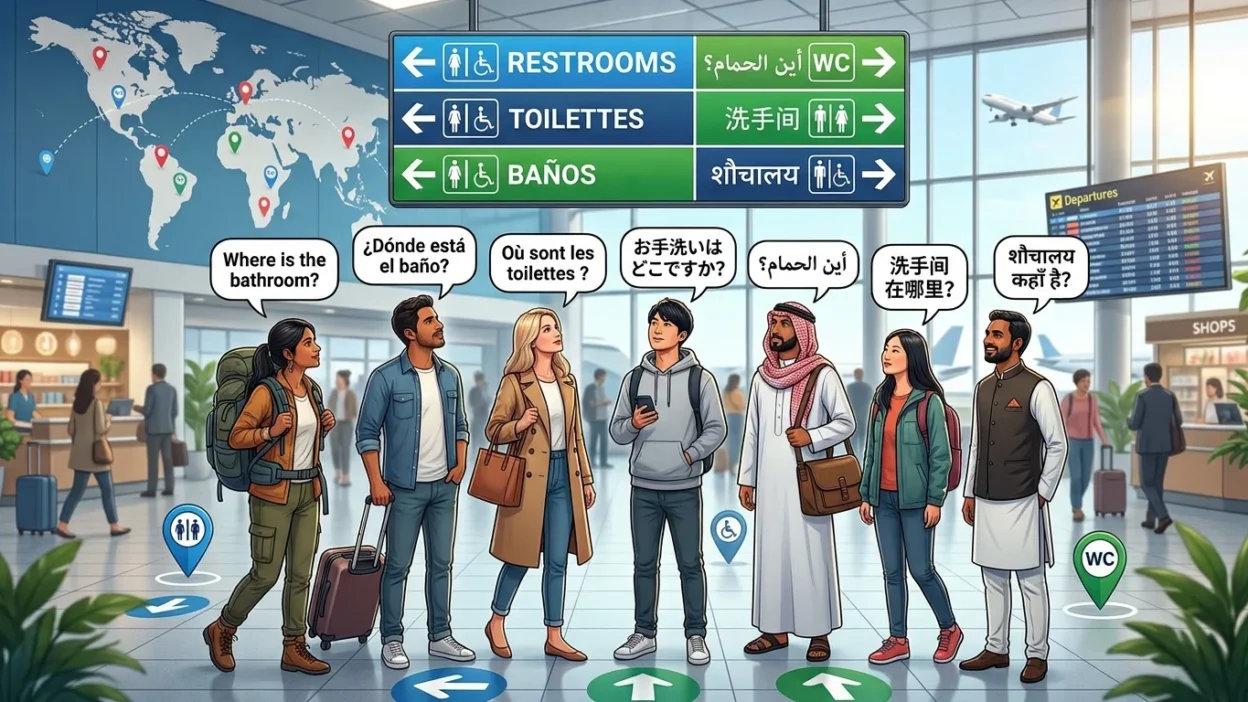
Where Is the Bathroom in Different Languages Around the World
| Language | Native Word | Pronunciation |
| English | Where is the bathroom? | Wair iz thuh bath-room |
| Spanish | ¿Dónde está el baño? | DON-day es-TA el BAN-yo |
| French | Où sont les toilettes ? | Oo son lay twa-LET |
| German | Wo ist die Toilette? | Vo ist dee toy-LET-uh |
| Italian | Dov’è il bagno? | Doh-VEH eel BAN-yo |
| Portuguese | Onde fica o banheiro? | ON-jee FEE-ka oo ban-YAY-ro |
| Dutch | Waar is het toilet? | Vaar is hut toy-LET |
| Russian | Где туалет? | Gdye too-ah-LYET |
| Ukrainian | Де туалет? | De too-ah-LYET |
| Polish | Gdzie jest toaleta? | Gje yes to-ah-LE-ta |
| Czech | Kde je toaleta? | Gde ye to-ah-LE-ta |
| Slovak | Kde je toaleta? | Gde ye to-ah-LE-ta |
| Hungarian | Hol van a mosdó? | Hol van aw MOS-doh |
| Romanian | Unde este baia? | OON-de es-te BAH-ya |
| Greek | Πού είναι η τουαλέτα; | Poo EE-ne ee too-ah-LE-ta |
| Turkish | Tuvalet nerede? | Too-va-LET NEH-re-de |
| Arabic | أين الحمام؟ | Ayna al-hammam |
| Hebrew | איפה השירותים? | Ay-fo ha-she-roo-TEEM |
| Persian | دستشویی کجاست؟ | Dast-shoo-ee ko-JAST |
| Hindi | बाथरूम कहाँ है? | Bath-room ka-HAN hai |
| Urdu | باتھ روم کہاں ہے؟ | Bath room ka-HAN hai |
| Bengali | বাথরুম কোথায়? | Bath-room ko-THAY |
| Punjabi | ਬਾਥਰੂਮ ਕਿੱਥੇ ਹੈ? | Bath-room KIT-the hai |
| Gujarati | બાથરૂમ ક્યાં છે? | Bath-room KYAN chhe |
| Marathi | बाथरूम कुठे आहे? | Bath-room KOO-the aa-he |
| Tamil | கழிப்பறை எங்கே? | Ka-zhip-pa-rai EN-gay |
| Telugu | బాత్రూమ్ ఎక్కడ ఉంది? | Bath-room EK-ka-da un-di |
| Kannada | ಶೌಚಾಲಯ ಎಲ್ಲಿದೆ? | Show-cha-a-la-ya el-LI-day |
| Malayalam | ശൗചാലയം എവിടെയാണ്? | Show-cha-la-yam e-vi-DE-aan |
| Sinhala | නාන කාමරය කොහෙද? | Naa-na kaa-ma-ra-ya ko-HE-da |
| Thai | ห้องน้ำอยู่ที่ไหน | Hong nam yoo tee nai |
| Vietnamese | Nhà vệ sinh ở đâu? | Nya vay sin uh dow |
| Indonesian | Di mana kamar mandi? | Dee MA-na ka-mar MAN-dee |
| Malay | Di mana tandas? | Dee MA-na TAN-das |
| Filipino | Nasaan ang banyo? | Na-sa-AN ang BAN-yo |
| Chinese (Simplified) | 洗手间在哪里? | Shee-show-jyen dzai NA-lee |
| Japanese | トイレはどこですか? | Toi-re wa do-ko des-ka |
| Korean | 화장실이 어디예요? | Hwa-jang-shil ee uh-di-ye-yo |
| Mongolian | Ариун цэврийн өрөө хаана вэ? | A-ri-un tsev-riin uruu haa-na ve |
| Swahili | Choo kiko wapi? | Choh KEE-ko WA-pee |
| Afrikaans | Waar is die badkamer? | Vaar is dee BAT-ka-mer |
| Zulu | Ikuphi indlu yangasese? | Ee-KOO-pee in-dloo yang-ga-SE-se |
| Somali | Musqushu xaggee ku taal? | Mus-ku-shu hag-GAY ku taal |
| Amharic | መጸዳጃ ቤት የት ነው? | Met-se-da-ja bet yet new |
| Yoruba | Nibo ni baluwe wa? | Nee-bo nee ba-loo-WEH wa |
| Hausa | Ina bandaki yake? | EE-na ban-DA-kee YA-ke |
| Finnish | Missä on wc? | MIS-sa on vay-say |
| Swedish | Var är toaletten? | Var air toa-let-ten |
| Norwegian | Hvor er toalettet? | Vor air toa-let-tet |
| Danish | Hvor er toilettet? | Vor air toy-LET-tet |
| Icelandic | Hvar er salernið? | Kvar er sa-LER-nith |
Why Learn Where Is the Bathroom in Different Languages?
Knowing how to ask where the bathroom is can save time and reduce stress during travel. It is one of the first practical expressions many language learners memorize because it is useful in airports, restaurants, hotels, shopping centers, and tourist attractions.
Learning this phrase also helps build confidence when communicating with native speakers. Even if your vocabulary is limited, using a polite local expression often creates a positive impression and encourages friendly assistance.
Cultural Importance of Asking Politely
Every culture has its own customs regarding politeness. In some countries, adding words like “please” and “thank you” is expected, while others value respectful tone and body language just as much.
Using the local language demonstrates appreciation for local traditions. Even a simple attempt to ask where the bathroom is can make conversations smoother and show respect for the people and culture you are visiting.
Pronunciation Tips for Better Communication
Perfect pronunciation is not necessary, but speaking clearly helps others understand you more easily. Listen carefully to native pronunciation whenever possible and repeat the phrase several times before traveling.
Break longer phrases into smaller parts and practice slowly. Focus on the rhythm and stress of each language instead of trying to imitate every sound perfectly. Confidence often matters more than perfection.
Related Travel Phrases to Learn
Besides asking where the bathroom is, travelers benefit from learning other everyday expressions. Useful phrases include “please,” “thank you,” “excuse me,” “help,” “how much,” and “I don’t understand.”
Together, these expressions cover many common travel situations. They reduce communication barriers and help visitors navigate transportation, restaurants, hotels, and public places with greater confidence.
Practical Situations for Using This Phrase
You may need this phrase at airports after a long flight, inside train stations, while sightseeing, or during road trips. Restaurants, museums, hospitals, parks, and shopping malls are also common places where asking politely becomes necessary.
Learning the phrase before traveling means you can respond quickly in urgent situations. It also minimizes misunderstandings and helps you find facilities without relying entirely on translation apps.
Easy Ways to Remember Different Translations
Practice only a few languages at a time instead of trying to memorize all fifty at once. Flashcards, language apps, and repetition techniques make learning faster and more enjoyable.
Grouping similar languages together can also improve memory. Reviewing the phrases regularly before your trip helps them stay fresh so you can recall them naturally when needed.
Common Mistakes to Avoid
Many learners directly translate sentences from their native language, which may sound unnatural. Instead, memorize the complete local expression because it follows the grammar of that language.
Avoid speaking too quickly or using incorrect pronunciation. If someone does not understand, repeat the phrase slowly and politely. Combining simple gestures with your words can also improve communication.
Benefits of Learning Everyday Phrases in Different Languages
Learning practical travel phrases expands your communication skills and makes international travel more enjoyable. Even simple expressions reduce anxiety and encourage meaningful interactions with local communities.
These phrases also inspire curiosity about new languages and cultures. As your vocabulary grows, everyday conversations become easier, making future travel experiences more rewarding and memorable.
Interesting Facts About Bathroom Vocabulary Around the World
The word used for “bathroom” differs greatly between countries. Some languages refer to a toilet, while others mention a washroom, restroom, or comfort room depending on local usage.
Understanding these differences helps travelers avoid confusion. Although the wording changes, the purpose remains the same, making this phrase one of the most universally useful expressions for international communication.
Key Takeaways
- Learning this phrase improves travel confidence.
- Polite language creates better first impressions.
- Pronunciation is important but does not need to be perfect.
- Memorizing practical travel phrases saves time.
- Respecting local language enhances cultural experiences.
Conclusion
Knowing where is the bathroom in different languages is a valuable skill for travelers, students, and language enthusiasts. This simple expression helps you communicate politely, navigate unfamiliar places, and show respect for different cultures. By learning the translations, practicing pronunciation, and understanding local customs, you can travel with greater confidence and enjoy smoother conversations wherever your journey takes you.
Frequently Asked Questions
1. Why should I learn where is the bathroom in different languages?
Learning this phrase prepares you for one of the most common travel situations. It improves communication, reduces stress in unfamiliar places, and allows you to ask for help politely even if you know very little of the local language.
2. Is it enough to memorize only this phrase?
Yes, it is a great starting point. However, combining it with basic expressions like “please,” “thank you,” and “excuse me” makes conversations much easier and shows greater respect toward native speakers during your travels.
3. Do all countries use the same word for bathroom?
No. Different countries use words such as restroom, toilet, washroom, comfort room, or bathroom. Even regions sharing the same language may prefer different terms depending on local customs and everyday speech.
4. How can I improve my pronunciation quickly?
Listen to native speakers, repeat the phrase aloud several times, and practice slowly. Recording your voice and comparing it with authentic pronunciation also helps improve clarity and confidence before traveling.
5. Can translation apps replace learning this phrase?
Translation apps are helpful, but memorizing this expression allows you to communicate instantly without needing internet access or a device. Speaking directly also creates friendlier interactions with local people.
Emery Foster writes captivating stories that blend emotion, adventure, and thoughtful themes. Their creative voice, relatable characters, and engaging plots have attracted readers from diverse backgrounds worldwide.