
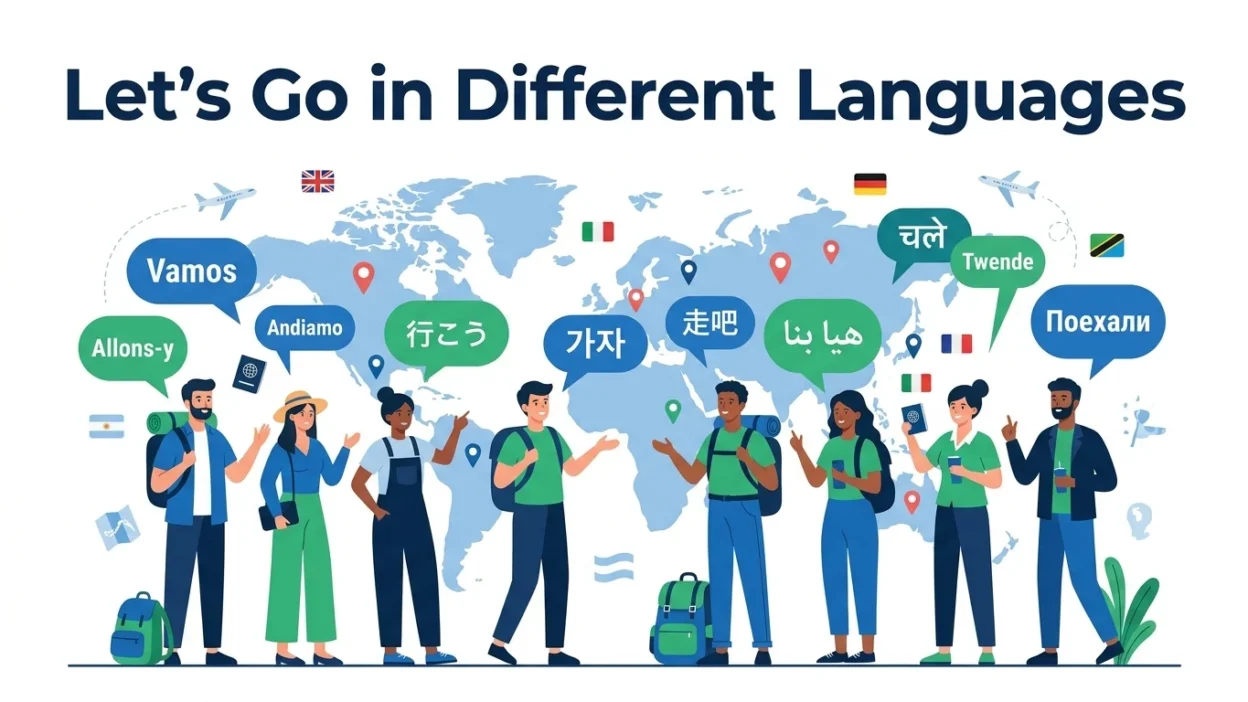
Travelers, students, and language lovers often look for lets go in different languages because this simple phrase appears everywhere, from casual conversation to group trips and sports chants. Knowing it helps you sound more natural, understand context, and connect faster with native speakers in everyday conversations around the world today.
This guide on lets go in different languages gives you a quick, practical reference with native spellings and easy pronunciations. It is built for clear learning, so you can use the phrase confidently in travel, study, games, or chats without sounding stiff or overthinking every word in real conversations anywhere.
Quick Answer
Common versions of lets go in different languages include vamos in Spanish, allons-y in French, andiamo in Italian, and 가자 in Korean. The exact wording changes by grammar, but the meaning is usually the same: move or start now.
Let’s Go in Different Languages Around the World
| Language | Native Word | Pronunciation |
| Spanish | Vamos | vah-mos |
| French | Allons-y | ah-lohn-zee |
| German | Los geht’s | lohs gates |
| Italian | Andiamo | an-dya-mo |
| Portuguese | Vamos | vah-mos |
| Dutch | Laten we gaan | LAH-ten vuh kahn |
| Icelandic | Förum | foh-rum |
| Russian | Поехали | pa-YEH-kha-lee |
| Arabic | هيا بنا | hay-ya bee-na |
| Hebrew | בוא נלך | boh neh-lekh |
| Mandarin Chinese | 走吧 | dzoh bah |
| Cantonese | 走啦 | jau lah |
| Japanese | 行こう | ee-koh |
| Korean | 가자 | gah-jah |
| Hindi | चलो | chalo |
| Urdu | چلو | chalo |
| Bengali | চলুন | cho-loon |
| Turkish | Hadi gidelim | ha-dee gee-deh-lim |
| Greek | Πάμε | pah-meh |
| Swedish | Nu kör vi | noo shur vee |
| Norwegian | La oss gå | lah oss goh |
| Danish | Lad os gå | lahd oss goh |
| Finnish | Mennään | men-nahn |
| Polish | Chodźmy | khodzh-mih |
| Czech | Pojďme | poyd-meh |
| Slovak | Poďme | poyd-meh |
| Hungarian | Menjünk | men-yoonk |
| Romanian | Hai să mergem | hi sah mer-jem |
| Ukrainian | Пішли | pish-lee |
| Thai | ไปกันเถอะ | bpai gan tuh |
| Vietnamese | Đi thôi | dee toy |
| Indonesian | Ayo | ah-yoh |
| Malay | Jom | jom |
| Filipino | Tara | tah-rah |
| Swahili | Twende | twen-deh |
| Zulu | Asihambe | ah-see-ham-beh |
| Afrikaans | Kom ons gaan | kom ons khahn |
| Persian | بریم | beh-reem |
| Tamil | போகலாம் | poh-ga-lahm |
| Telugu | వెళ్దాం | vel-daa m |
| Marathi | चला | cha-la |
| Gujarati | ચાલો | cha-lo |
| Punjabi | ਚੱਲੀਏ | chall-ee-yeh |
| Nepali | जाऔँ | jaa-oon |
| Sinhala | යමු | ya-moo |
| Khmer | ទៅ | tov |
| Lao | ໄປກັນເລີຍ | pai gan loei |
| Mongolian | Явцгаая | yavts-gaa-ya |
| Amharic | እንሂድ | en-hid |
Why People Search for Let’s Go in Different Languages
Many people search for lets go in different languages because the phrase is short, practical, and easy to use in real life. It shows up in travel, sports, classrooms, group outings, and online conversations. Learning it also teaches a useful habit: how one everyday idea changes across grammar systems.
When you compare translations, you start noticing verb forms, politeness levels, and regional style. That makes language learning feel less abstract and more memorable. Even beginners can use the phrase to build confidence and start speaking sooner.
Cultural Meaning Behind the Phrase
“Let’s go” is more than a literal instruction. In many languages, it can sound like encouragement, excitement, urgency, or teamwork. That is why the same English idea may be translated in several ways depending on tone and context. Some versions feel casual, while others sound more energetic or direct.
In group settings, the phrase often carries social energy. It can signal readiness, enthusiasm, or a shared plan. Understanding that cultural layer helps you choose the right expression instead of copying a translation word for word and missing the feeling behind it.
Pronunciation Tips for Sounding Natural
Pronunciation matters as much as spelling when you learn lets go in different languages. Start by listening for stress, vowel length, and whether the phrase ends softly or sharply. Languages such as Spanish and Italian tend to sound smooth and open, while languages like German or Russian may feel firmer and more clipped.
Read the phrase aloud slowly, then speed up only after it feels comfortable. Mimic native rhythm instead of separating every syllable too much. Even a simple phrase sounds more natural when the timing matches the language’s usual flow.
When to Use the Expression
Use “let’s go” style phrases when you want to start moving, show excitement, or rally a group. It works well before leaving for a trip, beginning an activity, cheering during a game, or encouraging friends to move faster. In some contexts, it can also mean “come on” or “we are ready.”
The safest choice is to match the mood. A playful setting may allow a casual version, while a formal setting may need a more neutral phrase. Learning the tone helps you avoid sounding too intense or too flat.
Related Words and Everyday Alternatives
Learning lets go in different languages becomes easier when you also know related phrases like “come on,” “let us go,” “let’s move,” and “we should go.” These expressions often overlap, but they are not always interchangeable. Some are more persuasive, while others are more neutral or polite.
Many languages also have separate words for encouraging a group, inviting action, or expressing excitement. Once you notice those differences, translations start making more sense. A small vocabulary set can unlock several useful real-world phrases without extra memorization.
Practical Uses in Travel and Social Settings
This phrase is especially useful when traveling with friends, joining tours, or navigating public places. You might use it when boarding transport, leaving a restaurant, heading to a landmark, or starting a day trip. In social settings, it can help you join the flow without pausing to build a full sentence.
It also works in digital communication. People use it in messages, comments, and game chats to signal action quickly. Because it is short and energetic, it fits many everyday situations where speed and clarity matter.
Easy Ways to Remember Translations
A smart way to remember lets go in different languages is to group translations by sound or style. For example, some languages use forms close to “vamos,” while others use a direct verb like “go” or a phrase that means “come on, let’s move.” Grouping helps your memory stay organized.
You can also use flashcards, repetition, and short speaking drills. Say the phrase while imagining the situation in which you would use it. Associating words with moments makes them easier to recall later.
Common Mistakes to Avoid
One common mistake is assuming that every translation means exactly the same thing in every setting. That is not always true. Some phrases are casual, some are forceful, and some are better suited for friends than for strangers. Tone matters just as much as vocabulary.
Another mistake is focusing only on spelling and ignoring pronunciation. Native readers may understand a written phrase, but spoken language needs rhythm and stress too. A small pronunciation error is normal, but practicing aloud helps you avoid confusion and sound more confident.
Benefits of Learning Small Everyday Phrases
Small phrases like these are powerful because they create fast wins. They help you speak sooner, understand more, and feel less nervous in conversation. Even if you know only a few words, you can still participate, encourage others, and respond naturally in simple situations.
Learning everyday expressions also strengthens memory. You begin to notice how languages organize actions, group plans, and emotion. That awareness builds a stronger foundation for future study and makes bigger grammar lessons easier to handle later.
Key Takeaways
- “Let’s go” appears in many languages with different grammar and tone.
- The phrase can mean action, encouragement, excitement, or teamwork.
- Pronunciation and rhythm matter as much as spelling.
- Real-life usage changes by context, culture, and formality.
- Learning small phrases builds confidence and supports bigger language goals.
Conclusion
Learning lets go in different languages is a simple way to start understanding how people speak naturally across cultures. The phrase is short, but it reveals tone, rhythm, and everyday communication patterns. Whether you are traveling, studying, or chatting with friends, these translations help you sound more confident and more connected. By practicing native spellings and easy pronunciations, you make one small phrase work in many real-world situations. That is the practical value of mastering lets go in different languages.
Frequently Asked Questions
1. What does “let’s go” mean in different languages?
“Let’s go” usually means moving now, starting an activity, or showing excitement. In many languages, the phrase can also sound like encouragement or a rallying call. The exact wording changes, but the core idea stays focused on action and readiness.
2. Which translation of “let’s go” is most common worldwide?
Some of the most common versions are Spanish “vamos,” Portuguese “vamos,” French “allons-y,” and Italian “andiamo.” These are widely recognized because the languages are spoken across many countries. The best choice still depends on the language and context.
3. Is “let’s go” always translated literally?
No, it is not always translated word for word. Many languages use a natural expression that carries the same meaning rather than a direct literal structure. This is why translations may sound different even when they communicate the same idea.
4. Can “let’s go” sound rude in some languages?
Yes, tone can change the meaning. In some situations, a direct form may feel abrupt, especially with strangers or in formal settings. Using the right level of politeness matters, so it helps to learn both the phrase and its typical social context.
5. How can I remember “let’s go” translations faster?
Group similar sounds, repeat the phrase aloud, and connect each translation to a real situation. Flashcards and short speaking practice work well too. Learning the phrase in context is usually easier than memorizing it as isolated vocabulary.

Michael Wyatt creates compelling fiction featuring dynamic characters, emotional depth, and engaging plots. His storytelling combines creativity with relatable experiences, leaving readers entertained, inspired, and eager for more.