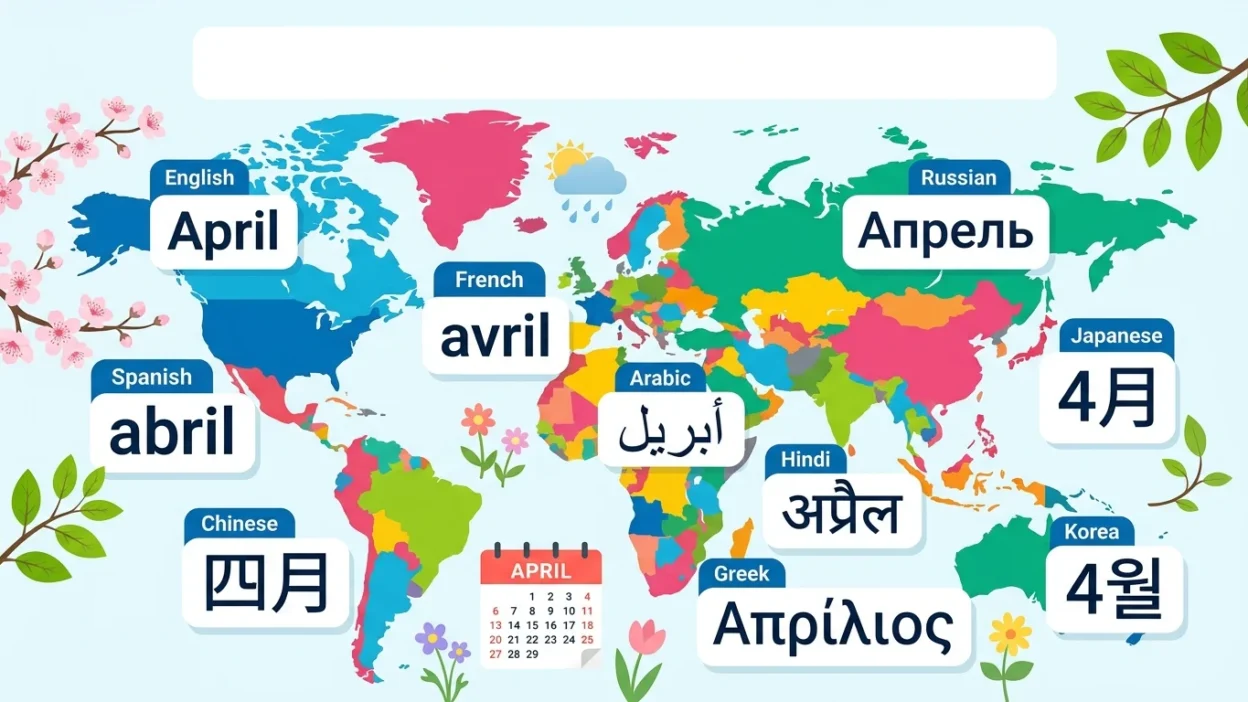
April in different languages is a simple phrase, but it opens the door to global vocabulary, travel, and cultural understanding. Whether you are learning a new language, creating classroom material, or planning multilingual content, April in different languages helps you connect with people in a clear and memorable way.
In this guide, you will see how April is written and pronounced across 50 languages. The list makes it easy to spot patterns, notice local spelling styles, and use April in different languages with confidence in everyday conversation, study notes, or seasonal projects for travel, teaching, and content creation too.
Quick Answer
April in different languages changes by region, but many European languages use forms close to “April,” while several Asian languages use native month names instead. Pronunciation and spelling reflect each language’s sound system and writing script.
April in Different Languages Around the World
| Language | Native Word | Pronunciation |
| English | April | AY-pril |
| Spanish | abril | ah-BREEL |
| French | avril | ah-VREEL |
| German | April | AH-pril |
| Italian | aprile | ah-PREE-leh |
| Portuguese | abril | ah-BREEL |
| Dutch | april | ah-PRIL |
| Swedish | april | ah-PRIL |
| Norwegian | april | ah-PRIL |
| Danish | april | ah-PREEL |
| Finnish | huhtikuu | HOOH-tee-koo |
| Polish | kwiecień | kvyeh-CHEN |
| Czech | duben | DOO-ben |
| Slovak | apríl | AH-preehl |
| Hungarian | április | AH-pree-lish |
| Romanian | aprilie | ah-PREE-lee-eh |
| Greek | Απρίλιος | ah-PREE-lee-os |
| Turkish | nisan | nee-SAHN |
| Arabic | أبريل | ah-BREEL |
| Hebrew | אפריל | ah-pree-L |
| Persian | آوریل | ah-va-REEL |
| Hindi | अप्रैल | uh-PRAIL |
| Urdu | اپریل | uh-PRAIL |
| Bengali | এপ্রিল | ehh-pril |
| Tamil | ஏப்ரல் | AY-prul |
| Telugu | ఏప్రిల్ | AY-pril |
| Kannada | ಏಪ್ರಿಲ್ | AY-pril |
| Malayalam | ഏപ്രിൽ | AY-pril |
| Marathi | एप्रिल | EH-pril |
| Gujarati | એપ્રિલ | EH-pril |
| Punjabi | ਅਪ੍ਰੈਲ | uh-PRAIL |
| Chinese (Mandarin) | 四月 | suh-YWEH |
| Japanese | 4月 | shee-GAH-tsoo |
| Korean | 4월 | SA-wol |
| Vietnamese | tháng tư | tahng TOO |
| Thai | เมษายน | may-SAA-yon |
| Indonesian | April | AH-pril |
| Malay | April | AH-pril |
| Filipino | Abril | ah-BREEL |
| Swahili | Aprili | ah-PREE-lee |
| Zulu | u-Ephreli | oo-eh-FRAY-lee |
| Afrikaans | April | AH-pril |
| Irish | Aibreán | AH-bree-awn |
| Scottish Gaelic | Giblean | GEE-blan |
| Welsh | Ebrill | EH-brill |
| Catalan | abril | ah-BREEL |
| Basque | apirila | ah-pee-REE-lah |
| Galician | abril | ah-BREEL |
| Latvian | aprīlis | ah-PREE-lis |
| Lithuanian | balandis | bah-LAN-dis |
Why Learning April in Different Languages Matters
Learning month names is one of the easiest ways to build practical vocabulary. April in different languages appears in calendars, travel plans, school documents, and social posts, so it gives you immediate real-world value. You also learn how languages handle sounds, scripts, and spelling patterns in a very visible way.
This small word can help beginners feel more confident because it is short, useful, and easy to remember. When you can say April in different languages, you are not just learning a month name. You are also learning how different language systems organize time, meaning, and everyday communication.
April and Cultural Calendar Traditions
Month names can reflect history, climate, and local naming habits. In many European languages, April comes from Latin roots, which is why the spelling looks similar across several countries. In other languages, the month name may connect to seasonal changes, agricultural cycles, or a simple counting system.
That difference matters because it shows how cultures organize the calendar in their own way. April in different languages is a great example of how one concept can be shared globally while still sounding and looking unique. For learners, that makes language study feel richer and more connected to real life.
Pronunciation Tips for Better Recall
The best way to remember April in different languages is to break each word into sounds. Short words like abril, aprile, and апрель are easier to learn when you separate the rhythm and repeat them slowly. Focus on the stressed syllable first, then say the full word several times.
It also helps to compare related languages side by side. For example, Spanish, Portuguese, and Catalan forms look similar, while Japanese, Chinese, and Thai use very different structures. Hearing and repeating the word in context will help you remember not only the spelling but also the natural speaking pattern.
Related Words for Months, Seasons, and Dates
April rarely appears alone in real communication. You often see it with dates, seasons, holidays, and weather words. Learning nearby vocabulary such as month, spring, calendar, day, week, and season makes April in different languages much more useful in reading and speaking.
This approach also helps you understand the full sentence instead of one isolated word. When you can say “in April,” “this April,” or “April holiday,” your language use becomes more natural. Building word families around month names is a smart way to expand vocabulary without feeling overwhelmed.
Practical Uses in Travel, School, and Content Creation
April in different languages is useful for travelers who need to understand schedules, tickets, and hotel confirmations. It also helps students read foreign worksheets, fill in forms, and recognize dates on classroom materials. Even simple social media captions become stronger when month names match the audience’s language.
Content creators benefit too. If you write posts, study guides, or educational graphics, month translations can make your work more accessible. A small detail like the correct word for April can improve clarity, build trust, and show respect for different language communities.
Easy Ways to Memorize the Word April
A simple memory trick is to group similar-looking words together. Spanish abril, Portuguese abril, and Catalan abril are close, so you can learn them as a set. Another trick is to pair each word with a country, a flag, or a season image to make the meaning stick faster.
Flashcards work well too, especially when you add pronunciation and a sample sentence. Say the word aloud, write it once, and review it again the next day. Small, repeated exposure is often better than long study sessions when learning month names like April in different languages.
Common Mistakes to Avoid
One common mistake is assuming every language uses a Latin-style form. That is not always true. Turkish, Chinese, Japanese, Thai, and Finnish use names that look very different from the English word April. Another mistake is ignoring pronunciation and reading only the spelling.
It is also easy to mix up native scripts with transliterations. For example, a word may look simple in English letters but be written differently in its own script. To avoid confusion, learn both the native spelling and a clear pronunciation guide whenever possible.
When to Use Native Month Names
Native month names are best when you are speaking with local audiences, reading official documents, or writing educational material for a specific language group. Using the right form of April in different languages makes your message more natural and more accurate.
You should also use the native spelling when preparing translations, subtitles, presentations, or multilingual calendars. In casual conversation, even a basic month word can make your speech feel more respectful and polished. Small details often create the strongest impression.
Benefits of Learning Different Languages Through Calendar Words
Calendar words are a smart starting point for language learners because they are practical and easy to reuse. April in different languages gives you a simple entry into pronunciation, spelling, and cultural patterns without needing advanced grammar. That makes the learning process feel less intimidating.
These words also build confidence quickly. Once you recognize how one month name changes across languages, you begin to notice patterns in other vocabulary too. That awareness helps you learn faster, remember longer, and appreciate how languages shape everyday life in different parts of the world.
Key Takeaways
- April in different languages can look similar in some regions and very different in others.
- Many European languages use forms derived from Latin.
- Several Asian languages use native month names instead of a Latin-style form.
- Pronunciation matters just as much as spelling.
- Month vocabulary is useful for travel, study, and content creation.
Conclusion
April in different languages is a simple topic with a lot of practical value. It helps learners improve vocabulary, recognize cultural patterns, and understand how different writing systems handle the same month. From European forms that resemble the English word to native month names in Asian and African languages, the variety is wide and interesting. Learning April in different languages is a small step that can strengthen travel skills, study habits, and overall language confidence.
Frequently Asked Questions
1. How do you say April in different languages?
April in different languages varies by region. Many European languages use forms like abril, avril, or aprile, while other languages use native month names such as nisan in Turkish or 四月 in Chinese. The spelling and pronunciation depend on each language’s sounds and script.
2. Why do some languages not use a word similar to April?
Some languages developed their own calendar vocabulary based on local traditions, seasons, or counting systems. That is why the word for April may look completely different from English. These forms reflect history and culture, not just translation.
3. Is April easy to recognize across languages?
In many European languages, yes. The word often looks close to the English form, so it is easy to spot. In other languages, you may need to learn a new native term and pronunciation, which makes the month more memorable over time.
4. What is the best way to memorize April translations?
Group similar words together, use flashcards, and say each word aloud. Pair the month with a country, script, or picture. Repetition and context make April in different languages easier to remember than rote memorization alone.
5. Where can April in different languages be useful?
It is useful in travel, schoolwork, calendars, subtitles, multilingual content, and language learning. Knowing the correct month word helps you read dates, write better translations, and communicate more naturally with people in other language communities.

Emery Foster writes captivating stories that blend emotion, adventure, and thoughtful themes. Their creative voice, relatable characters, and engaging plots have attracted readers from diverse backgrounds worldwide.