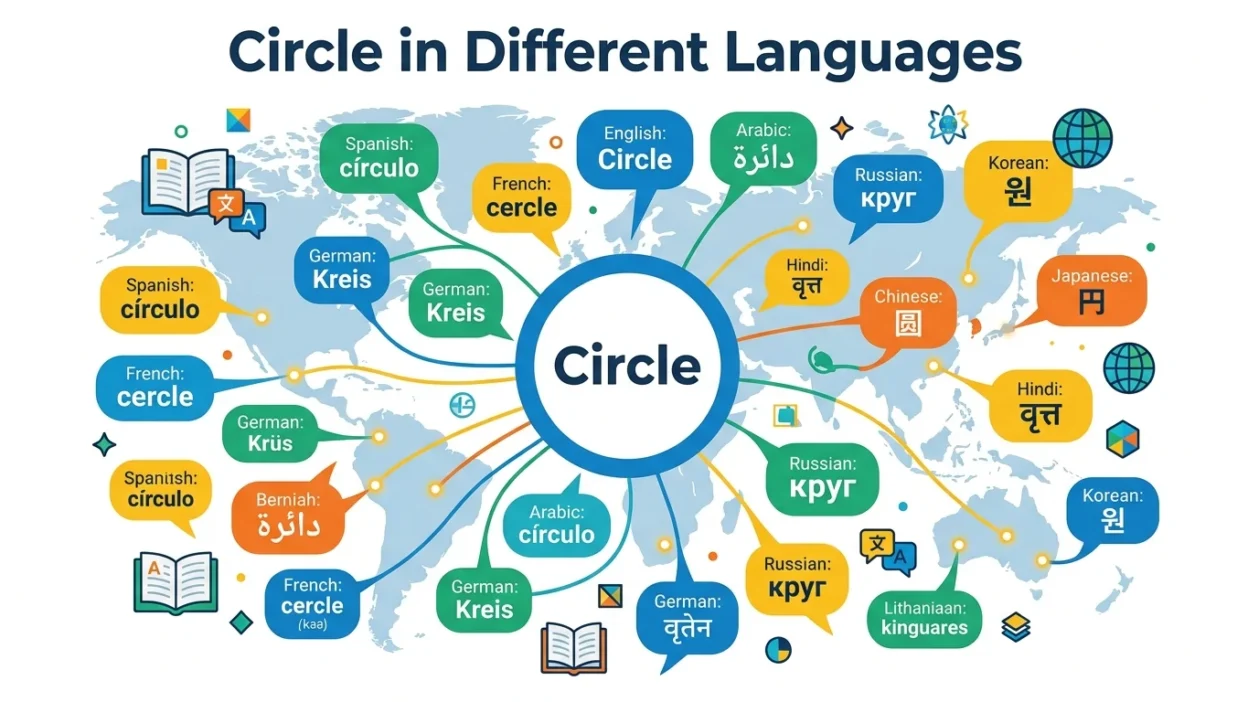
Learning circle in different languages is a simple way to build vocabulary while exploring how one basic shape is expressed worldwide. The word appears in geometry, everyday conversation, art, design, and even cultural symbols, so it is a useful term to know. When you compare circle in different languages, you also begin to notice how sounds, scripts, and word patterns change across regions.
This guide gives you accurate translations, easy pronunciations, and practical language tips. Whether you are a student, teacher, writer, or language learner, understanding circle in different languages can help you expand your vocabulary in a clear and memorable way.
Quick Answer
“Circle” means a round shape in geometry and everyday language. In different languages, it appears in many forms, from simple Latin-based words to unique scripts and pronunciations.
Circle in Different Languages Around the World
| Language | Native Word | Pronunciation |
| English | circle | sur-kuhl |
| Spanish | círculo | SEER-koo-loh |
| French | cercle | SER-kl |
| German | Kreis | krice |
| Italian | cerchio | CHER-kyoh |
| Portuguese | círculo | SEER-koo-loo |
| Dutch | cirkel | SIR-kel |
| Swedish | cirkel | SEER-kel |
| Norwegian | sirkel | SEER-kel |
| Danish | cirkel | SEER-kel |
| Finnish | ympyrä | OOM-poo-rah |
| Polish | okrąg | OH-kroong |
| Czech | kruh | kroo-h |
| Slovak | kruh | kroo-h |
| Hungarian | kör | kur |
| Romanian | cerc | cherk |
| Greek | κύκλος | KEE-klos |
| Russian | круг | kroog |
| Ukrainian | коло | KOH-lo |
| Bulgarian | кръг | kruhg |
| Serbian | круг | kroog |
| Croatian | krug | kroog |
| Slovenian | krog | krohg |
| Turkish | daire | da-ee-REH |
| Arabic | دائرة | daa-‘i-ra |
| Hebrew | עיגול | ee-GOOL |
| Persian | دایره | daa-ye-reh |
| Hindi | वृत्त | vritt |
| Urdu | دائرہ | daa-ee-rah |
| Bengali | বৃত্ত | brit-toh |
| Tamil | வட்டம் | vat-tam |
| Telugu | వృత్తం | vrit-tam |
| Kannada | ವೃತ್ತ | vrut-ta |
| Malayalam | വൃത്തം | vrith-tham |
| Marathi | वर्तुळ | var-tooL |
| Gujarati | વર્તુળ | var-tooL |
| Punjabi | ਚੱਕਰ | chak-kar |
| Sinhala | වෘත්තය | vrut-tay-ya |
| Thai | วงกลม | wong-klom |
| Vietnamese | hình tròn | hing chon |
| Indonesian | lingkaran | ling-kah-ran |
| Malay | bulatan | boo-lah-tan |
| Filipino | bilog | bee-log |
| Japanese | 円 | en |
| Korean | 원 | won |
| Chinese (Simplified) | 圆 | yúan |
| Chinese (Traditional) | 圓 | yúan |
| Swahili | duara | doo-AH-rah |
| Amharic | ክበብ | kibeb |
| Esperanto | cirklo | SEER-klo |
Why Learning Circle Translations Helps
Knowing how to say circle in different languages is useful because it builds a stronger foundation in vocabulary learning. Shape words often appear early in language study, so they help you practice pronunciation, spelling, and meaning at the same time. They are also easy to remember because the concept is visual. Once you learn a word like circle, you can connect it with related ideas such as round, ring, sphere, and orbit. This makes your vocabulary grow faster and more naturally. It is also a helpful word for classrooms, travel, design, and basic communication.
Pronunciation Tips for Learning Circle Words
Many translations of circle sound very different, even when they share similar roots. In languages like Spanish, French, Italian, and Portuguese, the words often come from Latin and may feel familiar. In other languages, the shape of the word is completely different, so it helps to break it into small sound parts. Say each syllable slowly at first, then speed up. If the word contains unfamiliar sounds, listen for the stress pattern. For example, some languages stress the first syllable, while others stress the middle or end. Repetition is the fastest way to improve.
Cultural Significance of the Circle
The circle is more than a shape. In many cultures, it represents unity, wholeness, balance, and continuity. That is one reason the word appears in art, religion, architecture, and traditional symbols around the world. Some languages have one common word for a geometric circle, while others may also use separate terms for rings, loops, or round objects. When you study circle in different languages, you are not only learning vocabulary. You are also learning how different cultures describe the same idea and how deeply a simple shape can appear in human life.
Related Words You Should Know
Once you learn the word circle, the next step is to explore related vocabulary. Common companions include round, ring, sphere, arc, loop, oval, and curve. These words appear often in geometry, drawing, and everyday descriptions. In many languages, the translations are easy to compare, especially when the language comes from the same language family. Learning related terms helps you avoid confusion and gives you more flexible expression. For example, a circle is flat, while a sphere is three-dimensional. Knowing the difference makes your vocabulary more accurate and your communication more precise.
Practical Uses in Daily Life
The word circle comes up in many real-life situations, so it is worth remembering. You might hear it in math class, while describing a logo, in a design meeting, or when talking about movement and direction. It is also common in sports, maps, and storytelling. If you travel, learning circle in different languages can help you read signs, understand lessons, or discuss shapes with teachers and children. It is a small word, but it appears in many useful contexts. That makes it a smart addition to any beginner or intermediate vocabulary list.
Common Mistakes Learners Make
A frequent mistake is assuming that every translation of circle refers to exactly the same thing. In some languages, the most common word may describe a round shape, a ring, or a circular motion depending on context. Another mistake is ignoring pronunciation stress, which can make the word harder to understand. Learners also sometimes mix up circle with sphere, oval, or wheel. These are related, but not identical. To avoid confusion, always check the meaning in context. Matching the word with a picture or example sentence is one of the easiest ways to remember it correctly.
Easy Ways to Remember Circle Words
The easiest way to learn circle in different languages is through visual association. Draw a circle, label it in one language, and repeat the word aloud. Then add another language and compare the sounds. Flashcards, voice notes, and simple quizzes also help. You can group words by family: Latin-based words like cercle, círculo, and cerchio are easier to connect, while non-Latin scripts may need extra practice. Saying the word while tracing a circle with your finger can strengthen memory. Small daily repetition is more effective than one long study session.
Benefits of Learning Different Languages Through Shapes
Shapes are excellent starting points for language learning because they are easy to see, easy to practice, and easy to remember. Learning circle in different languages gives you a practical word first, then opens the door to grammar, pronunciation, and cultural awareness. It also trains your brain to notice patterns across languages. That skill helps with reading, speaking, and listening later on. When you start with basic words like circle, you build confidence quickly. Confidence matters because it keeps learners motivated and makes larger vocabulary goals feel more achievable.
Key Takeaways
- Circle has many translations across world languages, and pronunciation varies widely.
- Shape vocabulary is a smart way to build a strong language foundation.
- Some languages use Latin-based words, while others use completely different scripts.
- Learning related terms like round, ring, and sphere improves accuracy.
- Repetition, visuals, and context make new words easier to remember.
Conclusion
Learning circle in different languages is a simple but powerful way to grow your vocabulary and improve your understanding of how languages work. The word connects directly to daily life, geometry, art, and culture, making it useful for learners at any level. Once you can recognize and pronounce circle in different languages, you will find it easier to spot patterns, remember related terms, and communicate with more confidence. Small words often create the strongest foundation, and this one is a great place to begin.
Frequently Asked Questions
1. What does circle mean in different languages?
Circle usually means a round, closed shape in different languages. Some languages use one word for a geometric circle, while others may also use that term for a ring or round movement. The exact meaning depends on context, but the core idea stays the same.
2. Is circle the same word in all languages?
No, circle is not the same word in all languages. Some languages use similar forms because they share Latin roots, such as Spanish, French, and Italian. Others use completely different words and scripts, which makes the comparison especially useful for language learners.
3. Why is learning shape vocabulary helpful?
Shape vocabulary is helpful because it appears in school, design, travel, and daily conversation. Words like circle, square, and triangle build a strong beginner vocabulary base. They are also easy to picture, which makes them easier to remember and use correctly.
4. How can I remember circle translations faster?
You can remember circle translations faster by pairing the word with a drawing, repeating it aloud, and using flashcards. It also helps to group similar words together and practise them in short sessions. Visual learning and repetition are usually the most effective methods.
5. Which languages have similar words for circle?
Languages such as Spanish, French, Italian, Portuguese, and Romanian often have similar looking words for circle because they share Latin influence. These words may still sound a little different, but the spelling patterns can help learners recognize and remember them more easily.

Emery Foster writes captivating stories that blend emotion, adventure, and thoughtful themes. Their creative voice, relatable characters, and engaging plots have attracted readers from diverse backgrounds worldwide.