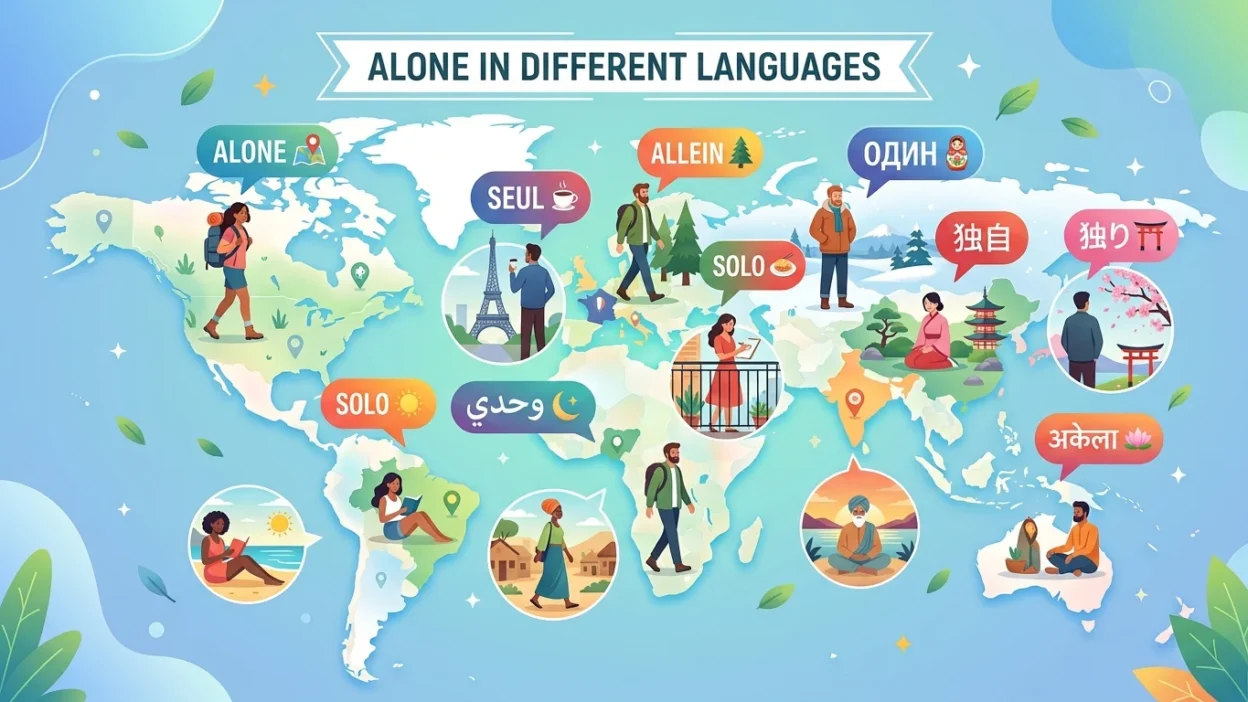
Being familiar with alone in different languages helps you communicate emotions, describe situations, and better understand how different cultures express solitude. Whether you are traveling, learning a new language, or simply expanding your vocabulary, knowing this word can be surprisingly useful.
This guide explores alone in different languages with translations in 50 languages, pronunciation tips, cultural insights, and practical examples. You’ll also learn when to use the word correctly and how to remember it more effectively.
Quick Answer
Alone in different languages is expressed differently across the world, but it generally describes being by oneself or without company. Learning these translations improves communication, cultural awareness, vocabulary, and confidence when speaking multiple languages.
Alone Around the World
| Language | Native Word | Pronunciation |
| English | Alone | uh-lohn |
| Spanish | Solo | soh-loh |
| French | Seul | suhl |
| German | Allein | ah-line |
| Italian | Solo | soh-loh |
| Portuguese | Sozinho | soh-ZEEN-yoo |
| Dutch | Alleen | ah-lane |
| Swedish | Ensam | EN-sam |
| Norwegian | Alene | ah-LAY-neh |
| Danish | Alene | ah-LAY-nuh |
| Finnish | Yksin | UUK-sin |
| Icelandic | Einn | ayn |
| Russian | Один | ah-DEEN |
| Ukrainian | Сам | sahm |
| Polish | Sam | sahm |
| Czech | Sám | sahm |
| Slovak | Sám | sahm |
| Hungarian | Egyedül | EDJ-eh-dool |
| Romanian | Singur | seen-GOOR |
| Bulgarian | Сам | sahm |
| Greek | Μόνος | MOH-nos |
| Turkish | Yalnız | yal-NUHZ |
| Arabic | وحيد | wa-HEED |
| Hebrew | לבד | leh-VAD |
| Persian | تنها | tan-HA |
| Hindi | अकेला | ah-KAY-la |
| Urdu | اکیلا | ah-KAY-la |
| Punjabi | ਇਕੱਲਾ | ih-KAL-la |
| Bengali | একা | EH-ka |
| Gujarati | એકલો | EK-lo |
| Marathi | एकटा | ek-TA |
| Tamil | தனியாக | tha-nee-YA-ga |
| Telugu | ఒంటరిగా | on-ta-REE-ga |
| Kannada | ಒಬ್ಬನೇ | ob-ba-NAY |
| Malayalam | ഒറ്റയ്ക്ക് | oh-ta-YK |
| Chinese (Simplified) | 独自 | doo-jrr |
| Japanese | 一人 | hee-toh-ree |
| Korean | 혼자 | hon-ja |
| Vietnamese | Một mình | moat meen |
| Thai | คนเดียว | khon dee-ow |
| Indonesian | Sendiri | sen-DEE-ree |
| Malay | Bersendirian | ber-sen-DEE-ree-an |
| Filipino | Mag-isa | mag-ee-SA |
| Swahili | Peke yangu | PEH-keh YAN-goo |
| Zulu | Ngedwa | ngeh-DWA |
| Afrikaans | Alleen | ah-LANE |
| Esperanto | Sola | SO-la |
| Latin | Solus | SO-loos |
| Irish | Aonar | AY-nar |
| Welsh | Ar fy mhen fy hun | ar vuh pen vuh heen |
Why Learn Alone in Different Languages?
Learning how to say alone in multiple languages strengthens your vocabulary and improves everyday communication. It is a common word used in conversations, travel, literature, and entertainment.
Understanding emotional vocabulary also helps you interpret books, movies, and songs more accurately. Whether describing peaceful solitude or unwanted loneliness, knowing the correct translation helps you express yourself naturally across different cultures.
Cultural Meaning of Being Alone
The meaning of being alone varies widely around the world. Some cultures associate solitude with peace, self-reflection, and personal growth. Others may connect it with loneliness or social isolation.
Because of these cultural differences, context matters. In many languages, there are separate words for being physically alone and feeling emotionally lonely, making communication more precise.
How to Pronounce Alone Correctly
Correct pronunciation makes conversations smoother and builds confidence. Listen carefully to native speakers and repeat the word several times until it feels natural.
Focus on syllable stress, vowel sounds, and rhythm rather than speaking quickly. Practicing short phrases instead of isolated words also improves pronunciation and helps you remember the word longer.
Common Situations to Use the Word Alone
The word alone appears in many daily situations. You may use it when explaining travel plans, describing your living situation, or talking about personal preferences.
Examples include saying you traveled alone, stayed home alone, studied alone, or enjoyed spending time by yourself. Understanding these contexts helps you use the word naturally during conversations.
Related Words You Should Learn
Expanding your vocabulary beyond alone improves communication. Useful related words include lonely, together, friend, family, companion, independent, isolated, and peaceful.
Learning these connected terms allows you to express emotions and relationships more clearly. It also makes it easier to understand conversations, books, and media in different languages.
Easy Tips to Remember Alone in Different Languages
Learning 50 translations may seem difficult, but simple techniques make the process easier. Flashcards, spaced repetition, and daily practice are highly effective.
Grouping languages by region or language family also helps memory. Speaking the words aloud and writing them in short sentences reinforces long-term retention while improving pronunciation.
Common Mistakes to Avoid
Many learners confuse alone with lonely. Although they are related, they have different meanings. Alone describes being by yourself, while lonely describes an emotional feeling.
Another common mistake is using direct translations without considering cultural context. Always pay attention to grammar, gender, and sentence structure because they differ across languages.
Benefits of Learning Different Languages
Learning words like alone opens the door to broader language skills. Every new word strengthens memory, improves listening ability, and increases speaking confidence.
Multilingual vocabulary also supports travel, career opportunities, cultural appreciation, and international friendships. Even learning a single useful word in many languages creates curiosity and encourages continued language study.
Interesting Facts About the Word Alone
Many languages have multiple ways to express being alone depending on context. Some distinguish between temporary solitude and emotional loneliness, while others use different grammatical forms based on gender.
Language reflects culture, and studying simple words reveals fascinating differences in how people think and communicate. This makes vocabulary learning both educational and enjoyable.
Key Takeaways
- Learn how to say alone in 50 different languages.
- Understand pronunciation for accurate communication.
- Recognize cultural differences behind the meaning of solitude.
- Avoid confusing alone with lonely.
- Practice regularly to improve vocabulary and language skills.
Conclusion
Learning alone in different languages is an excellent way to expand your vocabulary while gaining insight into cultures around the world. A single word can reveal unique perspectives on communication, emotions, and daily life. By practicing pronunciation, understanding context, and using the translations regularly, you can speak with greater confidence. Whether you are a traveler, student, or language enthusiast, mastering these expressions is a valuable step toward becoming a more effective global communicator.
Frequently Asked Questions
1. Why should I learn alone in different languages?
Learning this word improves your vocabulary and helps you communicate in everyday situations. It is useful for travel, language learning, reading, and understanding cultural differences. Since it is a frequently used word, mastering it makes conversations more natural and meaningful.
2. Is the meaning of alone the same in every language?
No. While the basic meaning remains similar, cultural interpretations and grammar often differ. Some languages separate physical solitude from emotional loneliness, making context important when choosing the correct word.
3. What is the easiest way to remember these translations?
Practice a few languages each day using flashcards, pronunciation exercises, and simple example sentences. Reviewing regularly with spaced repetition helps move new vocabulary into long-term memory while improving speaking confidence.
4. Can I use these translations while traveling?
Yes. Knowing how to say alone can help you explain situations, answer questions, and understand conversations. It is especially useful when discussing travel plans, accommodations, or personal experiences in another country.
5. How can I improve my pronunciation of foreign words?
Listen to native speakers, repeat words slowly, and focus on syllable stress rather than speed. Daily speaking practice, recording your voice, and using words in complete sentences significantly improve pronunciation over time.

Brooklyn Walker is a contemporary writer known for engaging storytelling, memorable characters, and emotionally rich narratives. Their work inspires readers through creativity, imagination, meaningful themes, and compelling literary style.