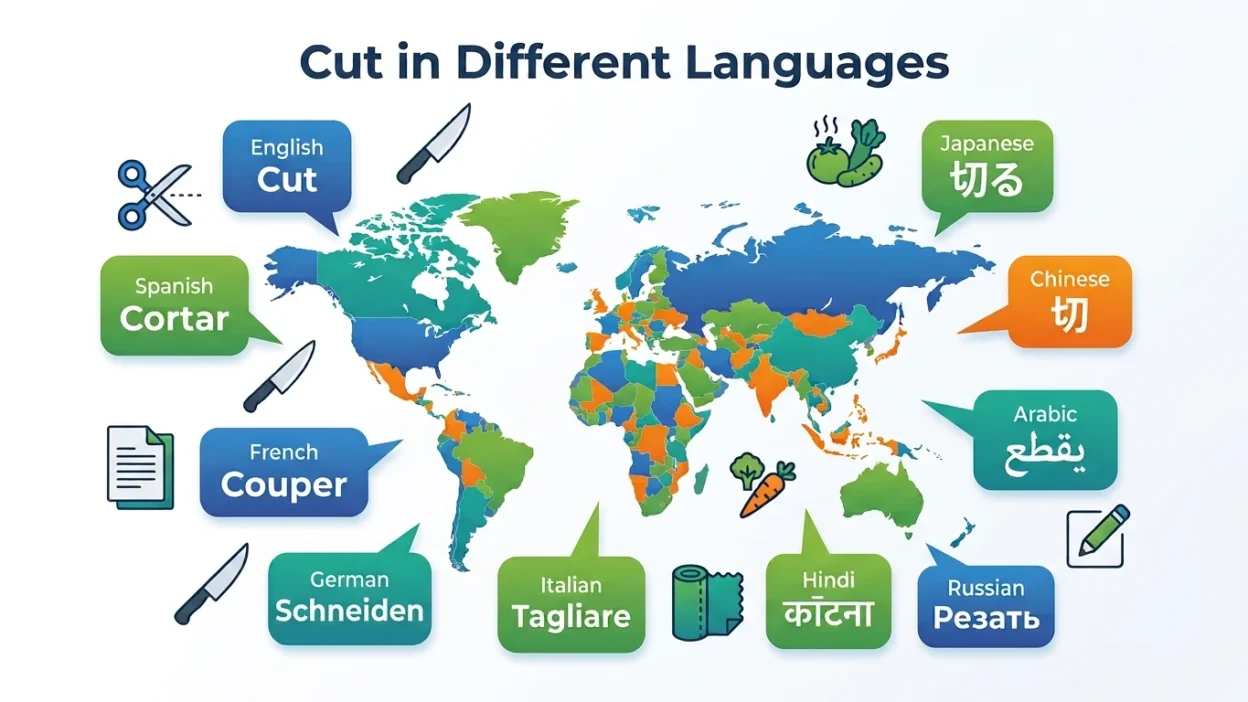
Learning cut in different languages is useful for travelers, language learners, students, and anyone interested in global communication. This common word appears in daily conversations, cooking, crafts, sports, healthcare, and many other situations. Knowing how to say cut in different languages helps you communicate more naturally across cultures.
Whether you need to ask someone to cut paper, slice vegetables, trim hair, or edit a document, understanding cut in different languages expands your vocabulary and builds confidence. This guide covers translations, pronunciations, practical examples, pronunciation tips, and fascinating language facts.
Quick Answer
The word cut in different languages has many translations depending on the language and context. While meanings remain similar, pronunciation, spelling, and usage vary, making it an essential vocabulary word for travelers, students, and multilingual communication.
Cut Around the World
| Language | Native Word | Pronunciation |
| English | Cut | Kut |
| Spanish | Cortar | Kor-TAR |
| French | Couper | Koo-PAY |
| German | Schneiden | SHNY-den |
| Italian | Tagliare | Tal-YA-re |
| Portuguese | Cortar | Kor-TAR |
| Dutch | Snijden | SNY-den |
| Swedish | Skära | SHEH-ra |
| Norwegian | Kutte | KOOT-teh |
| Danish | Skære | SKAIR-eh |
| Finnish | Leikata | LAY-ka-ta |
| Icelandic | Skera | SKEH-ra |
| Polish | Ciąć | Chyontch |
| Czech | Řezat | RZEH-zat |
| Slovak | Rezať | REH-zach |
| Hungarian | Vágni | VAAG-nee |
| Romanian | Tăia | Tuh-YA |
| Bulgarian | Режа | RE-zha |
| Serbian | Сећи | SEH-chee |
| Croatian | Rezati | REH-za-tee |
| Slovenian | Rezati | REH-za-tee |
| Ukrainian | Різати | REE-za-ty |
| Russian | Резать | RYE-zat |
| Belarusian | Рэзаць | RYE-zats |
| Greek | Κόβω | KO-vo |
| Turkish | Kesmek | KES-mek |
| Arabic | يقطع | Yak-ta |
| Hebrew | לחתוך | Lakh-TOKH |
| Persian | بریدن | Bo-REE-dan |
| Urdu | کاٹنا | Kaat-na |
| Hindi | काटना | Kaat-na |
| Bengali | কাটা | Ka-ta |
| Punjabi | ਕੱਟਣਾ | Kat-na |
| Gujarati | કાપવું | Kaap-vu |
| Marathi | कापणे | Kaa-pa-nay |
| Tamil | வெட்ட | Vet-ta |
| Telugu | కోయడం | Koya-dam |
| Kannada | ಕತ್ತರಿಸು | Kat-ta-ri-su |
| Malayalam | മുറിക്കുക | Mu-ri-ku-ka |
| Sinhala | කපන්න | Ka-pan-na |
| Thai | ตัด | Tat |
| Vietnamese | Cắt | Kat |
| Indonesian | Memotong | Meh-mo-TONG |
| Malay | Potong | Po-TONG |
| Filipino | Putulin | Poo-too-LIN |
| Chinese (Simplified) | 切 | Chyeh |
| Japanese | 切る | Kee-roo |
| Korean | 자르다 | Ja-reu-da |
| Swahili | Kata | KA-ta |
| Zulu | Sika | SEE-ka |
Why Learn “Cut” in Different Languages?
The word “cut” is used every day in homes, schools, workplaces, restaurants, salons, and hospitals. Learning its translation helps you handle simple conversations with greater confidence while traveling or interacting with native speakers.
It is also valuable for language learners because it appears in beginner vocabulary lessons. Mastering common action verbs like “cut” creates a strong foundation for forming complete sentences and understanding everyday conversations more easily.
Cultural Significance of the Word
Although the basic meaning is similar worldwide, cultures often associate cutting with different traditions. Some communities connect it with cooking, while others relate it to farming, tailoring, art, or celebrations.
Many languages also use “cut” in idioms and expressions. For example, cutting expenses, cutting ties, or cutting corners may have direct or figurative translations depending on the language. Understanding these differences improves both vocabulary and cultural awareness.
Pronunciation Tips for Better Speaking
Learning pronunciation is just as important as memorizing vocabulary. Listen carefully to native speakers and repeat each word several times until it feels natural.
Break longer words into smaller syllables and practice slowly before increasing your speed. Recording yourself and comparing your pronunciation with native speech can also help improve clarity and confidence over time.
Common Situations Where You Use “Cut”
The word “cut” appears in countless everyday situations. You may use it when preparing food, trimming hair, cutting paper, editing videos, reducing costs, or describing injuries.
Because it has both literal and figurative meanings, context matters. Learning complete phrases instead of single words helps you understand which translation is appropriate in each conversation.
Related Words and Useful Expressions
Expanding your vocabulary makes communication smoother. After learning “cut,” study related action words such as slice, chop, trim, divide, carve, clip, shorten, and separate.
You can also learn useful phrases like “Please cut this,” “Cut into pieces,” “Cut carefully,” or “Don’t cut yourself.” These expressions are practical and commonly used in daily conversations across many languages.
Easy Ways to Remember the Translations
Instead of memorizing all fifty translations at once, study five languages each day. Review them regularly and use flashcards to reinforce your memory.
Writing simple sentences with each translation also improves retention. Speaking the words aloud while reading their pronunciations strengthens listening, speaking, and long-term vocabulary recall.
Common Mistakes to Avoid
Many learners assume one translation works in every situation. However, some languages use different verbs depending on whether you cut food, paper, hair, or fabric.
Another common mistake is ignoring pronunciation. Even if the spelling is correct, poor pronunciation may confuse listeners. Practicing both written and spoken forms produces better communication skills.
Benefits of Learning Different Languages
Learning vocabulary from multiple languages improves memory, communication, and cultural understanding. It also increases confidence when meeting people from different backgrounds.
Simple words like “cut” become stepping stones toward fluency because they appear frequently in real conversations. Building your vocabulary one practical word at a time makes language learning enjoyable and sustainable.
Interesting Facts About the Word “Cut”
Many languages have several words that translate as “cut,” each chosen according to the object or action involved. This highlights how vocabulary reflects everyday life and cultural priorities.
English itself uses numerous variations, including cut, slice, chop, trim, carve, and clip. Exploring these similarities and differences helps learners appreciate the richness of world languages while improving their overall communication skills.
Key Takeaways
- “Cut” is a common action verb used in everyday communication.
- Different languages use unique spellings and pronunciations.
- Context determines the correct translation in many languages.
- Regular pronunciation practice improves speaking confidence.
- Learning practical vocabulary builds a stronger language foundation.
Conclusion
Learning cut in different languages is an excellent way to expand your vocabulary while improving communication across cultures. Because this simple verb appears in daily conversations, mastering its translations and pronunciations provides practical value for travelers, students, and language enthusiasts alike. Practice a few languages each day, focus on pronunciation, and use the word in real-life sentences. Consistent learning will help you remember new vocabulary more naturally and develop stronger multilingual communication skills over time.
Frequently Asked Questions
1. Why should I learn the word “cut” in different languages?
Learning this everyday verb helps you communicate in practical situations such as cooking, crafts, travel, shopping, and education. Since it is frequently used, knowing its translation improves vocabulary and makes conversations with native speakers easier and more natural.
2. Does every language use the same word for every type of cutting?
No. Many languages have separate verbs depending on what is being cut. For example, different words may be used for cutting food, trimming hair, slicing bread, or editing documents. Context is important when choosing the correct translation.
3. What is the best way to memorize these translations?
Study a few languages at a time instead of trying to learn all fifty at once. Practice pronunciation daily, create flashcards, write example sentences, and review regularly. Repetition combined with real-life usage improves long-term memory.
4. Is pronunciation more important than spelling?
Both matter, but pronunciation plays a major role in spoken communication. Correct pronunciation helps native speakers understand you more easily, while accurate spelling supports reading and writing. Practicing both together produces the best learning results.
5. Can learning simple words improve overall language skills?
Yes. Everyday action verbs form the foundation of conversation. Once you master common words like “cut,” you can build longer sentences, understand native speech more easily, and gain confidence while learning additional vocabulary.

Michael Wyatt creates compelling fiction featuring dynamic characters, emotional depth, and engaging plots. His storytelling combines creativity with relatable experiences, leaving readers entertained, inspired, and eager for more.