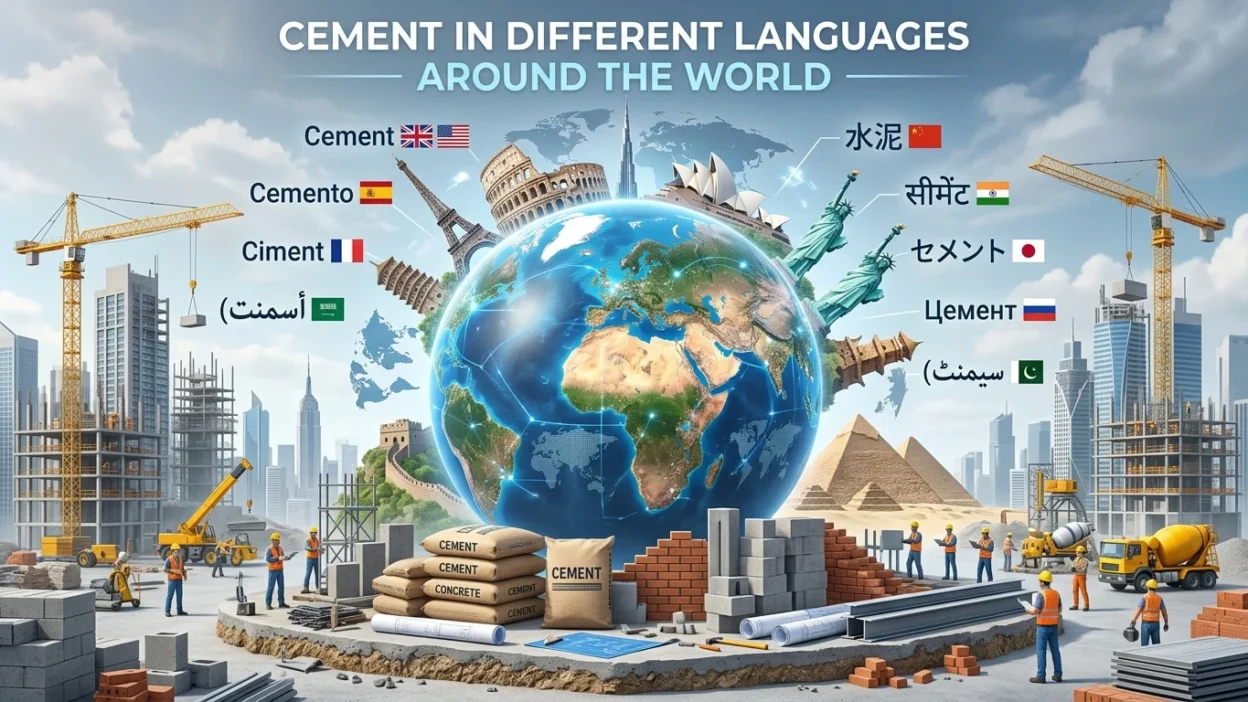
Cement in different languages is a useful phrase for travelers, construction professionals, language learners, and anyone interested in global communication. Learning how to say cement in different languages helps you understand technical vocabulary while improving your cultural awareness.
Whether you work in engineering, architecture, or simply enjoy discovering new languages, knowing cement in different languages makes communication easier across countries. This guide provides translations, pronunciations, and practical insights to help you use the word confidently.
Quick Answer
The word cement in different languages varies across the world, but its meaning remains the same—a binding material used in construction. Learning these translations improves communication in international building projects, travel, education, and multilingual conversations.
Cement Around the World
| Language | Native Word | Pronunciation |
| English | Cement | suh-MENT |
| Spanish | Cemento | seh-MEN-toh |
| French | Ciment | see-MON |
| German | Zement | tseh-MENT |
| Italian | Cemento | cheh-MEN-toh |
| Portuguese | Cimento | see-MEN-too |
| Dutch | Cement | seh-MENT |
| Russian | Цемент | tse-MYENT |
| Ukrainian | Цемент | tse-MENT |
| Polish | Cement | TSE-ment |
| Czech | Cement | TSE-ment |
| Slovak | Cement | TSE-ment |
| Hungarian | Cement | TSE-ment |
| Romanian | Ciment | chee-MENT |
| Greek | Τσιμέντο | tsee-MEN-to |
| Turkish | Çimento | chee-MEN-to |
| Arabic | أسمنت | us-MENT |
| Hebrew | מלט | meh-LET |
| Persian | سیمان | see-MAAN |
| Urdu | سیمنٹ | SEE-ment |
| Hindi | सीमेंट | SEE-ment |
| Bengali | সিমেন্ট | see-MENT |
| Punjabi | ਸੀਮੈਂਟ | SEE-ment |
| Gujarati | સિમેન્ટ | SEE-ment |
| Marathi | सिमेंट | SEE-ment |
| Tamil | சிமெண்டு | see-MEN-doo |
| Telugu | సిమెంట్ | SEE-ment |
| Kannada | ಸಿಮೆಂಟ್ | see-MENT |
| Malayalam | സിമന്റ് | see-MENT |
| Sinhala | සිමෙන්ති | si-MEN-ti |
| Nepali | सिमेन्ट | see-MENT |
| Chinese (Simplified) | 水泥 | shway-NEE |
| Chinese (Traditional) | 水泥 | shway-NEE |
| Japanese | セメント | seh-MEN-to |
| Korean | 시멘트 | shee-MEN-teu |
| Vietnamese | Xi măng | see-MANG |
| Thai | ซีเมนต์ | see-MENT |
| Indonesian | Semen | SEH-men |
| Malay | Simen | SEE-men |
| Filipino | Semento | seh-MEN-to |
| Swahili | Saruji | sah-ROO-jee |
| Afrikaans | Sement | seh-MENT |
| Finnish | Sementti | seh-MENT-tee |
| Swedish | Cement | seh-MENT |
| Norwegian | Sement | seh-MENT |
| Danish | Cement | seh-MENT |
| Icelandic | Sement | seh-MENT |
| Latvian | Cements | TSE-ments |
| Lithuanian | Cementas | tse-MEN-tas |
| Estonian | Tsement | tse-MENT |
Why Learn Cement in Different Languages?
Understanding how to say cement in multiple languages is valuable for people working in construction, engineering, architecture, and international trade. Many projects involve teams from different countries, making clear communication essential.
Language learners also benefit from expanding their technical vocabulary. Even if you never work on a construction site, knowing common building terms strengthens your language skills and helps you understand signs, manuals, and conversations while traveling abroad.
The Importance of Cement Across Cultures
Cement is one of the world’s most widely used building materials. From modern skyscrapers to bridges and homes, it plays a central role in infrastructure across nearly every country.
Although languages use different words for cement, the material represents progress, durability, and development everywhere. Learning its translations also offers a glimpse into how technical vocabulary spreads between cultures through trade, engineering, and education.
How to Pronounce Cement Correctly in Different Languages
Pronunciation varies depending on each language’s sound system. Some languages stress the second syllable, while others pronounce every syllable evenly. Listening to native speakers can improve your accuracy.
Practice repeating each translation slowly before increasing your speed. Focus on vowel sounds and stress patterns instead of translating word-for-word. Regular practice helps you sound more natural when speaking with native speakers.
Related Construction Vocabulary
Learning the word cement becomes even more useful when combined with other common construction terms. Words such as concrete, brick, sand, stone, mortar, building, wall, foundation, and steel often appear together.
Building a small vocabulary around construction makes conversations more practical. It also helps students, professionals, and travelers understand manuals, work instructions, and educational materials more easily.
Practical Situations Where You May Use the Word
Knowing how to say cement is useful while visiting hardware stores, construction sites, or discussing home renovation projects abroad. It also helps when reading product labels or asking for building materials.
Professionals involved in international construction projects often communicate with suppliers from different countries. Understanding local terminology reduces confusion and improves teamwork during planning and execution.
Easy Ways to Remember Cement in Different Languages
Group similar languages together because many European languages use closely related versions of the word. This makes memorization much easier than learning every translation separately.
Flashcards, language apps, and daily repetition also improve memory. Try using each translation in a simple sentence or connect it with images of buildings to create stronger mental associations.
Interesting Facts About the Word Cement
Many modern translations of cement originate from Latin roots or have been borrowed through international trade. Because of this history, numerous European languages use nearly identical spellings.
In several Asian languages, the pronunciation has also been adapted from English or other European languages. These similarities make the word surprisingly recognizable even across distant regions.
Common Mistakes When Using Cement in Other Languages
One common mistake is confusing cement with concrete. Cement is only one ingredient used to produce concrete, which also contains sand, gravel, and water.
Another mistake is assuming the pronunciation matches English. Even when the spelling appears similar, stress patterns and vowel sounds often differ. Paying attention to native pronunciation leads to clearer communication.
Benefits of Learning Different Languages
Learning vocabulary from multiple languages strengthens memory, improves communication skills, and increases cultural understanding. Technical words like cement help learners expand beyond everyday conversations.
Multilingual knowledge also supports international careers in engineering, architecture, manufacturing, logistics, and education. Even learning one new word from several languages builds confidence and encourages lifelong language learning.
Key Takeaways
- Cement has unique translations across 50 different languages.
- Learning technical vocabulary improves international communication.
- Correct pronunciation helps avoid misunderstandings.
- Construction professionals benefit from multilingual terminology.
- Language learning becomes easier by studying related vocabulary together.
Conclusion
Learning cement in different languages is an excellent way to expand your vocabulary while improving cross-cultural communication. Whether you are a student, traveler, engineer, architect, or language enthusiast, understanding this important construction term helps you interact more confidently in international settings. By practicing the translations, pronunciations, and related vocabulary shared in this guide, you can strengthen both your language skills and your understanding of global construction terminology in a practical and memorable way.
Frequently Asked Questions
1. Why should I learn cement in different languages?
Learning the word cement in different languages improves communication with international workers, travelers, suppliers, and students. It also expands your technical vocabulary and makes it easier to understand construction-related discussions, manuals, and educational materials across different countries.
2. Is the word for cement similar in many languages?
Yes. Many European languages use words that closely resemble the English term because they share historical linguistic roots. Several Asian languages have also adopted similar pronunciations, making the word easier to recognize internationally than many other technical terms.
3. What is the difference between cement and concrete?
Cement is a binding powder used to make concrete. Concrete is produced by mixing cement with water, sand, and gravel or crushed stone. Although people often use the terms interchangeably, they refer to different construction materials.
4. Who benefits from learning construction vocabulary in multiple languages?
Engineers, architects, builders, contractors, students, translators, travelers, and business professionals all benefit from multilingual construction vocabulary. It improves communication, reduces misunderstandings, and supports collaboration on international projects and educational activities.
5. What is the best way to memorize cement in different languages?
Practice with flashcards, repeat pronunciations daily, group similar languages together, and use each translation in simple sentences. Consistent review combined with listening to native speakers helps improve both memory and pronunciation over time.

Paisley Cooper is celebrated for expressive writing and imaginative narratives. Their stories emphasize courage, friendship, and personal growth, creating meaningful connections with readers through engaging and inspiring literature.