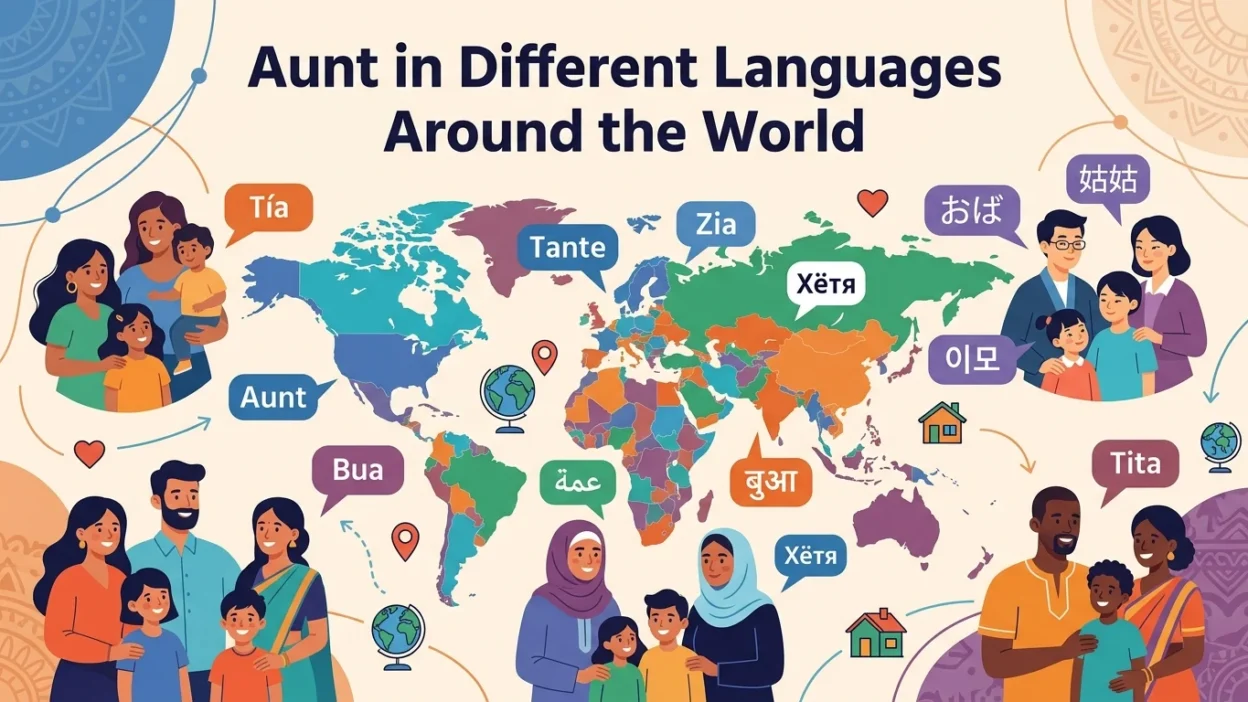
Learning aunt in different languages is a simple way to understand both family vocabulary and cultural differences. In many places, the word for aunt changes depending on whether she is from the mother’s side or the father’s side, so aunt in different languages is more than a translation exercise. It is also a small window into how families are described around the world.
This guide makes the topic easy to use in daily life, travel, and language study. You will find clear pronunciations, useful examples, and a 50-language table that helps you compare aunt in different languages quickly and confidently.
Quick Answer:
“Aunt” changes across languages, and many cultures use separate words for maternal and paternal aunts. The right term often depends on family side, local customs, and how formal the conversation is.
Aunt in Different Languages Around the World
| Language | Native Word | Pronunciation |
| English | aunt | ANT / AHNT |
| Spanish | tía | TEE-ah |
| French | tante | TONT |
| German | Tante | TAHN-tuh |
| Italian | zia | TSEE-ah |
| Portuguese | tia | TEE-ah |
| Dutch | tante | TAHN-tuh |
| Swedish | moster / faster | MOH-ster / FAHS-ter |
| Norwegian | tante | TAHN-teh |
| Danish | tante | TAHN-duh |
| Finnish | täti | TAH-tee |
| Icelandic | frænka | FRYEN-ka |
| Russian | тётя | TYOH-tya |
| Ukrainian | тітка | TEET-ka |
| Polish | ciocia | CHOH-chah |
| Czech | teta | TEH-tah |
| Slovak | teta | TEH-tah |
| Hungarian | nagynéni | NAHDY-nay-nee |
| Romanian | mătușă | muh-TOO-shuh |
| Greek | θεία | THEE-ah |
| Turkish | teyze | TAY-zeh |
| Arabic | عمة / خالة | AH-mah / KHAH-lah |
| Hebrew | דודה | DOH-dah |
| Persian | عمه / خاله | AM-meh / KHAH-leh |
| Hindi | बुआ / मौसी | BOO-ah / MAW-see |
| Urdu | پھوپھی / خالہ | POO-pee / KHAH-lah |
| Bengali | পিসি / মাসি | PEE-see / MAH-see |
| Punjabi | ਤਾਈ / ਮਾਸੀ | TAH-ee / MAH-see |
| Gujarati | કાકી / માસી | KAH-kee / MAH-see |
| Marathi | आत्या / मावशी | AA-tya / MAAV-shee |
| Tamil | அத்தை | ATH-thai |
| Telugu | అత్తయ్య | AH-tha-yya |
| Kannada | ಚಿಕ್ಕಮ್ಮ / ದೊಡ್ಡಮ್ಮ | CHIK-ka-mma / DOD-da-mma |
| Malayalam | അമ്മായി | am-MAA-yi |
| Sinhala | නැන්දා | NAN-dah |
| Nepali | फुपू / माइजू | FOO-poo / MY-joo |
| Japanese | おば | OH-bah |
| Korean | 이모 / 고모 | EE-moh / GOH-moh |
| Chinese (Mandarin) | 姑姑 / 姨妈 | GOO-goo / YEE-ma |
| Cantonese | 姨姨 | YEE-yee |
| Vietnamese | cô / dì | koh / zee |
| Thai | ป้า | BPAA |
| Lao | ປ້າ | BPAA |
| Khmer | មីង | meeng |
| Burmese | အန်တီ / ဒေါ်ကြီး | AN-tee / DAW-gee |
| Indonesian | bibi | BEE-bee |
| Malay | makcik | MAK-cheek |
| Tagalog | tita | TEE-tah |
| Swahili | shangazi | shahn-GAH-zee |
| Zulu | anti | AHN-tee |
| Afrikaans | tannie | TAH-nee |
Why Learning Aunt in Different Languages Matters
Knowing how to say aunt in different languages is useful for more than memorization. It helps you speak politely in family settings, understand cultural titles, and avoid awkward mistakes during travel or multilingual conversations. Some languages use one general word, while others have separate terms for a mother’s sister and a father’s sister.
That difference can matter a lot in real life. If you are meeting relatives, reading family stories, or learning a new language, using the right word shows respect and attention. It also builds confidence because family vocabulary is often one of the first things people hear in everyday conversations.
When One Language Uses More Than One Word
Many languages do not treat “aunt” as a single idea. Instead, they separate the term by family side or even by age and respect. Arabic, Hindi, Urdu, Persian, and several South Asian languages often do this clearly. That means a direct translation can miss the real meaning.
For example, one word may mean your mother’s sister, while another may mean your father’s sister. In some cultures, those differences are important in daily speech, family introductions, and respectful greetings. Learning the exact term helps you sound natural and avoid confusion when speaking with native speakers.
Pronunciation Tips for Easy Memory
The easiest way to remember aunt in different languages is to break each word into small sound parts. Focus on the first strong syllable, then repeat the word slowly three times. For example, “tía” becomes “TEE-ah,” and “tante” becomes “TAHN-tuh.” This method makes the words feel less intimidating.
It also helps to group similar sounds together. Languages like Spanish, Portuguese, and Italian often feel smooth and vowel-heavy, while Germanic and Slavic languages may sound sharper. When you practice, say the word out loud and connect it to one person you know. That simple memory trick makes the word stick faster.
Cultural Meaning Behind Aunt Terms
Aunt words often carry family respect, warmth, and social tradition. In many cultures, an aunt is not just a relative; she is also a caregiver, teacher, or authority figure. That is why some languages use special titles instead of a simple one-word translation.
These words can also reflect how families are organized. In some places, older family members are addressed with honorific-like terms, and the word for aunt may extend beyond blood relation. Understanding this cultural layer makes language learning richer because you are not only learning vocabulary, you are learning how people relate to one another.
Practical Uses in Travel and Family Conversations
Aunt vocabulary is especially helpful when you meet extended family, write greeting cards, or talk about relatives abroad. If you are visiting another country, knowing the local term for aunt can make introductions feel more natural and polite. It also helps when you hear relatives speaking in their native language.
This vocabulary is useful in stories, school projects, ancestry research, and social media posts too. A simple sentence about your aunt can become easier to share when you know the correct word. Even if you do not use the term often, it becomes a useful part of everyday communication and cultural understanding.
Related Family Words Worth Learning
Once you learn aunt in different languages, it makes sense to learn nearby family words too. Terms like mother, father, uncle, cousin, sister, and grandmother often appear together in conversations. Learning them as a group helps you recognize patterns and remember them faster.
This approach also improves listening skills. When you hear family words in another language, you start noticing pronunciation habits and common word endings. Over time, that makes it easier to understand entire conversations about relatives, celebrations, and family history. Family vocabulary is one of the best starting points for practical language learning.
Common Mistakes to Avoid
One common mistake is assuming every language has just one word for aunt. That is not always true. Another mistake is choosing the wrong side of the family when the language makes a distinction. In some languages, using the wrong term may sound unnatural or overly casual.
A second mistake is focusing only on spelling and ignoring pronunciation. A word may look familiar but sound very different in conversation. To avoid confusion, learn both the written form and the spoken form together. That gives you a fuller understanding and helps you use the word with more confidence.
Easy Ways to Remember the Translations
A simple memory method is to learn aunt words in small groups by language family. For example, group Romance languages together, then Slavic languages, then Asian languages. Similar sound patterns make them easier to recall. You can also attach each word to a real person, photo, or family story.
Flashcards work well too, especially if you write the native word on one side and the pronunciation on the other. Speaking the word aloud during review helps your memory even more. The more personal and visual the practice, the easier it becomes to remember aunt in different languages without effort.
Benefits of Learning Different Languages
Learning family words such as aunt in different languages improves more than vocabulary. It builds cultural awareness, strengthens listening skills, and helps you speak more naturally with native speakers. Even one word can open the door to better conversations and stronger relationships.
It also makes language learning feel practical from the start. Instead of memorizing random words, you learn terms people actually use with loved ones. That creates a deeper connection to the language and encourages steady progress. Small wins like this make learning feel rewarding and meaningful.
Key Takeaways
- “Aunt” can have one meaning or several, depending on the language.
- Many cultures use different words for maternal and paternal aunts.
- Pronunciation matters just as much as spelling when learning family vocabulary.
- Learning related family terms helps you remember aunt words faster.
- Cultural context makes the translation more accurate and natural.
Conclusion
Aunt in different languages is a useful topic for language learners, travelers, and anyone interested in family vocabulary. It shows how different cultures describe relationships with care and precision. By learning the native words, pronunciations, and family-side differences, you gain more than translation skills. You gain context, respect, and confidence. Whether you are speaking, reading, or writing, knowing aunt in different languages helps you connect more naturally with people across the world.
Frequently Asked Questions
1. Why does aunt have different words in some languages?
Some languages separate maternal and paternal aunts because family relationships are culturally important. The word may also change based on respect, age, or family role. That is why one English word can turn into several different terms in another language.
2. Is there one universal word for aunt?
No, there is no universal word used everywhere. English has “aunt,” but many languages use different forms depending on the family side. Some even use separate words for formal and informal speech, which makes context important.
3. What is the easiest way to learn aunt in different languages?
Learn the word in small groups, say it aloud, and connect it to a real family member or memory. Flashcards, repetition, and pronunciation practice work very well. Grouping similar languages together can also make the words easier to remember.
4. Do all languages distinguish between maternal and paternal aunts?
No, not all languages do. Some use one general word, while others have multiple terms. Languages that make this distinction often reflect deeper family traditions and social structure, so the correct word depends on the speaker’s culture.
5. Can aunt words be used as terms of respect?
Yes, in many cultures aunt words are used respectfully for older women even outside the immediate family. This is common in several Asian, African, and Middle Eastern languages. The word can signal warmth, politeness, and familiarity at the same time.

Brooklyn Walker is a contemporary writer known for engaging storytelling, memorable characters, and emotionally rich narratives. Their work inspires readers through creativity, imagination, meaningful themes, and compelling literary style.