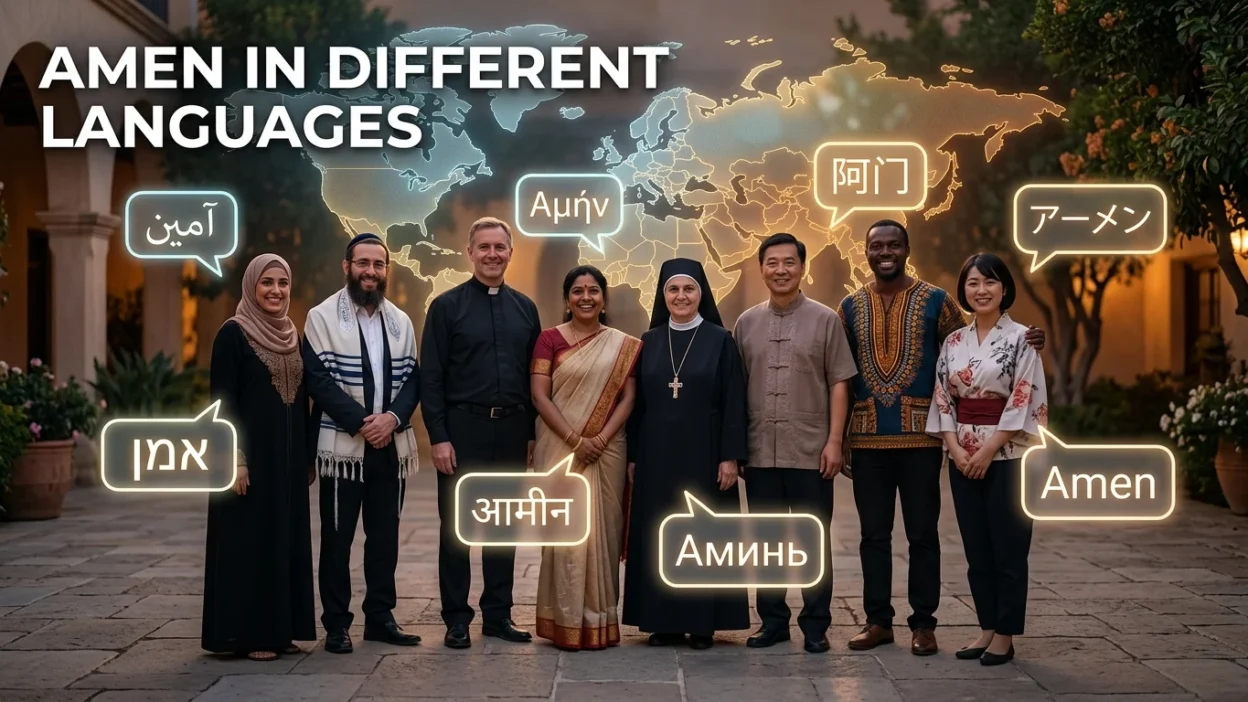
Amen in different languages is a fascinating topic that connects faith, culture, and communication across the globe. Whether you are studying languages, exploring world religions, or preparing a multilingual prayer, learning amen in different languages helps you appreciate the shared meaning behind this timeless word.
Although pronunciation and spelling may vary slightly, the meaning of amen in different languages remains remarkably consistent. It expresses agreement, truth, certainty, or the heartfelt wish that a prayer or statement may come to pass.
Quick Answer
Amen in different languages is generally written as a variation of “Amen,” meaning “so be it,” “truly,” or “let it be.” While pronunciation changes across cultures, the word symbolizes faith, agreement, and affirmation in many religions worldwide.
Amen Around the World
| Language | Native Word | Pronunciation |
| English | Amen | Ah-men |
| Arabic | آمين | Aa-meen |
| Hebrew | אמן | Ah-men |
| Spanish | Amén | Ah-men |
| French | Amen | Ah-men |
| German | Amen | Ah-men |
| Italian | Amen | Ah-men |
| Portuguese | Amém | Ah-meng |
| Dutch | Amen | Ah-men |
| Swedish | Amen | Ah-men |
| Norwegian | Amen | Ah-men |
| Danish | Amen | Ah-men |
| Finnish | Aamen | Aa-men |
| Icelandic | Amen | Ah-men |
| Polish | Amen | Ah-men |
| Czech | Amen | Ah-men |
| Slovak | Amen | Ah-men |
| Hungarian | Ámen | Aa-men |
| Romanian | Amin | Ah-meen |
| Bulgarian | Амин | Ah-meen |
| Serbian | Амин | Ah-meen |
| Croatian | Amen | Ah-men |
| Slovenian | Amen | Ah-men |
| Russian | Аминь | Ah-meen |
| Ukrainian | Амінь | Ah-meen |
| Belarusian | Амін | Ah-meen |
| Greek | Αμήν | Ah-meen |
| Turkish | Amin | Ah-meen |
| Persian | آمین | Aa-meen |
| Urdu | آمین | Aa-meen |
| Hindi | आमीन | Aa-meen |
| Punjabi | ਆਮੀਨ | Aa-meen |
| Bengali | আমিন | Aa-meen |
| Gujarati | આમીન | Aa-meen |
| Marathi | आमीन | Aa-meen |
| Tamil | ஆமென் | Aa-men |
| Telugu | ఆమేన్ | Aa-men |
| Kannada | ಆಮೆನ್ | Aa-men |
| Malayalam | ആമേൻ | Aa-men |
| Sinhala | ආමෙන් | Aa-men |
| Chinese (Simplified) | 阿门 | Ah-men |
| Japanese | アーメン | Aa-men |
| Korean | 아멘 | Ah-men |
| Thai | อาเมน | Aa-men |
| Vietnamese | A-men | Ah-men |
| Indonesian | Amin | Ah-meen |
| Malay | Amin | Ah-meen |
| Swahili | Amina | Ah-mee-na |
| Filipino | Amen | Ah-men |
| Zulu | Amen | Ah-men |
What Does Amen Mean?
The word “Amen” has ancient origins and is commonly understood as “so be it,” “truly,” or “certainly.” It is spoken at the end of prayers, blessings, and religious declarations to express agreement and faith.
Across different languages, the meaning remains nearly identical even when pronunciation changes. This universal consistency has helped the word become one of the world’s most recognizable expressions of spiritual affirmation.
Why Learn Amen in Different Languages?
Learning amen in different languages helps you communicate respectfully in multicultural settings. It is especially useful when attending international religious services, cultural celebrations, or language classes.
Knowing how different communities pronounce the same sacred word also builds cultural awareness. It reminds us that people from many backgrounds often share similar beliefs and traditions despite speaking different languages.
Cultural Significance of Amen
Amen carries deep spiritual importance in Judaism, Christianity, and Islam. It signifies agreement with a prayer, trust in God’s will, and confidence that the spoken words are true.
Many cultures have preserved this ancient expression for centuries. Even when translated into different writing systems, the core meaning remains unchanged, making it one of the most enduring words in religious history.
Pronunciation Tips
Although many languages use a similar spelling, pronunciation varies slightly. English speakers often say “Ah-men,” while Arabic, Urdu, Persian, and Turkish commonly pronounce it as “Aa-meen.”
Listening to native speakers can improve your pronunciation. Paying attention to vowel sounds and stress patterns helps you say the word naturally and respectfully in different languages.
When Is Amen Used?
Amen is typically spoken after prayers, blessings, hymns, and religious readings. Individuals may also say it during worship to express agreement with a speaker or sermon.
Outside formal worship, some people use “Amen” in everyday conversations to show strong agreement with an opinion or statement, especially in informal English.
Related Religious Expressions
Many languages include other meaningful religious expressions alongside Amen. Examples include “Peace be with you,” “God bless you,” and “Hallelujah.”
Learning these expressions together provides greater understanding of religious vocabulary and helps language learners recognize common phrases used in worship and daily life.
Benefits of Learning Different Languages
Studying words like Amen introduces learners to the connections between language, history, and culture. Even a single familiar word can reveal how languages influence one another.
Learning multilingual expressions also strengthens communication skills, improves cultural appreciation, and encourages respectful interactions with people from diverse backgrounds.
Interesting Facts About Amen
Amen is among the oldest continuously used words in the world. It has remained part of religious traditions for thousands of years with very little change in meaning.
Its remarkable consistency across dozens of languages demonstrates how powerful cultural and religious traditions can preserve important words across generations and continents.
Common Mistakes When Saying Amen
One common mistake is assuming every language uses the exact same pronunciation. While many spellings look alike, vowel sounds often differ from one language to another.
Another mistake is confusing “Amen” with unrelated words that sound similar. Practicing with native pronunciation and understanding the context helps ensure respectful and accurate usage.
Key Takeaways
- Amen means “so be it,” “truly,” or “let it be.”
- The word appears in many languages with similar meanings.
- Pronunciation differs slightly across cultures.
- Amen plays an important role in several major religions.
- Learning multilingual religious words promotes cultural understanding.
Conclusion
Learning amen in different languages offers more than vocabulary knowledge. It reveals the remarkable way cultures around the world preserve a shared expression of faith, hope, and agreement. Whether you are studying languages, participating in international communities, or exploring religious traditions, understanding amen in different languages helps you communicate respectfully and appreciate the cultural connections that unite people across different countries and beliefs.
Frequently Asked Questions
1. What does Amen mean in different languages?
Although pronunciation and spelling may change slightly, Amen generally means “so be it,” “truly,” or “let it be.” The word expresses agreement, faith, and affirmation in many languages and religious traditions throughout the world.
2. Is Amen the same in every language?
No. While many languages use a similar spelling, others adapt it to their writing systems or pronunciation rules. Despite these differences, the meaning remains nearly identical across cultures.
3. Which religions use the word Amen?
Amen is widely used in Judaism, Christianity, and Islam. It commonly appears at the end of prayers and blessings to affirm sincerity, agreement, and trust in the message being spoken.
4. Why do some languages pronounce Amen differently?
Every language has unique pronunciation patterns and sound systems. As the word spread across cultures, local pronunciation naturally evolved while preserving the original meaning and religious significance.
5. Is learning Amen in different languages useful?
Yes. It improves cultural awareness, supports respectful communication during international gatherings, and helps language learners recognize a widely used religious expression found in many countries and traditions.

Paisley Cooper is celebrated for expressive writing and imaginative narratives. Their stories emphasize courage, friendship, and personal growth, creating meaningful connections with readers through engaging and inspiring literature.