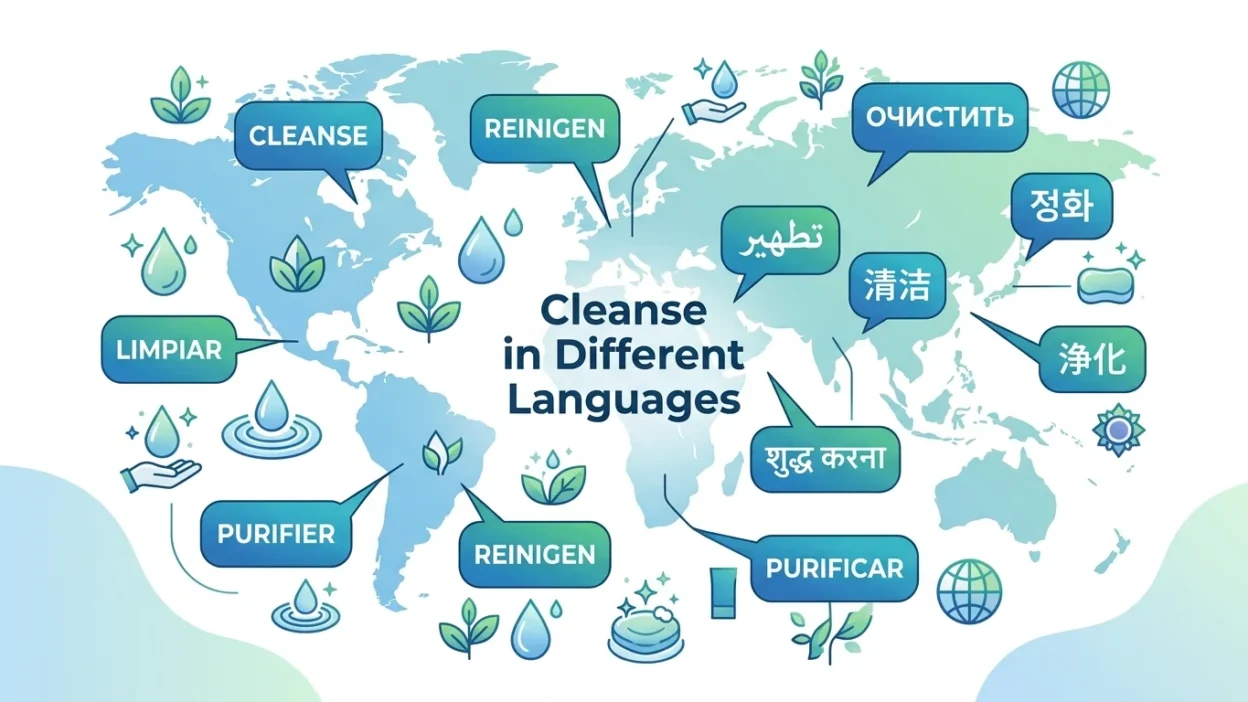
Learning cleanse in different languages is useful for travelers, language learners, wellness enthusiasts, and anyone interested in global communication. The word “cleanse” can describe physical cleaning, spiritual purification, detoxification, or removing impurities depending on the language and cultural context.
Understanding cleanse in different languages also helps you appreciate how different cultures express ideas of purity, renewal, and hygiene. This guide explores translations, pronunciations, pronunciation tips, practical uses, and fascinating cultural insights to make learning easier and more enjoyable.
Quick Answer
Cleanse in different languages refers to the translated word or expression meaning “to clean,” “purify,” or “remove impurities.” While the exact term varies by language, most convey ideas of physical cleanliness, spiritual purification, or renewal depending on cultural context.
Cleanse in Different Languages Around the World
| Language | Native Word | Pronunciation |
| English | Cleanse | KLENZ |
| Spanish | Purificar | Poo-ree-fee-KAR |
| French | Purifier | Poo-ree-fee-AY |
| German | Reinigen | RYE-nee-gen |
| Italian | Purificare | Poo-ree-fee-KAH-reh |
| Portuguese | Purificar | Poo-ree-fee-KAR |
| Dutch | Reinigen | RYE-nee-ghen |
| Swedish | Rena | REH-na |
| Norwegian | Rense | REN-seh |
| Danish | Rense | REN-seh |
| Finnish | Puhdistaa | POO-dis-taa |
| Icelandic | Hreinsa | HRAYN-sa |
| Irish | Glanadh | GLAH-nuh |
| Welsh | Glanhau | GLAN-high |
| Scottish Gaelic | Glan | GLAN |
| Russian | Очищать | Ah-chee-SHAT |
| Ukrainian | Очищати | Oh-chee-SHA-ty |
| Polish | Oczyścić | Oh-CHISH-chitch |
| Czech | Očistit | OCH-is-tit |
| Slovak | Očistiť | OCH-is-teet |
| Hungarian | Megtisztítani | Meg-tees-TAH-nee |
| Romanian | Purifica | Poo-ree-fee-KA |
| Bulgarian | Пречиствам | Pre-CHEES-tam |
| Greek | Καθαρίζω | Ka-tha-REE-zo |
| Turkish | Arındırmak | Ah-run-DUR-mak |
| Arabic | يُطَهِّر | Yu-tah-HIR |
| Hebrew | לטהר | Le-ta-HER |
| Persian | پاکسازی کردن | Pak-sa-zee KAR-dan |
| Hindi | शुद्ध करना | Shuddh Kar-na |
| Urdu | صاف کرنا | Saaf Kar-na |
| Punjabi | ਸਾਫ਼ ਕਰਨਾ | Saaf Kar-na |
| Bengali | পরিষ্কার করা | Po-ri-SKAR Ko-ra |
| Gujarati | શુદ્ધ કરવું | Shuddh Kar-vu |
| Marathi | शुद्ध करणे | Shuddh Ka-ra-nay |
| Tamil | சுத்தப்படுத்து | Sut-tha-pa-DUT-thu |
| Telugu | శుభ్రపరచు | Shu-bhra-pa-ra-chu |
| Kannada | ಶುದ್ಧಗೊಳಿಸು | Shud-dha-go-li-su |
| Malayalam | ശുദ്ധീകരിക്കുക | Shud-dhee-ka-ree-ku-ka |
| Chinese (Simplified) | 净化 | Jing-Hwa |
| Japanese | 浄化する | Joh-ka Soo-roo |
| Korean | 정화하다 | Jeong-hwa-ha-da |
| Vietnamese | Thanh lọc | Tang Lok |
| Thai | ชำระล้าง | Cham-ra Lang |
| Indonesian | Membersihkan | Mem-ber-see-kan |
| Malay | Membersihkan | Mem-ber-see-kan |
| Filipino | Linisin | Lee-nee-sin |
| Swahili | Kusafisha | Koo-sa-FEE-sha |
| Zulu | Hlanza | HLAN-za |
| Afrikaans | Suiwer | SAY-ver |
| Esperanto | Purigi | Poo-REE-gee |
| Latin | Purgare | Poor-GAH-reh |
Why Learn Cleanse in Different Languages?
Learning how to say cleanse in different languages expands your vocabulary and helps you communicate in many real-life situations. Whether discussing health, beauty, religion, household cleaning, or environmental topics, knowing the correct word improves conversations.
It also strengthens your cultural understanding. Many societies associate cleansing with renewal, healing, or spiritual growth. By learning these translations, you gain insight into traditions while building practical language skills useful for travel, education, and international communication.
Cultural Meaning of Cleanse Around the World
The idea of cleansing extends beyond physical washing in many cultures. Some traditions use the concept for religious rituals, meditation, emotional healing, or symbolic fresh beginnings. Others primarily associate it with hygiene and sanitation.
Because of these cultural differences, the translation of “cleanse” may vary depending on context. Understanding these meanings helps learners choose the most appropriate word while respecting local customs and traditions during conversations.
How to Pronounce Cleanse in Different Languages
Correct pronunciation improves confidence and makes communication clearer. Start by listening carefully to native speakers whenever possible and repeat each word slowly before increasing your speed.
Breaking unfamiliar words into smaller syllables also helps. Practice consistently instead of memorizing everything at once. Repeating words daily strengthens pronunciation, improves listening skills, and makes new vocabulary easier to remember over time.
Practical Situations Where You Can Use These Words
Knowing cleanse in different languages is useful when discussing personal hygiene, healthcare, skincare, household products, water purification, wellness, and spiritual practices. These situations often require accurate vocabulary.
Travelers may encounter the word on product labels, instructions, or wellness centers. Students studying biology, medicine, or environmental science may also find these translations helpful when reading multilingual materials or communicating internationally.
Related Words You Should Learn
Learning similar vocabulary makes conversations more natural. Helpful related words include clean, wash, purify, disinfect, sanitize, refresh, detox, hygiene, soap, water, and healthy.
Building groups of connected words improves retention and helps learners understand context instead of relying on direct translations alone. This approach develops stronger communication skills and expands everyday vocabulary more efficiently.
Easy Tips to Remember New Vocabulary
Study only a few new words each day rather than trying to memorize every translation at once. Short, regular practice sessions improve long-term memory and reduce confusion between similar languages.
Flashcards, pronunciation practice, writing exercises, and speaking aloud are all effective learning methods. Reviewing older vocabulary regularly keeps words fresh in your memory and strengthens language retention over time.
Common Mistakes When Translating Cleanse
A common mistake is assuming one translation fits every situation. Some languages distinguish between cleaning, washing, purifying, disinfecting, or spiritually cleansing, making context very important.
Another mistake is ignoring pronunciation. Even if spelling looks familiar, sounds often differ significantly between languages. Learning both pronunciation and meaning ensures your communication remains clear and culturally appropriate.
Interesting Facts About the Word Cleanse
Many languages have multiple words that relate to cleansing depending on whether the action involves people, objects, water, food, or religious ceremonies. This reflects the importance of context in communication.
The concept of cleansing appears throughout history in literature, medicine, philosophy, and religion. Across civilizations, cleansing has symbolized health, renewal, purity, and positive transformation, making it a meaningful word in many cultures.
Benefits of Learning Different Languages
Learning vocabulary like cleanse in different languages improves memory, communication, and cultural awareness. It also develops problem-solving skills by encouraging learners to recognize patterns between languages.
Understanding multilingual vocabulary opens opportunities for travel, education, business, and international friendships. Even learning a single useful word across many languages builds confidence and creates stronger connections with people from different backgrounds.
Key Takeaways
- Learn how to say cleanse in 50 widely spoken languages.
- Pronunciation is as important as accurate translation.
- Context determines the best word in many languages.
- Related vocabulary improves communication naturally.
- Regular practice makes multilingual learning easier and more effective.
Conclusion
Learning cleanse in different languages is an excellent way to expand your vocabulary while exploring the rich diversity of global cultures. Although translations differ across languages, the core ideas of cleaning, purification, and renewal remain widely understood. Practicing pronunciation, understanding cultural context, and learning related words will help you communicate more naturally. Whether you are traveling, studying languages, or simply curious about world cultures, these translations provide a valuable foundation for confident multilingual communication.
Frequently Asked Questions
1. Why does the word “cleanse” have different meanings in various languages?
Many languages distinguish between physical cleaning, spiritual purification, medical sanitation, and symbolic renewal. The appropriate translation depends on the context, cultural traditions, and intended meaning, making it important to understand how native speakers commonly use the word.
2. Is “cleanse” always translated as “purify”?
No. Some languages use separate words for cleaning surfaces, washing the body, disinfecting objects, and spiritual purification. While “purify” is sometimes appropriate, another translation may better match everyday conversations or specific situations.
3. Which languages have similar words for cleanse?
Many European languages share similar words because of historical linguistic influences. Spanish, French, Italian, Portuguese, Romanian, and Latin all use closely related terms that resemble “purify,” making them easier for learners to recognize.
4. What is the best way to remember cleanse in different languages?
Practice a few languages each day, use flashcards, repeat pronunciations aloud, write example sentences, and review regularly. Learning related vocabulary alongside each translation also improves long-term memory and practical language skills.
5. Can I use these translations while traveling?
Yes. These translations are useful for reading labels, asking questions, discussing hygiene, shopping for cleaning products, and communicating basic ideas. However, always consider local context because some situations may require a more specific or natural expression.

Everly Bennett is recognized for imaginative storytelling and heartfelt writing. Their books explore relationships, resilience, and hope, delivering memorable reading experiences that resonate with audiences across generations.