A clock in different languages is a fascinating way to explore how cultures describe one of the world’s most essential everyday objects. Whether you are learning a new language, traveling abroad, or expanding your vocabulary, knowing the word for a clock can improve your communication and cultural understanding.
Learning clock in different languages also helps you recognize similarities between languages and appreciate their unique writing systems. This guide provides accurate translations, pronunciation tips, and practical information to help you confidently use clock in different languages in real-life conversations.
Quick Answer
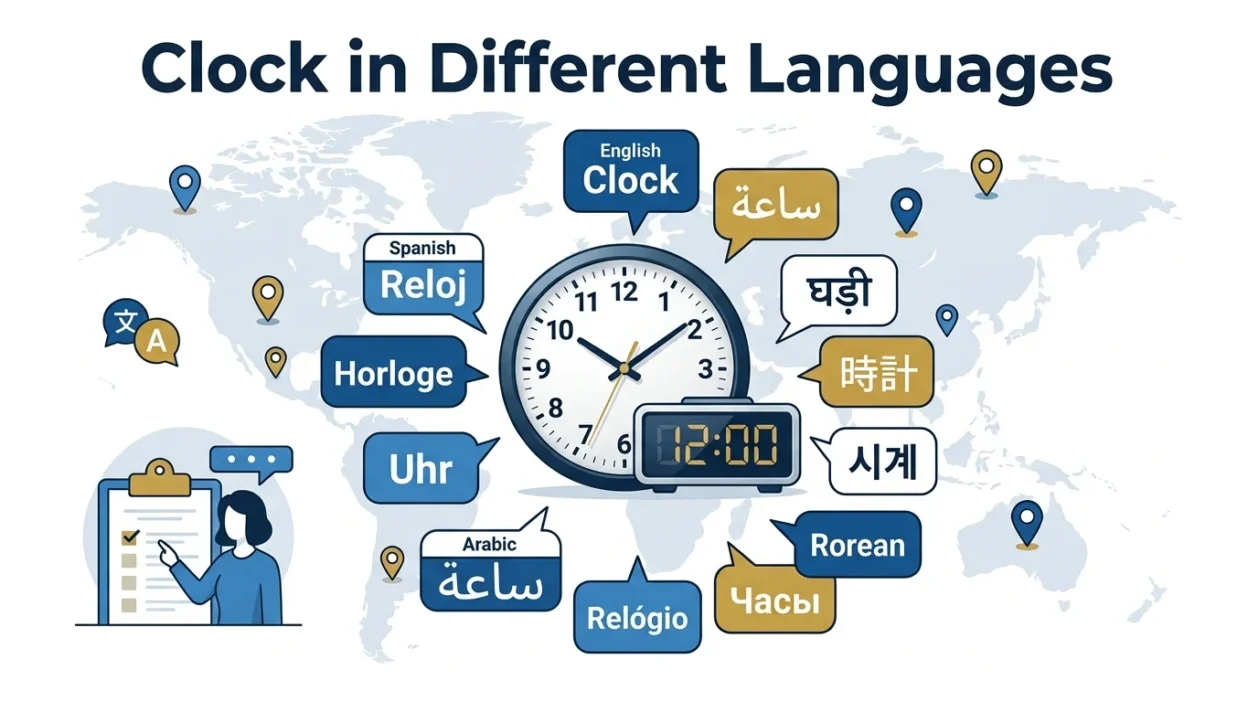
The word clock in different languages varies across the world, from clock in English and reloj in Spanish to horloge in French and 時計 (tokei) in Japanese. Learning these words improves communication, travel experiences, and language skills.
Clock in Different Languages Around the World
| Language | Native Word | Pronunciation |
| English | Clock | Klok |
| Spanish | Reloj | reh-LOHKH |
| French | Horloge | or-LOZH |
| German | Uhr | OOR |
| Italian | Orologio | oh-roh-LOH-joh |
| Portuguese | Relógio | heh-LOH-zhyoo |
| Dutch | Klok | Klok |
| Swedish | Klocka | KLOK-ah |
| Norwegian | Klokke | KLOK-eh |
| Danish | Ur | OOR |
| Finnish | Kello | KEL-lo |
| Icelandic | Klukka | KLOOT-kah |
| Russian | Часы | cha-SY |
| Ukrainian | Годинник | ho-DIN-nyk |
| Polish | Zegar | ZEH-gar |
| Czech | Hodiny | HO-di-nee |
| Slovak | Hodiny | HO-di-nee |
| Hungarian | Óra | OH-rah |
| Romanian | Ceas | Chyas |
| Bulgarian | Часовник | cha-SOV-nik |
| Greek | Ρολόι | ro-LO-ee |
| Turkish | Saat | SAHT |
| Arabic | ساعة | SA-ah |
| Hebrew | שעון | sha-ON |
| Persian | ساعت | SA-at |
| Hindi | घड़ी | gha-DEE |
| Urdu | گھڑی | gha-REE |
| Bengali | ঘড়ি | GHO-ri |
| Punjabi | ਘੜੀ | gha-REE |
| Gujarati | ઘડિયાળ | gha-di-YAAL |
| Marathi | घड्याळ | gha-DYAAL |
| Tamil | கடிகாரம் | ka-di-KAA-ram |
| Telugu | గడియారం | ga-di-YAA-ram |
| Kannada | ಗಡಿಯಾರ | ga-di-YAA-ra |
| Malayalam | ഘടികാരം | gha-ti-KAA-ram |
| Sinhala | ඔරලෝසුව | o-ra-LO-su-va |
| Chinese (Simplified) | 时钟 | shir-JONG |
| Japanese | 時計 | toh-KEI |
| Korean | 시계 | shi-GYE |
| Thai | นาฬิกา | na-LI-ka |
| Vietnamese | Đồng hồ | dong-HO |
| Indonesian | Jam | JAHM |
| Malay | Jam | JAHM |
| Filipino | Orasan | o-ra-SAN |
| Swahili | Saa | SA-ah |
| Afrikaans | Horlosie | hor-LO-see |
| Zulu | Iwashi | ee-WA-shee |
| Somali | Saacad | SAA-kad |
| Irish | Clog | Klug |
| Welsh | Cloc | Klok |
Why Learn the Word “Clock” in Different Languages?
Knowing how to say “clock” in different languages is useful in everyday situations. You may need it while asking for directions, shopping, visiting schools, hotels, museums, or offices. Understanding this simple word also builds confidence during conversations.
For language learners, everyday vocabulary creates a strong foundation. Since clocks are found everywhere, the word appears frequently in books, apps, classrooms, and daily speech. Mastering it makes learning more practical and enjoyable.
The Cultural Importance of Clocks Around the World
Clocks represent more than timekeeping in many cultures. They symbolize organization, punctuality, responsibility, and progress. Famous public clocks often become landmarks and reflect a city’s history and architectural style.
Different societies value time differently, but clocks remain essential everywhere. Learning the local word helps you understand cultural attitudes toward schedules, appointments, and daily routines while showing respect for the language and traditions.
How to Pronounce “Clock” Correctly in Different Languages
Pronunciation varies widely because every language has unique sounds. Some words are short and simple, while others contain unfamiliar letters or tones. Listening carefully and repeating the word aloud improves pronunciation naturally.
Practice speaking slowly before increasing your speed. Recording yourself and comparing your pronunciation with native speakers can also help. Regular repetition builds confidence and improves accuracy over time.
Related Time Vocabulary You Should Learn
After learning the word for “clock,” expand your vocabulary with related terms. Useful words include time, watch, hour, minute, second, alarm, calendar, schedule, morning, afternoon, and evening.
Learning these connected words makes conversations smoother and more meaningful. They frequently appear together in travel situations, business meetings, classrooms, and daily life, making them valuable additions to your vocabulary.
Practical Situations Where You May Use This Word
The word “clock” appears in many everyday situations. You might ask where the nearest clock is, describe the time displayed, or discuss classroom or office schedules.
Travelers often see clocks in airports, railway stations, hospitals, schools, and government buildings. Understanding the local word allows you to ask questions confidently and follow directions without confusion.
Easy Tips for Remembering Clock in Different Languages
Learning multiple translations becomes easier when you group similar languages together. For example, many European languages share words with similar roots, making them easier to remember.
Use flashcards, mobile vocabulary lists, and daily repetition. Label objects around your home with their names in different languages. Seeing and speaking the word regularly helps move it into long-term memory.
Common Mistakes Learners Should Avoid
Many beginners confuse the words for “clock” and “watch.” Although both measure time, languages often use different words for each object. Learning the distinction improves communication.
Another common mistake is focusing only on spelling while ignoring pronunciation. Practice both equally to avoid misunderstandings. Always learn the word within simple example sentences for better retention.
Benefits of Learning Everyday Words in Multiple Languages
Everyday vocabulary forms the backbone of language learning. Simple words like “clock” appear frequently, making them valuable for beginners and advanced learners alike.
Building a collection of practical words improves speaking, reading, listening, and travel experiences. It also increases confidence and creates a stronger foundation for learning more complex grammar and expressions later.
Interesting Facts About Clocks and Language
Many languages have developed unique words for clocks based on history and technology. Some terms originally referred to bells, while others evolved from words meaning “hour” or “time.”
Public clocks have influenced cultures for centuries by helping communities organize work, transportation, education, and religious activities. Their names often reflect each language’s rich linguistic heritage.
Key Takeaways
- Learn how to say “clock” in 50 different languages.
- Everyday vocabulary improves communication and travel experiences.
- Correct pronunciation is as important as accurate spelling.
- Related time words strengthen your overall language skills.
- Regular practice helps you remember new vocabulary faster.
Conclusion
Learning clock in different languages is an enjoyable way to expand your vocabulary while discovering the diversity of world languages. Whether you are studying for personal growth, traveling internationally, or simply satisfying your curiosity, these translations provide a practical starting point. By practicing pronunciation, learning related words, and using the vocabulary in everyday situations, you will remember the terms more easily. Keep exploring new languages, and each new word will bring you closer to confident and meaningful communication across cultures.
Frequently Asked Questions
1. Why should I learn clock in different languages?
Learning the word for “clock” helps you communicate during travel, language study, and everyday conversations. Since clocks are found everywhere, this practical vocabulary appears frequently and supports faster language learning while improving confidence in real-world situations.
2. Is the word for clock the same as watch in every language?
No. Many languages use separate words for a wall clock and a wristwatch, while others may use one general term depending on context. Learning both words helps you avoid misunderstandings and communicate more accurately.
3. What is the easiest way to remember clock in different languages?
The best method combines repetition, pronunciation practice, flashcards, and grouping similar languages together. Using the words in simple sentences and reviewing them regularly makes memorization easier and improves long-term recall.
4. Which languages have similar words for clock?
Many European languages share related words because of historical influences. For example, Spanish, Portuguese, and French have similar terms, while several Germanic languages use words closely related to the English word “clock.”
5. Can learning everyday vocabulary improve language fluency?
Yes. Everyday words like “clock” are used frequently in conversations, reading, and listening. Mastering practical vocabulary first creates a stronger language foundation, making it easier to learn grammar, expressions, and more advanced communication skills later.

Paisley Cooper is celebrated for expressive writing and imaginative narratives. Their stories emphasize courage, friendship, and personal growth, creating meaningful connections with readers through engaging and inspiring literature.