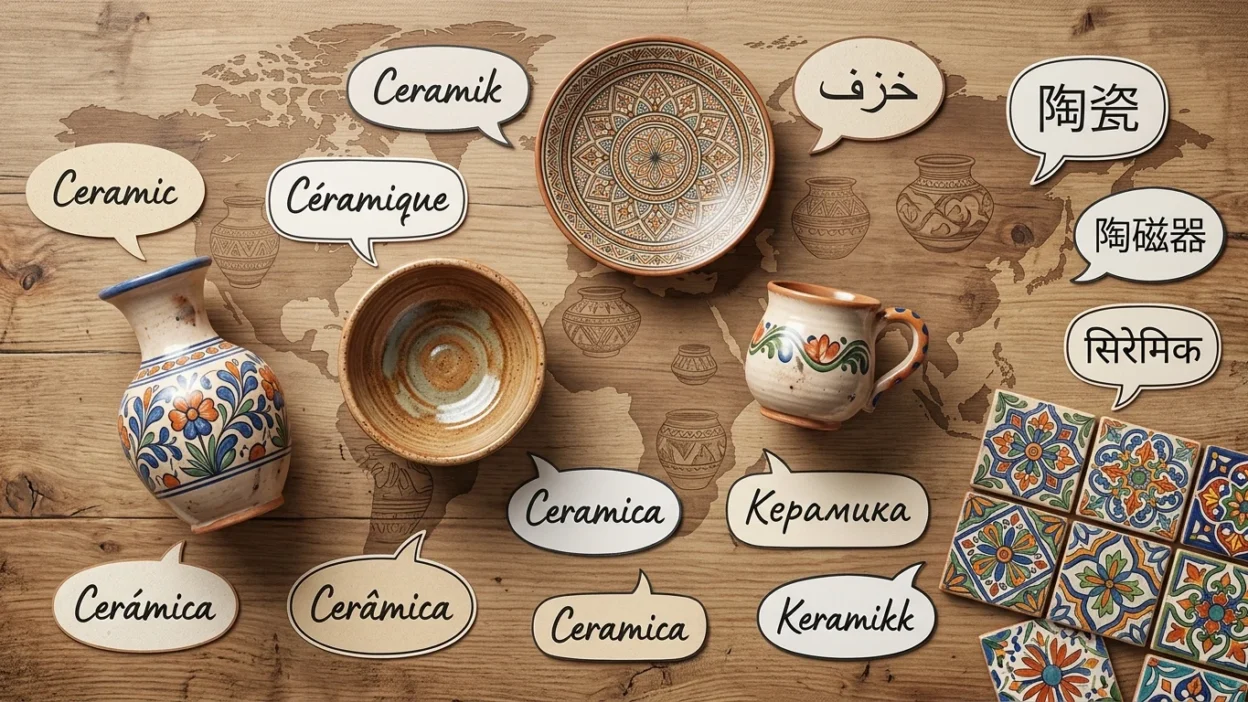
Ceramic in different languages is a useful topic for students, travelers, artists, designers, and anyone interested in world cultures. Learning how to say ceramic in different languages helps you communicate more confidently while exploring art, pottery, architecture, and everyday conversations across different countries.
The phrase ceramic in different languages also highlights how cultures describe objects made from clay and fired at high temperatures. Understanding these translations expands your vocabulary while giving you a deeper appreciation for traditional craftsmanship and modern design around the world.
Quick Answer
Ceramic in different languages refers to the translated word for ceramic across various languages. Knowing these translations improves communication, supports language learning, and helps travelers, artists, and professionals discuss pottery, tiles, porcelain, and ceramic products worldwide.
Ceramic in Different Languages Around the World
| Language | Native Word | Pronunciation |
| English | Ceramic | suh-RAM-ik |
| Spanish | Cerámica | seh-RAH-mee-kah |
| French | Céramique | say-rah-MEEK |
| German | Keramik | keh-RAH-mik |
| Italian | Ceramica | cheh-RAH-mee-kah |
| Portuguese | Cerâmica | seh-RAH-mee-kah |
| Dutch | Keramiek | keh-rah-MEEK |
| Danish | Keramik | keh-RAH-mik |
| Swedish | Keramik | keh-RAH-mik |
| Norwegian | Keramikk | keh-rah-MEEK |
| Finnish | Keramiikka | keh-rah-MEEK-kah |
| Icelandic | Keramik | keh-RAH-mik |
| Polish | Ceramika | tseh-rah-MEE-kah |
| Czech | Keramika | keh-RAH-mee-kah |
| Slovak | Keramika | keh-RAH-mee-kah |
| Slovenian | Keramika | keh-RAH-mee-kah |
| Croatian | Keramika | keh-RAH-mee-kah |
| Serbian | Керамика | keh-RAH-mee-kah |
| Bosnian | Keramika | keh-RAH-mee-kah |
| Romanian | Ceramică | cheh-RAH-mee-kuh |
| Hungarian | Kerámia | keh-RAA-mee-ah |
| Greek | Κεραμικό | keh-rah-mee-KO |
| Russian | Керамика | kyeh-RAH-mee-kah |
| Ukrainian | Кераміка | keh-RAH-mee-kah |
| Bulgarian | Керамика | keh-RAH-mee-kah |
| Belarusian | Кераміка | keh-RAH-mee-kah |
| Turkish | Seramik | seh-rah-MIK |
| Arabic | سيراميك | see-rah-MEEK |
| Hebrew | קרמיקה | krah-MEE-kah |
| Persian | سرامیک | seh-rah-MEEK |
| Hindi | सिरेमिक | si-REH-mik |
| Urdu | سیرامک | see-RAH-mik |
| Bengali | সিরামিক | shi-RAH-mik |
| Punjabi | ਸਿਰਾਮਿਕ | si-RAH-mik |
| Gujarati | સિરામિક | si-RAH-mik |
| Marathi | सिरॅमिक | si-RAH-mik |
| Tamil | செராமிக் | seh-RAH-mik |
| Telugu | సిరామిక్ | si-RAH-mik |
| Kannada | ಸೆರಾಮಿಕ್ | seh-RAH-mik |
| Malayalam | സെറാമിക് | seh-RAH-mik |
| Chinese (Simplified) | 陶瓷 | tao-tsrr |
| Japanese | セラミック | seh-rah-MIK-ku |
| Korean | 세라믹 | seh-rah-mik |
| Thai | เซรามิก | seh-rah-mik |
| Vietnamese | Gốm sứ | gom-su |
| Indonesian | Keramik | keh-RAH-mik |
| Malay | Seramik | seh-RAH-mik |
| Swahili | Kauri | KOW-ree |
| Filipino | Seramika | seh-rah-MEE-kah |
| Esperanto | Ceramiko | cheh-rah-MEE-ko |
Why Learn Ceramic in Different Languages?
Learning ceramic in different languages is valuable for travelers, students, artists, interior designers, and professionals working with pottery or construction materials. Knowing the correct word helps when buying ceramic products, discussing artwork, visiting museums, or communicating with local craftspeople.
Expanding your vocabulary also improves cultural understanding. Many languages have similar forms of the word because they share historical roots, making it easier to recognize and remember. This knowledge becomes especially useful in international trade, tourism, and education.
The Cultural Importance of Ceramic Around the World
Ceramics have played an important role in human civilization for thousands of years. Ancient cultures created pottery for cooking, storage, decoration, and religious ceremonies. Today, ceramic products remain essential in homes, architecture, healthcare, and artistic expression.
Learning ceramic in different languages provides insight into these traditions. Every culture has developed unique pottery styles, glazing techniques, and decorative patterns that reflect local history, geography, and creativity. Understanding the terminology deepens appreciation for these remarkable traditions.
How to Pronounce Ceramic in Different Languages
Many European languages use words that closely resemble the English term ceramic. Although spellings appear similar, pronunciation often changes according to local speech patterns. Paying attention to vowel sounds and stress helps improve accuracy.
Listening to native speakers and repeating the words aloud strengthens pronunciation. Practice a few languages at a time rather than memorizing every translation at once. Consistent repetition builds confidence and improves long-term retention.
Common Situations Where You Use the Word Ceramic
The word ceramic appears in many everyday conversations. You may encounter it while shopping for tiles, dishes, mugs, decorative items, bathroom fixtures, kitchen accessories, or handcrafted pottery. Museums and art galleries also frequently use this vocabulary.
Professionals in architecture, engineering, manufacturing, and healthcare often discuss ceramic materials because they are durable, heat-resistant, and widely used in specialized products. Learning the term helps you communicate more effectively in both personal and professional settings.
Related Words to Learn Alongside Ceramic
Building vocabulary becomes easier when related words are learned together. Along with ceramic, consider learning words such as pottery, clay, porcelain, tile, vase, bowl, sculpture, kiln, glaze, and craft.
Grouping related terms strengthens memory and allows you to describe objects more naturally. Instead of memorizing isolated words, you’ll develop practical vocabulary that supports conversations about art, construction, decoration, and traditional craftsmanship.
Easy Tips for Remembering Ceramic in Different Languages
Focus first on languages you encounter most often. Many European languages share similar spellings, making them easier to remember. Group languages with comparable vocabulary to recognize common linguistic patterns.
Flashcards, pronunciation practice, and daily review sessions help reinforce memory. Labeling household ceramic items with their translated names can also create meaningful connections between vocabulary and real-life objects.
Common Mistakes to Avoid
One common mistake is confusing ceramic with pottery or porcelain. Although related, these terms do not always describe exactly the same materials or products. Understanding the distinction improves communication and prevents misunderstandings.
Another mistake involves copying English pronunciation into every language. Even similar-looking words may have different sounds or stress patterns. Taking time to learn authentic pronunciation leads to more natural conversations.
Benefits of Learning Different Languages Through Everyday Vocabulary
Everyday vocabulary provides an excellent starting point for language learning. Practical words such as ceramic appear in travel, shopping, education, and professional discussions, making them highly useful from the beginning.
Learning familiar objects across multiple languages also strengthens memory and reveals fascinating connections between cultures. This approach builds confidence, expands communication skills, and encourages continued language learning through real-world experiences.
Interesting Facts About the Word Ceramic
The English word ceramic originates from ancient Greek roots connected with pottery and fired clay. Over time, the term spread into many languages, often keeping a recognizable form while adapting to local pronunciation.
Today, ceramic refers not only to traditional pottery but also to advanced materials used in medicine, electronics, aerospace, and engineering. This broad meaning reflects the continuing importance of ceramics in both history and modern technology.
Key Takeaways
- Ceramic has recognizable translations across many world languages.
- Learning the word improves travel, communication, and cultural understanding.
- Similar spellings make many translations easier to remember.
- Correct pronunciation increases speaking confidence.
- Everyday vocabulary creates a strong foundation for language learning.
Conclusion
Learning ceramic in different languages is a practical way to expand your global vocabulary while exploring art, culture, travel, and everyday communication. Whether you are studying languages, visiting new countries, purchasing ceramic products, or appreciating traditional pottery, these translations help you communicate more effectively. By practicing pronunciation, understanding cultural context, and learning related vocabulary, you can remember the word more easily and build stronger language skills that remain useful in many real-life situations.
Frequently Asked Questions
1. Why should I learn ceramic in different languages?
Learning ceramic in different languages helps you communicate during travel, shopping, education, and professional discussions. It also improves cultural awareness, expands vocabulary, and makes conversations about pottery, architecture, interior design, and art more natural across different countries.
2. Is the word ceramic similar in many languages?
Yes. Many languages use words that closely resemble ceramic because they share historical linguistic influences. Although spelling and pronunciation vary slightly, the similarities make the translations easier to recognize and remember when learning multiple languages.
3. What is the difference between ceramic and pottery?
Ceramic is a broad category covering objects made from fired clay and similar materials. Pottery specifically refers to ceramic vessels and handmade clay products. Porcelain and stoneware are also types of ceramic with their own unique characteristics.
4. Where is the word ceramic commonly used?
The word ceramic appears in conversations about construction, interior design, manufacturing, art, museums, education, healthcare, and household products. It is commonly used when discussing tiles, dishes, pottery, sculptures, and decorative home accessories.
5. What is the best way to remember ceramic in different languages?
Practice a few languages at a time, repeat pronunciations aloud, use flashcards, and connect each translation with real ceramic objects. Learning related vocabulary together also strengthens memory and makes the words easier to recall during everyday conversations.

Brooklyn Walker is a contemporary writer known for engaging storytelling, memorable characters, and emotionally rich narratives. Their work inspires readers through creativity, imagination, meaningful themes, and compelling literary style.