
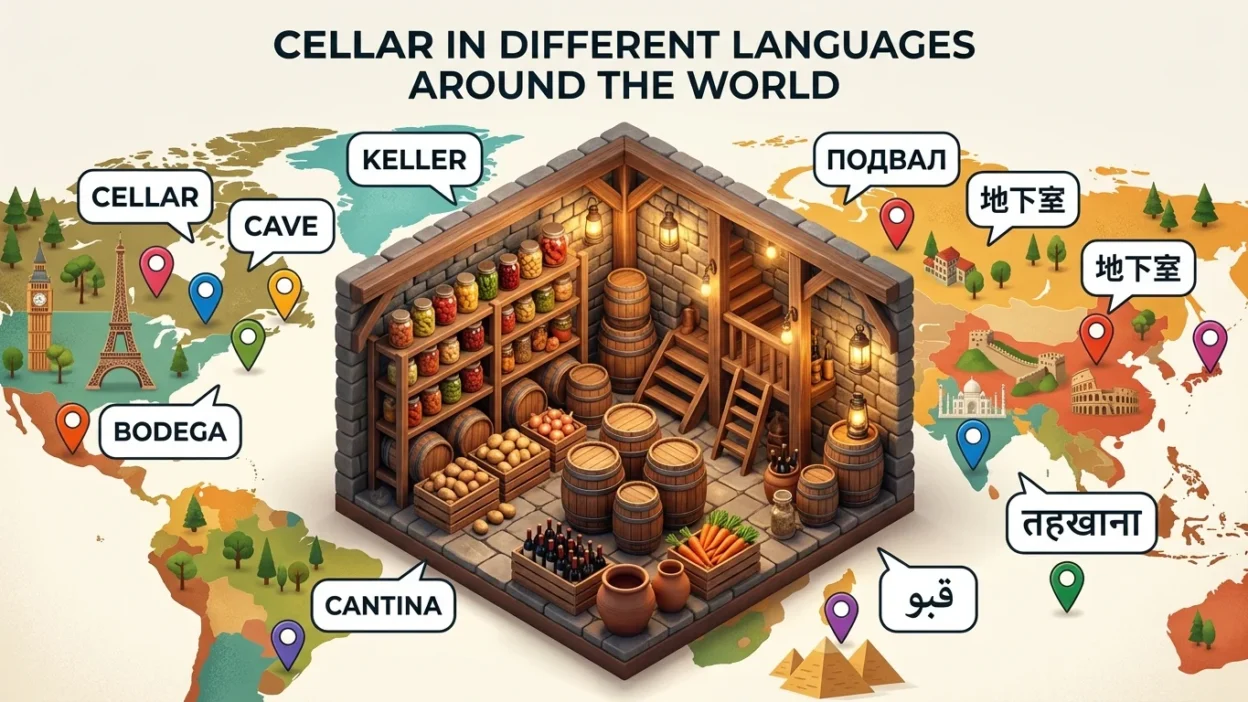
A cellar is an important part of many homes and buildings, used for storing food, wine, supplies, or other valuable items. Learning cellar in different languages helps travelers, language learners, and cultural enthusiasts communicate more effectively while expanding their vocabulary across the world.
Whether you are studying foreign languages, exploring international architecture, or simply curious about global vocabulary, understanding cellar in different languages offers valuable cultural insights. This guide covers translations, pronunciation, practical usage, and interesting facts to help you master this useful word.
Quick Answer
Cellar in different languages refers to the translated word for an underground storage room across various languages. While many cultures use unique terms, they generally describe a cool underground space used for storing food, beverages, and household supplies.
Cellar in Different Languages Around the World
| Language | Native Word | Pronunciation |
| English | Cellar | SEL-er |
| Spanish | Sótano | SOH-tah-noh |
| French | Cave | Kahv |
| German | Keller | KEL-er |
| Italian | Cantina | Kan-TEE-nah |
| Portuguese | Adega | Ah-DEH-gah |
| Dutch | Kelder | KEL-der |
| Danish | Kælder | KEL-der |
| Swedish | Källare | SHEL-lah-reh |
| Norwegian | Kjeller | CHEL-er |
| Finnish | Kellari | KEL-lah-ree |
| Icelandic | Kjallari | KYAT-lah-ree |
| Irish | Siléar | Shil-AIR |
| Welsh | Seler | SEL-er |
| Polish | Piwnica | Peev-NEE-tsa |
| Czech | Sklep | SKLEP |
| Slovak | Pivnica | PIV-nee-tsa |
| Slovenian | Klet | KLET |
| Croatian | Podrum | POD-room |
| Serbian | Подрум | POD-room |
| Bosnian | Podrum | POD-room |
| Romanian | Pivniță | Peev-NEE-tsuh |
| Bulgarian | Мазе | MAH-zeh |
| Ukrainian | Підвал | Peed-VAL |
| Russian | Подвал | Pad-VAL |
| Belarusian | Падвал | Pad-VAL |
| Greek | Κελάρι | Keh-LAH-ree |
| Turkish | Mahzen | Mah-ZEN |
| Arabic | قبو | QAH-boo |
| Hebrew | מרתף | Mer-TEF |
| Persian | زیرزمین | Zeer-ZA-meen |
| Hindi | तहखाना | Tah-kha-NA |
| Urdu | تہہ خانہ | Tah-kha-NA |
| Bengali | ভূগর্ভস্থ ঘর | Bhoo-gor-bos-tho Ghor |
| Punjabi | ਤਹਿਖਾਨਾ | Tah-khi-KHA-na |
| Gujarati | તહખાનું | Tah-kha-NOO |
| Marathi | तळघर | Tul-GHAR |
| Tamil | நிலவறை | Nila-va-rai |
| Telugu | నేలమాళిగ | Nay-la-MAA-li-ga |
| Kannada | ನೆಲಮಾಳಿಗೆ | Nela-MAA-li-ge |
| Malayalam | നിലവറ | Nila-va-ra |
| Chinese (Simplified) | 地窖 | Dee-JYOW |
| Japanese | 地下室 | Chee-kah-shitsu |
| Korean | 지하 저장실 | Jee-ha Jeh-jang-shil |
| Vietnamese | Hầm | Hum |
| Thai | ห้องใต้ดิน | Hong Tai Din |
| Indonesian | Ruang bawah tanah | Roo-ang BAH-wah TAH-nah |
| Malay | Ruang bawah tanah | Roo-ang BAH-wah TAH-nah |
| Swahili | Pishi | PEE-shee |
| Afrikaans | Kelder | KEL-der |
| Esperanto | Kelo | KEH-lo |
Why Learn Cellar in Different Languages?
Learning the word “cellar” in multiple languages improves communication while traveling, studying, or working internationally. It is especially useful when discussing homes, architecture, food storage, wineries, or historical buildings.
Many language learners focus only on greetings, but practical vocabulary makes conversations more meaningful. Knowing how to say cellar in different languages also helps when reading maps, property descriptions, museums, and historical documents.
Cultural Significance of Cellars Worldwide
Cellars have played an important role throughout history. In many European countries, they preserve wine, cheese, vegetables, and other foods because underground temperatures remain cool throughout the year.
In other cultures, underground storage rooms protected families during extreme weather or conflict. Today, many modern homes still include cellars for storage, while historic buildings preserve them as important architectural features reflecting local traditions.
How to Pronounce Cellar in Different Languages
Correct pronunciation helps speakers communicate confidently. Instead of translating literally, practice listening carefully to native pronunciation and repeat each word several times until it feels natural.
Learning pronunciation becomes easier when focusing on similar language families. Germanic languages often share similar sounds, while Romance languages have consistent pronunciation patterns that become familiar with regular practice.
Related Words You Should Know
Besides cellar, learners often encounter words like basement, storage room, underground room, wine cellar, pantry, and warehouse. These terms may have different meanings depending on the language and region.
Understanding related vocabulary prevents confusion during conversations about homes, buildings, construction, and architecture. Expanding your vocabulary helps you describe locations more naturally in everyday situations.
Practical Uses of the Word Cellar
The word cellar appears frequently in travel guides, hotel descriptions, real estate listings, cooking books, and historical tours. Knowing its translation makes reading and communicating much easier.
People visiting wineries, castles, museums, or old buildings often hear guides mention underground storage spaces. Recognizing the local word improves comprehension and creates a richer travel experience.
Easy Tips for Remembering Cellar in Different Languages
Group similar words together instead of memorizing random translations. For example, German, Dutch, Danish, and Afrikaans all use closely related words that share similar spelling and pronunciation.
Flashcards, language apps, and daily review sessions also improve long-term memory. Speaking each word aloud while associating it with pictures of actual cellars strengthens vocabulary retention more effectively.
Common Mistakes When Translating Cellar
A common mistake is confusing cellar with basement. Although they are sometimes interchangeable, some languages distinguish between a storage cellar and a general underground level of a building.
Another mistake involves literal translations without considering local usage. Always learn how native speakers use the word naturally instead of relying solely on direct dictionary equivalents.
When Should You Use the Word Cellar?
Use the word cellar when referring to underground spaces designed mainly for storage, especially for food, beverages, or household supplies. Context matters because some languages prefer a different word for residential basements.
Choosing the appropriate translation demonstrates better language skills and improves communication with native speakers. Paying attention to context ensures your vocabulary sounds natural rather than overly literal.
Benefits of Learning Different Languages Through Everyday Vocabulary
Learning common household vocabulary builds practical language skills that can be applied immediately. Words like cellar appear more often than many learners expect in travel, education, and daily conversations.
Expanding vocabulary across multiple languages also improves memory, cultural awareness, and communication confidence. Small, useful words provide a strong foundation before moving to more advanced grammar and expressions.
Key Takeaways
- Learning cellar in different languages improves practical communication.
- Many languages have unique words reflecting local culture and architecture.
- Correct pronunciation builds speaking confidence.
- Understanding related vocabulary reduces translation mistakes.
- Everyday words create a stronger language-learning foundation.
Conclusion
Learning cellar in different languages is an excellent way to expand your international vocabulary while gaining a deeper appreciation for different cultures and architectural traditions. Whether you are traveling, studying a foreign language, reading historical materials, or simply exploring global words, these translations provide practical value. By practicing pronunciation, understanding cultural context, and learning related terms, you can confidently use this useful vocabulary in real-life situations while strengthening your overall language skills.
Frequently Asked Questions
1. Why should I learn cellar in different languages?
Learning cellar in different languages improves communication during travel, language study, and cultural exploration. It also helps you understand property descriptions, museum tours, historical buildings, and conversations related to architecture or food storage, making your vocabulary more practical and useful.
2. Is cellar the same as basement in every language?
No. Some languages use separate words for cellar and basement because they serve different purposes. A cellar usually refers to a storage space, while a basement may describe an entire underground floor with multiple functions, including living or utility areas.
3. Which languages have similar words for cellar?
Many Germanic languages share similar terms, including German, Dutch, Danish, Norwegian, Swedish, and Afrikaans. These similarities make it easier for learners studying multiple related languages to recognize and remember the vocabulary more efficiently.
4. Where is the word cellar commonly used?
The word cellar frequently appears in discussions about homes, wineries, restaurants, castles, museums, farms, and historical buildings. It is also common in real estate listings, travel guides, and books related to architecture and food preservation.
5. What is the best way to memorize cellar in different languages?
Practice using flashcards, pronunciation exercises, and daily review sessions. Grouping similar languages together, reading example sentences, and connecting each translation with images of real cellars can significantly improve long-term vocabulary retention.

Emery Foster writes captivating stories that blend emotion, adventure, and thoughtful themes. Their creative voice, relatable characters, and engaging plots have attracted readers from diverse backgrounds worldwide.