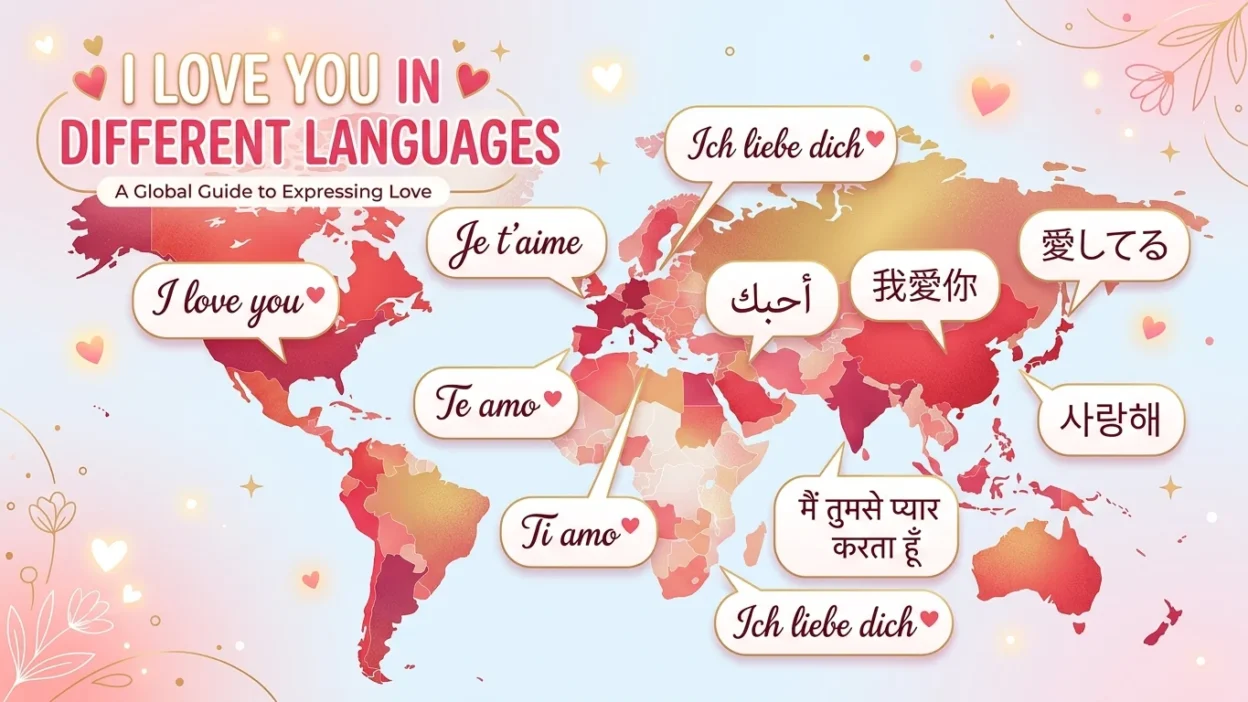
Love sounds different in every culture, but the meaning stays universal. Learning i love you in different languages is a simple way to connect with people more deeply, show respect, and understand how affection is expressed around the world. It is also a popular search topic for people looking for translations, pronunciation help, and romantic phrases.
Whether you are writing a message, planning a card, or simply exploring global languages, i love you in different languages opens the door to meaningful communication. This guide gives you accurate translations, easy pronunciations, and practical tips so you can say it naturally and confidently.
Quick Answer
“I love you” is translated differently across languages, but each version expresses affection in a unique cultural style. Below you will find 50 accurate translations, simple pronunciations, and helpful tips for using them correctly in real-life conversation.
I Love You in Different Languages Around the World
| Language | Native Word | Pronunciation |
| Arabic | أحبك | uhibbuka / uhibbuki |
| Chinese (Mandarin) | 我爱你 | wǒ ài nǐ |
| Spanish | te quiero / te amo | teh kyeh-roh / teh ah-moh |
| French | je t’aime | zhuh tem |
| German | ich liebe dich | ikh lee-beh dish |
| Italian | ti amo | tee ah-moh |
| Portuguese | eu te amo | eh-oo chee ah-moh |
| Russian | я тебя люблю | ya tebya lyublyu |
| Japanese | 愛してる | ah-ee-shee-teh-roo |
| Korean | 사랑해 | sah-rang-heh |
| Hindi | मैं तुमसे प्यार करता हूँ | main tum-se pyaar kar-ta hoon |
| Bengali | আমি তোমায় ভালোবাসি | aami tomay bhalobashi |
| Urdu | میں تم سے محبت کرتا ہوں | main tum se mohabbat karta hoon |
| Turkish | seni seviyorum | seh-nee seh-vee-yo-room |
| Greek | σ’ αγαπώ | sa aghapó |
| Hebrew | אני אוהב אותך | ani ohev otcha / ani ohevet otach |
| Dutch | ik hou van jou | ik how vahn yow |
| Swedish | jag älskar dig | yag el-skar dej |
| Norwegian | jeg elsker deg | yay el-sker day |
| Danish | jeg elsker dig | yay el-sker dai |
| Finnish | rakastan sinua | rah-kas-tan see-noo-ah |
| Polish | kocham cię | ko-ham chyeh |
| Czech | miluji tě | mee-loo-yee teh |
| Slovak | milujem ťa | mee-loo-yem tya |
| Hungarian | szeretlek | seh-ret-lek |
| Romanian | te iubesc | teh yoo-besk |
| Bulgarian | обичам те | oh-bee-cham teh |
| Serbian | волим те | vo-leem teh |
| Croatian | volim te | vo-leem teh |
| Slovenian | ljubim te | lyoo-beem teh |
| Ukrainian | я тебе кохаю | ya te-beh koh-kha-yu |
| Thai | ฉันรักคุณ | chan rak khun |
| Vietnamese | anh yêu em / em yêu anh | anh yoo em / em yoo anh |
| Indonesian | aku cinta kamu | ah-koo chin-tah kah-moo |
| Malay | saya cinta awak | sah-yah chin-tah ah-wak |
| Filipino (Tagalog) | mahal kita | mah-hal kee-tah |
| Swahili | nakupenda | nah-koo-pen-dah |
| Zulu | ngiyakuthanda | ngee-yah-koo-thahn-dah |
| Xhosa | ndiyakuthanda | n-dee-yah-koo-thahn-dah |
| Amharic | እወድሃለሁ | ewedihalehu |
| Persian (Farsi) | دوستت دارم | doo-set dah-ram |
| Punjabi | ਮੈਂ ਤੈਨੂੰ ਪਿਆਰ ਕਰਦਾ ਹਾਂ | main tainu pyaar karda haan |
| Tamil | நான் உன்னை காதலிக்கிறேன் | naan unnai kaadhalikkiren |
| Telugu | నేను నిన్ను ప్రేమిస్తున్నాను | nenu ninnu premistunnanu |
| Marathi | माझं तुझ्यावर प्रेम आहे | maazha tujhyavar prem aahe |
| Gujarati | હું તને પ્રેમ કરું છું | hun tane prem karu chu |
| Icelandic | ég elska þig | yehk el-skah tihg |
| Irish | tá mé i ngrá leat | taw may ee ngraw lyat |
| Welsh | dw i’n dy garu di | doo in duh gah-ree dee |
| Basque | maite zaitut | my-teh zai-toot |
| Swahili (Kenya/Tanzania) | nakupenda sana | nah-koo-pen-dah sah-nah |
Why Learning This Phrase Matters
Learning how to say i love you in different languages is more than a language exercise. It helps you connect with people in a thoughtful, memorable way. Even a short phrase can make a message feel warmer and more personal.
This is especially useful in friendships, cross-cultural relationships, travel, and international communication. When you use someone’s language, you show effort and respect. That small gesture can create trust faster than a long speech. It also makes gifts, greeting cards, and social posts feel more genuine and emotionally rich.
Cultural Meaning Behind the Words
Not every language uses love phrases in the same way. Some cultures say “I love you” often and casually, while others reserve it for deeper, more serious feelings. That is why context matters just as much as translation.
For example, Spanish speakers may use both te quiero and te amo, depending on the relationship. Japanese, Korean, and many other languages may express affection more subtly in daily life. Understanding the cultural side of i love you in different languages helps you avoid awkward moments and use each phrase with more confidence.
Pronunciation Tips for Better Speaking
Pronunciation can change the feeling of a phrase, so it is worth practicing slowly. Break the words into small parts, say them aloud, and listen for stress on the right syllable. That approach works better than memorizing spelling alone.
For languages with unfamiliar sounds, focus on rhythm first. You do not need perfect accent to be sincere. A calm, clear pronunciation is usually more important than sounding native. When learning i love you in different languages, repeat the phrase in short sessions until it feels natural and easy to remember.
Related Romantic Words and Greetings
“I love you” is powerful, but it is not the only affectionate phrase you can learn. Words like “my dear,” “sweetheart,” “darling,” “miss you,” and “thinking of you” add variety and warmth to your messages. These phrases help you sound more natural in real conversations.
Many languages also have greetings that pair well with love expressions. A simple hello, good morning, or thank you in the same language can make your message feel more complete. Combining these phrases with i love you in different languages creates more thoughtful and emotionally balanced communication.
Practical Uses in Daily Life
There are many situations where knowing these translations is useful. You might write a Valentine’s card, send a romantic text, label a gift, or create a multilingual social media post. It also works well for travel, cultural events, and language-learning projects.
In business or community settings, a respectful affection phrase can help you connect with people from different backgrounds. Just be sure the situation feels appropriate. A warm phrase has the best effect when it matches the relationship, the tone, and the setting. That makes i love you in different languages both meaningful and practical.
Easy Ways to Learn and Remember Them
The easiest way to learn these phrases is to group similar-sounding languages together. For example, Romance languages like Spanish, French, Italian, and Portuguese often feel easier to compare. This helps your brain notice patterns instead of treating each phrase as unrelated.
You can also use flashcards, voice notes, and repetition. Say the phrase once, then write it, then speak it again. Pairing sound, spelling, and meaning improves memory faster. If your goal is to master i love you in different languages, consistency matters more than long study sessions.
Common Mistakes to Avoid
A common mistake is assuming one translation fits every relationship. Some languages have separate phrases for romantic love, family love, and friendly affection. Using the wrong version can sound overly intense or too casual.
Another mistake is focusing only on literal meaning and ignoring pronunciation. If a phrase is pronounced poorly, it may be hard to understand. Also, do not rely on machine translation alone for emotionally important messages. Checking cultural context gives your version of i love you in different languages a more natural and respectful tone.
When It Is Best to Use These Phrases
These phrases work best when you want to add sincerity, surprise, or personal effort to your message. They are ideal for anniversaries, love letters, gifts, and romantic conversations. They also work well when you are learning a partner’s language or writing a special note.
Use them carefully in formal or unfamiliar settings. In some cultures, direct affection is private rather than public. Choosing the right moment matters. When used thoughtfully, i love you in different languages can make ordinary words feel unforgettable and deeply personal.
Interesting Facts About Love Across Languages
One interesting fact is that many languages have more than one way to express love, depending on the type of relationship. Another is that some languages borrow foreign expressions in songs, films, and social media, making them globally recognizable.
You will also notice that the sound of the phrase often changes more than the emotion behind it. That is what makes language so fascinating. Even though the words differ, the feeling stays universal. Exploring i love you in different languages is a reminder that human connection goes far beyond vocabulary.
Key Takeaways
- “I love you” has many translations, and each one reflects a different culture.
- Pronunciation matters, but sincerity matters even more.
- Some languages use more than one phrase for love, depending on context.
- Learning these phrases can improve travel, relationships, and communication.
- A few minutes of daily practice can make multilingual phrases easier to remember.
Conclusion
Learning i love you in different languages is a simple but powerful way to express affection with more meaning. It helps you connect across cultures, speak with more confidence, and make your words feel personal. From romantic notes to everyday conversations, these translations add warmth and depth. With the right pronunciation, cultural awareness, and practice, you can use these phrases naturally and respectfully in real life.
Frequently Asked Questions
1. What is the easiest way to say I love you in different languages?
Start with widely used phrases like Spanish, French, Italian, and German. These are easy to pronounce and remember. Practice slowly, then repeat them aloud until they feel natural. Short daily review works better than memorizing too many at once.
2. Are all translations of I love you romantic?
No, not always. Some languages use one phrase for romantic love, while others may use different expressions for family, friendship, or deep affection. Always check the context before using a phrase so your message matches the relationship appropriately.
3. Can I use these phrases in greeting cards or social media posts?
Yes, they work very well in cards, captions, and multilingual messages. Just make sure the language and tone suit the occasion. A simple phrase in another language can make your message feel thoughtful, personal, and more memorable.
4. Why do some languages have more than one way to say I love you?
Many languages separate romantic love from general affection. This gives speakers more precision and helps them avoid misunderstandings. That is why one phrase may sound more serious while another feels softer, friendlier, or more casual depending on the situation.
5. How can I remember so many different translations?
Use patterns, repetition, and small study groups. Learn a few languages at a time, say them aloud, and write them down. Associating the phrase with a person, place, or memory also makes it easier to recall later.

Paisley Cooper is celebrated for expressive writing and imaginative narratives. Their stories emphasize courage, friendship, and personal growth, creating meaningful connections with readers through engaging and inspiring literature.