
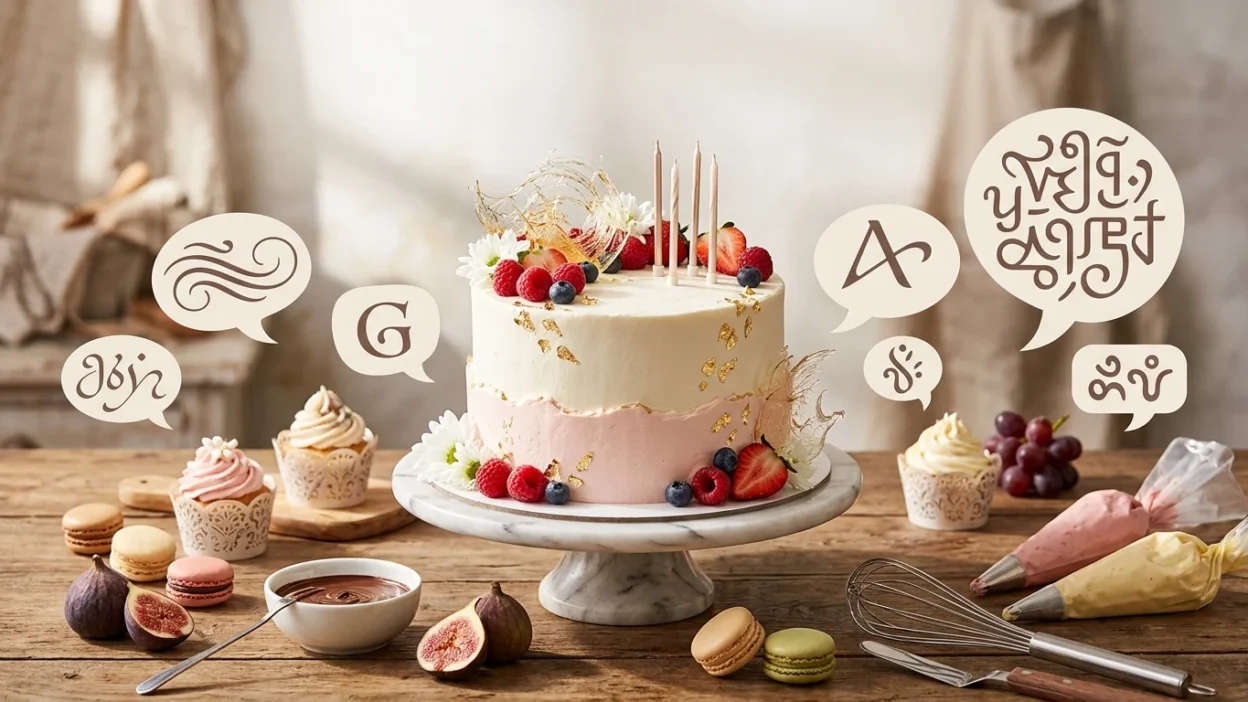
Cake is one of the world’s most familiar desserts, enjoyed at birthdays, weddings, holidays, and everyday celebrations. Learning how to say cake in different languages gives you more than a new vocabulary word. It also introduces you to the food traditions and cultural expressions connected with celebrations around the world. Whether you love baking, traveling, studying languages, or exploring international cuisine, knowing the local word for cake can make conversations more enjoyable.
The phrase cake in different languages reveals interesting similarities and differences between languages. Many cultures have their own traditional cakes, ingredients, and serving customs. Learning these words is a simple way to expand your vocabulary while discovering how people describe a beloved dessert across cultures.
Quick Answer
The word “cake” has different forms worldwide. For example, it is gâteau in French, kuchen in German, torta in Spanish and Italian, pastel in Portuguese, and bolo in Brazilian Portuguese.
Cake in Different Languages Around the World
| Language | Native Word | Pronunciation |
| English | Cake | kayk |
| Spanish | Pastel | pah-STEL |
| French | Gâteau | gah-TOH |
| German | Kuchen | KOO-khen |
| Italian | Torta | TOR-tah |
| Portuguese | Bolo | BOH-loo |
| Dutch | Taart | tahrt |
| Swedish | Tårta | TOR-tah |
| Danish | Kage | KAY-eh |
| Norwegian | Kake | KAH-keh |
| Finnish | Kakku | KAHK-koo |
| Icelandic | Kaka | KAH-ka |
| Irish | Cáca | KAW-kuh |
| Welsh | Cacen | KAH-ken |
| Scottish Gaelic | Cèic | kayk |
| Polish | Ciasto | CHAS-toh |
| Czech | Dort | dort |
| Slovak | Torta | TOR-tah |
| Slovenian | Torta | TOR-tah |
| Croatian | Torta | TOR-tah |
| Serbian | Торта | TOR-tah |
| Bulgarian | Торта | TOR-tah |
| Macedonian | Торта | TOR-tah |
| Russian | Торт | tort |
| Ukrainian | Торт | tort |
| Belarusian | Торт | tort |
| Lithuanian | Tortas | TOR-tas |
| Latvian | Kūka | KOO-ka |
| Estonian | Kook | kook |
| Hungarian | Torta | TOR-tah |
| Romanian | Tort | tort |
| Greek | Τούρτα | TOOR-tah |
| Turkish | Pasta | PAHS-tah |
| Albanian | Tortë | TOR-tuh |
| Armenian | Տորթ | tort |
| Georgian | ტორტი | TOR-tee |
| Arabic | كعكة | KAH-kah |
| Persian | کیک | keek |
| Urdu | کیک | kek |
| Hindi | केक | kayk |
| Bengali | কেক | kek |
| Punjabi | ਕੇਕ | kek |
| Gujarati | કેક | kek |
| Marathi | केक | kayk |
| Nepali | केक | kek |
| Tamil | கேக் | kayk |
| Telugu | కేక్ | kayk |
| Kannada | ಕೇಕ್ | kayk |
| Malayalam | കേക്ക് | kayk |
| Chinese | 蛋糕 | dahn-GOW |
| Japanese | ケーキ | kay-kee |
| Korean | 케이크 | kay-ee-kuh |
Why Learn the Word Cake in Other Languages?
Learning the word for cake in another language is a small but practical vocabulary-building exercise. Food words appear frequently in everyday conversations, restaurant visits, recipes, shopping, and celebrations, making them useful for beginners.
The word also provides an easy introduction to pronunciation and spelling patterns. Some languages use forms that sound surprisingly similar to English, while others have completely different terms. Comparing these words can help language learners notice connections between related languages and recognize borrowed vocabulary. If you enjoy international cooking or travel, knowing the local term for cake can also make it easier to understand menus, bakery signs, and conversations about desserts.
How Different Cultures Define Cake
Cake does not mean exactly the same type of food everywhere. Ingredients, textures, preparation methods, and serving traditions vary considerably between cultures. Some cakes are light and fluffy, while others are dense, layered, steamed, filled, or decorated with fruit and cream.
European baking traditions have influenced many modern cakes, but local ingredients have created distinctive regional varieties. In parts of Asia, cakes may incorporate rice flour, green tea, coconut, beans, or tropical fruits. Celebratory cakes can also carry symbolic meanings connected with family, hospitality, prosperity, or important life events. Understanding these differences makes learning the vocabulary more meaningful because the word represents a broader culinary tradition.
Pronunciation Tips for Cake Around the World
Pronouncing cake-related vocabulary correctly becomes easier when you focus on the sounds rather than English spelling. Words such as Spanish pastel, French gâteau, and German Kuchen require pronunciation patterns that may not exist in English.
Start by listening carefully to the vowel sounds and syllable stress used by native speakers. Avoid automatically applying English pronunciation rules to unfamiliar words. For languages with written forms such as Arabic, Hindi, Japanese, Korean, and Chinese, learning the native script alongside pronunciation can strengthen your memory. Practicing each word slowly before saying it naturally can also improve accuracy and confidence.
Cake-Related Words You Can Learn Next
Once you know the word for cake, expanding into related food vocabulary is a natural next step. Useful terms include words for bakery, dessert, bread, chocolate, cream, sugar, flour, candle, birthday, celebration, and recipe.
You can also learn common phrases such as “birthday cake,” “chocolate cake,” “piece of cake,” and “I would like some cake.” These combinations are often more useful in real conversations than isolated vocabulary. For language learners, grouping words by theme creates stronger associations and makes new vocabulary easier to recall. A simple dessert vocabulary list can therefore become the foundation for broader conversations about food and celebrations.
Cake and Celebrations Across the World
Cake has a strong connection with celebrations in many societies. Birthday cakes are commonly decorated with candles, while wedding cakes often represent celebration, togetherness, and tradition. Cakes also appear during religious festivals, anniversaries, family gatherings, and national holidays.
Although customs differ, sharing a sweet dessert often creates a sense of hospitality and togetherness. The appearance of cake at a celebration can also reflect local ingredients and artistic traditions. From elaborate layered desserts to simple homemade sponge cakes, the food can tell a story about family customs and regional tastes. Learning the word “cake” therefore opens a small window into how different communities celebrate meaningful occasions.
Common Mistakes When Saying Cake in Another Language
One common mistake is assuming that every translation means exactly the same type of cake. A word may refer to a particular style of dessert rather than every food that English speakers classify as cake. Context matters, especially when discussing traditional dishes.
Another mistake involves pronunciation. Learners may read foreign words using English sound rules, which can make familiar-looking words sound incorrect. Spelling can also vary because some languages use grammatical endings or different writing systems. The best approach is to learn the native form, practice its pronunciation, and notice how native speakers use it in everyday phrases.
Easy Ways to Remember Cake Vocabulary
You can remember these translations more effectively by connecting each word with an image, recipe, country, or personal experience. For example, associate gâteau with French pastries, torta with Italian or Spanish desserts, and kuchen with German baking traditions.
Flashcards are another useful method. Put the language on one side and the native word on the other, then test yourself regularly. Speaking the word aloud helps reinforce pronunciation while writing it strengthens visual memory. You can also create short sentences using each word. Learning five to ten terms at a time is often more manageable than trying to memorize the entire list immediately.
Interesting Facts About the Word Cake
The English word “cake” has a long history and is related to older Germanic words for baked food. Across Europe, related vocabulary developed differently, which explains why some modern words look or sound similar while others do not.
Several languages have adopted forms that resemble the English word, particularly in regions where English has influenced modern food vocabulary. At the same time, many languages retain older native terms or use words with distinct historical roots. Comparing these forms provides a fascinating example of how food, trade, migration, and cultural exchange influence language. A simple dessert word can therefore reveal connections between languages and societies.
Benefits of Learning Food Words in Different Languages
Food vocabulary is particularly useful for language learners because it appears in everyday situations. You can use it while ordering at restaurants, reading menus, shopping for ingredients, discussing recipes, or talking about favorite foods.
Learning food words also makes cultural exploration more interactive. Instead of simply recognizing a traditional dish, you can understand what local speakers call it and ask questions about its preparation. These small vocabulary additions can make travel and conversation more comfortable. They also provide approachable practice for beginners because food is a familiar subject. Starting with common words such as cake, bread, fruit, and chocolate can gradually build confidence for more advanced language learning.
Key Takeaways
- “Cake” has different names and pronunciations across languages.
- Many European languages use words with similar historical or cultural connections.
- Cake traditions vary according to regional ingredients and celebrations.
- Learning food vocabulary can improve practical conversational skills.
- Pronunciation and cultural context are important when using translated words.
Conclusion
Learning cake in different languages is a simple and enjoyable way to explore vocabulary, pronunciation, and food culture. From gâteau in French and kuchen in German to torta in several European languages, each word reflects the linguistic history of its speakers. Understanding these translations can make travel, cooking, and international conversations more engaging. Whether you are a beginner language learner or simply curious about global traditions, adding food-related vocabulary to your language skills offers practical value. The next time you enjoy a slice of cake, you can also remember how people around the world name this beloved dessert.
Frequently Asked Questions
What is the word for cake in different languages?
The word for cake changes from one language to another. Common examples include gâteau in French, pastel in Spanish, kuchen in German, torta in Italian, bolo in Portuguese, торт in Russian, 蛋糕 in Chinese, and ケーキ in Japanese.
How do you say cake in Spanish?
In Spanish, cake is commonly translated as pastel, pronounced approximately “pah-STEL.” Depending on the Spanish-speaking region and the specific dessert, other terms such as torta or tarta may also be used. Regional vocabulary is important because dessert names can vary significantly between Spanish-speaking countries.
How do you say cake in French?
Cake is commonly called gâteau in French, pronounced approximately “gah-TOH.” The word can refer to various cakes and sweet baked desserts. French also has more specific terms for particular pastries and desserts, so the exact vocabulary may change depending on the type of cake being discussed.
Is the word for cake similar in many languages?
Yes, several languages use words that are similar to one another, particularly across European languages. Examples include Italian torta, Spanish torta or tarta, Croatian torta, and Serbian торта. Similar vocabulary can sometimes reflect shared linguistic roots, borrowing, or cultural contact between neighboring languages.
Why should I learn food words in other languages?
Food vocabulary is useful because it appears frequently in everyday communication. Learning words for cake, bread, fruit, vegetables, and drinks can help with restaurant visits, travel, shopping, recipes, and casual conversations. Food terms also provide an enjoyable way to explore cultural traditions while building practical foreign language vocabulary.

Emery Foster writes captivating stories that blend emotion, adventure, and thoughtful themes. Their creative voice, relatable characters, and engaging plots have attracted readers from diverse backgrounds worldwide.