
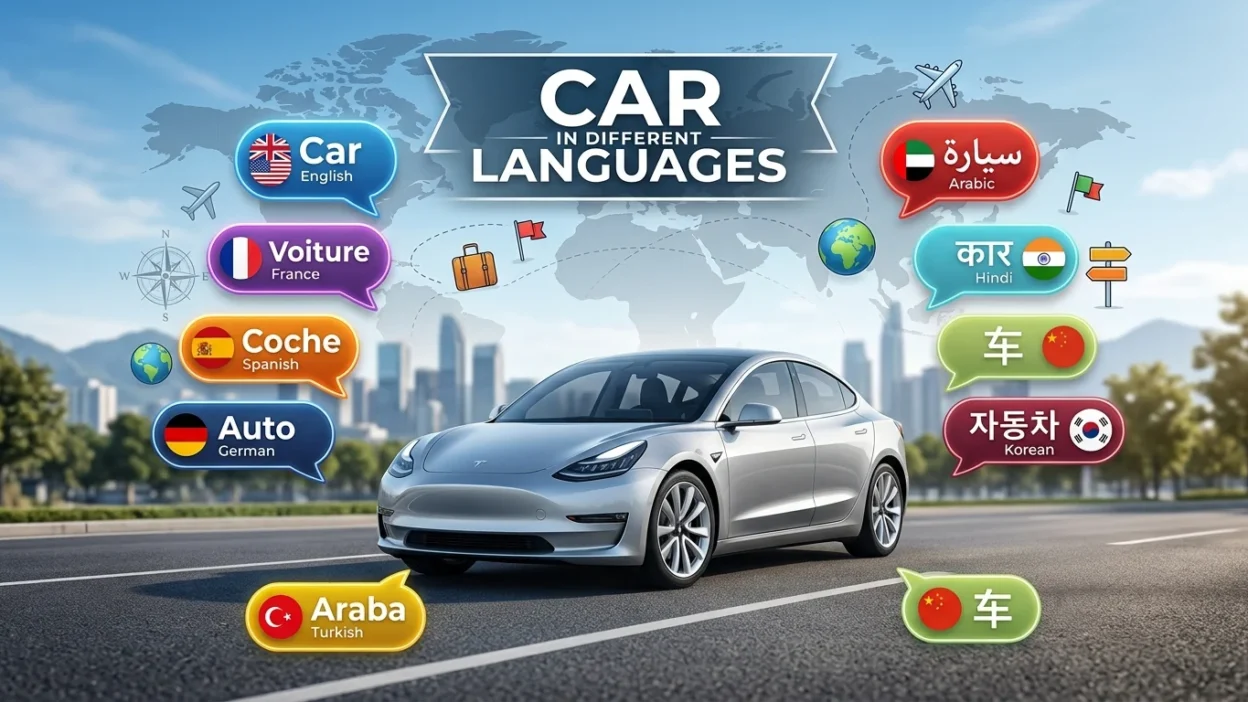
Learning how to say car in different languages is a way to expand your vocabulary and understand how transportation is described around the world. Although the object is familiar, each language uses its own word, pronunciation, and history.
Exploring car in different languages can make travel, language study, and cultural conversations more engaging. Some languages use words related to automobile, while others have shorter everyday terms. This guide presents 50 languages with their native words and easy English pronunciations, followed by practical tips, cultural insights, and useful vocabulary connections to help you remember and confidently use the word in conversation.
Quick Answer
The word “car” has many forms across languages. For example, it is voiture in French, coche in Spanish, Auto in German, bil in Swedish, and автомобиль (avtomobil) in Russian.
Car in Different Languages Around the World
| Language | Native Word | Pronunciation |
| English | car | kar |
| Spanish | coche | KOH-cheh |
| French | voiture | vwah-TUR |
| German | Auto | OW-toh |
| Italian | automobile | ow-toh-MOH-bee-leh |
| Portuguese | carro | KAH-hoh |
| Dutch | auto | OW-toh |
| Swedish | bil | beel |
| Norwegian | bil | beel |
| Danish | bil | beel |
| Finnish | auto | OW-toh |
| Icelandic | bíll | beetl |
| Irish | carr | kar |
| Welsh | car | kar |
| Scottish Gaelic | càr | ka:r |
| Polish | samochód | sa-MOH-khoot |
| Czech | auto | OW-toh |
| Slovak | auto | OW-toh |
| Slovenian | avto | AHF-toh |
| Croatian | automobil | ow-toh-MOH-beel |
| Serbian | аутомобил | ow-toh-MOH-beel |
| Bulgarian | автомобил | ow-toh-moh-BEEL |
| Russian | автомобиль | ahf-tah-moh-BEEL |
| Ukrainian | автомобіль | ahf-toh-moh-BEEL |
| Greek | αυτοκίνητο | af-toh-KEE-nee-toh |
| Romanian | mașină | muh-SHEE-nuh |
| Hungarian | autó | OW-toh |
| Albanian | makinë | mah-KEE-neh |
| Turkish | araba | ah-rah-BAH |
| Arabic | سيارة | say-YAH-rah |
| Hebrew | מכונית | meh-ko-NEET |
| Persian | ماشین | MAA-sheen |
| Hindi | कार | kaar |
| Urdu | گاڑی | GAA-ree |
| Bengali | গাড়ি | GAA-ree |
| Punjabi | ਕਾਰ | kaar |
| Gujarati | કાર | kaar |
| Marathi | गाडी | GAA-dee |
| Nepali | गाडी | GAA-dee |
| Tamil | கார் | kaar |
| Telugu | కారు | KAA-roo |
| Kannada | ಕಾರು | KAA-roo |
| Malayalam | കാർ | kaar |
| Chinese (Mandarin) | 汽车 | CHEE-chuh |
| Japanese | 車 | kuruma |
| Korean | 자동차 | jah-dong-cha |
| Vietnamese | ô tô | oh TOH |
| Thai | รถยนต์ | rot-yon |
| Indonesian | mobil | MOH-beel |
| Malay | kereta | kuh-REH-tah |
| Swahili | gari | GAH-ree |
Why Learn the Word “Car” in Different Languages?
Learning the word for car in several languages gives language learners practical vocabulary they can use immediately. Cars appear in conversations about travel, commuting, shopping, road trips, directions, and transportation.
This vocabulary is especially useful for travelers. Knowing a basic word such as “car” can make signs, conversations, and simple questions easier to understand.
It also provides an introduction to how languages borrow and adapt words. For example, many European languages use forms related to “auto” or “automobile,” while others have developed completely different everyday terms. Comparing these forms makes vocabulary study more memorable and reveals interesting connections between languages.
How Do Different Languages Describe a Car?
Languages do not always use a word that directly resembles the English term “car.” Some use shorter everyday vocabulary, while others use terms connected to automobile or motor vehicle.
For instance, French uses voiture, Spanish commonly uses coche, and Turkish uses araba. In Scandinavian languages such as Swedish, Norwegian, and Danish, bil is widely used.
Asian languages also show considerable variety. Mandarin uses 汽车, Japanese commonly uses 車, and Korean uses 자동차. These differences demonstrate why direct word-for-word translation does not always work.
Understanding the native term is more useful than simply translating individual letters or sounds.
Pronunciation Tips for Saying “Car” Correctly
Pronunciation varies significantly across the 50 languages listed above. English speakers may find familiar-looking words easy, but some terms contain sounds that do not exist naturally in English.
Start by listening to the word carefully and breaking it into syllables. Words such as araba, voiture, and automobile become easier when practiced slowly before being spoken at normal speed.
Pay attention to vowel sounds, rolled or tapped consonants, and stress patterns. English-style pronunciation can sometimes make a foreign word difficult to recognize.
The pronunciations in the table are simple English approximations, so they are best treated as learning aids rather than exact phonetic transcriptions.
Cultural Differences Behind the Word for Car
The vocabulary surrounding cars often reflects local language history and cultural habits. A country may prefer a traditional native word, a shortened form, or a term borrowed from another language.
In German, Dutch, Finnish, and Hungarian, forms related to Auto are common. Several Slavic languages use forms related to automobil, while Swedish, Norwegian, and Danish commonly use the much shorter bil.
Everyday usage can also differ from formal terminology. A dictionary may list one word as the standard translation, while native speakers regularly use another in casual conversation.
Learning both the standard term and its common everyday alternatives can therefore improve practical communication.
Useful Car-Related Vocabulary to Learn
Once you know how to say car, learning related transportation vocabulary can make your language skills much more useful. Consider adding words for driver, road, vehicle, bus, taxi, parking, and fuel.
You can also build simple phrases around the word. For example, learners might practice sentences meaning “Where is the car?”, “I have a car,” or “The car is outside.”
This approach creates vocabulary groups rather than isolated words. Grouping related terms helps your brain form stronger associations and makes it easier to recall words during real conversations.
For travelers, transportation vocabulary is particularly valuable because it frequently appears in directions, rental information, signs, and everyday discussions.
Easy Ways to Remember “Car” in Another Language
A good way to memorize foreign vocabulary is to connect the word with an image or familiar situation. Picture a car while saying the target word aloud several times.
Flashcards can also help. Put the native word on one side and its meaning on the other, then review it at increasing intervals. Spaced repetition can strengthen long-term recall without requiring lengthy study sessions.
Another effective technique is to use the word in a short sentence. Instead of memorizing only bil, for example, create a simple sentence using the Swedish word.
Short, repeated practice is generally more effective than trying to memorize dozens of vocabulary items in one sitting.
Common Mistakes When Translating “Car”
One common mistake is assuming that a single English word always has one perfect equivalent in another language. In reality, languages can have several terms depending on region, formality, context, or type of vehicle.
Another mistake involves pronunciation. A familiar spelling does not necessarily mean the word sounds the same as it would in English.
Learners should also avoid confusing car with broader terms such as vehicle or specialized words for trucks, vans, or automobiles. Context matters.
When learning a new translation, check how native speakers use the word in ordinary conversation. This helps you understand whether the term is formal, casual, regional, or widely accepted.
When Is the Word “Car” Useful in Everyday Conversation?
The word “car” is useful whenever people discuss transportation or movement. Travelers may need it while arranging a rental vehicle, asking about parking, finding a taxi, or discussing directions.
It also appears in everyday conversations about commuting, family routines, road trips, buying vehicles, and driving.
For language learners, simple vocabulary becomes especially useful when combined with common verbs and questions. Learning expressions equivalent to “drive a car,” “buy a car,” “park the car,” or “Where is the car?” can turn one vocabulary item into several practical sentences.
This makes transportation vocabulary an excellent starting point for beginners who want language skills they can use outside the classroom.
Benefits of Learning Everyday Words in Multiple Languages
Studying everyday words such as car across multiple languages can improve vocabulary awareness and encourage curiosity about linguistic differences. Familiar objects provide an easy starting point because learners already understand the concept.
Comparing words can also reveal relationships between languages. Similar forms may point to shared roots or borrowing, while completely different words demonstrate how independently languages can express the same idea.
Multilingual vocabulary can also support travel and cross-cultural communication. Even knowing a handful of basic words can show respect for another language and make interactions more comfortable.
Most importantly, everyday vocabulary is practical. Words connected to transportation, food, greetings, family, and directions can quickly become useful in real-world situations.
Interesting Facts About the Word “Car”
The modern word “car” has a longer history than its association with automobiles. English ultimately connects the word with older terms for wheeled vehicles, while many other languages developed their modern transportation vocabulary through different linguistic paths.
The term automobile itself combines roots associated with self-movement, which explains why related forms appear in numerous languages. This is why words resembling auto or automobil are common across Europe and beyond.
At the same time, languages such as French, Spanish, Turkish, and Japanese use distinctive everyday terms. This mixture of shared international vocabulary and unique native words makes transportation terminology an interesting subject for language learners.
Key Takeaways
- “Car” has different words and pronunciations across languages.
- Many European languages use forms related to auto or automobile.
- Other languages use distinctive everyday terms such as voiture, coche, and araba.
- Learning pronunciation alongside spelling improves practical communication.
- Related transportation vocabulary can make basic language skills more useful.
Conclusion
Learning car in different languages is a practical and enjoyable way to explore vocabulary, pronunciation, and linguistic diversity. Although every language describes the same familiar vehicle, the words used can vary widely in sound, spelling, and origin. From voiture in French to bil in Swedish and 車 in Japanese, each term offers a small insight into another language. By practicing native spellings, simple pronunciations, and related transportation phrases, learners can build useful vocabulary while gaining a deeper appreciation for how languages describe everyday life.
Frequently Asked Questions
What is the word for car in French?
The French word for car is voiture. It is commonly used in everyday French when referring to a car or automobile. The approximate pronunciation is “vwah-TUR.” Learning this word is useful for travelers because cars, driving, parking, and transportation frequently arise in practical conversations.
How do you say car in Spanish?
In Spanish, coche is commonly used for car, particularly in Spain. It is pronounced approximately “KOH-cheh.” In many Latin American countries, other terms such as carro or auto are also widely used. Regional vocabulary is therefore important when learning transportation words in Spanish.
What is car called in German?
The common German word for car is Auto, pronounced approximately “OW-toh.” It is a shortened form associated with Automobil and is widely used in everyday speech. German learners can combine Auto with words for driving, roads, parking, and other transportation topics to build practical vocabulary.
How do you say car in Japanese?
The Japanese word 車 (kuruma) commonly means car or vehicle, depending on context. It is pronounced approximately “koo-roo-mah.” Japanese also uses 自動車 (jidōsha) as a more formal term for automobile or motor vehicle. Kuruma is an especially useful word for everyday communication.
What is the word for car in Arabic?
The Arabic word سيارة (sayyāra) means car and is widely recognized across Arabic speaking communities. Its approximate pronunciation is “say-YAH-rah.” Arabic vocabulary can vary somewhat between dialects, but سيارة is a standard and broadly useful term for referring to a car.

Michael Wyatt creates compelling fiction featuring dynamic characters, emotional depth, and engaging plots. His storytelling combines creativity with relatable experiences, leaving readers entertained, inspired, and eager for more.